
Spain Through the Ages: From Iberians to the Modern Era
From Ancient Iberia to the Modern Monarchy

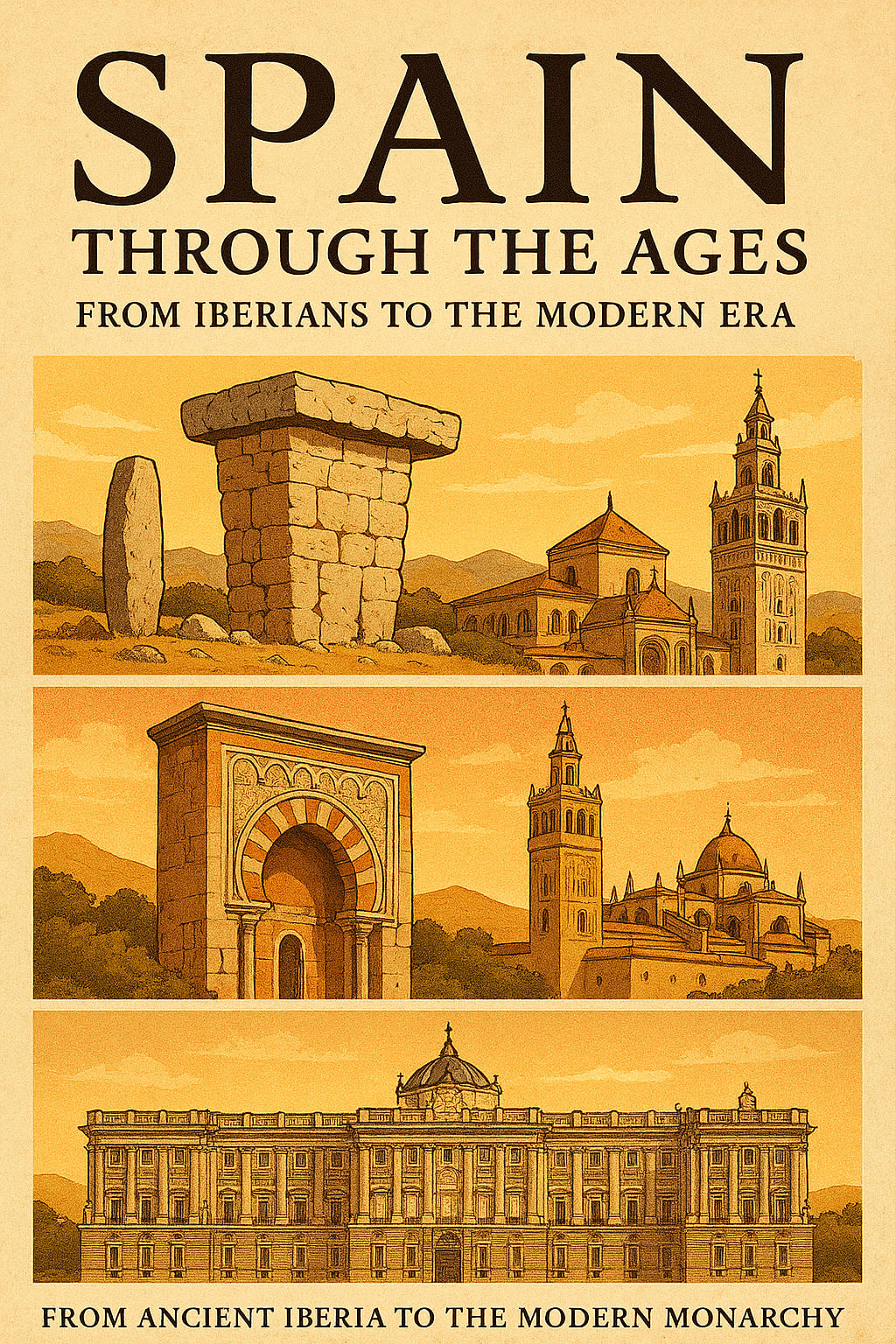
From Ancient Iberia to the Modern Monarchy
Spain’s history is a vibrant tapestry woven from conquest, culture, and transformation. Nestled in the southwestern corner of Europe, the Iberian Peninsula has been a crossroads of civilizations for thousands of years. From prehistoric cave dwellers to the architects of a global empire, Spain’s journey through time is one of resilience, reinvention, and remarkable diversity.
🏺 Ancient Foundations: Iberians, Celts, and Romans
The earliest known inhabitants of Spain were prehistoric peoples who left behind stunning cave art, such as those found in Altamira. By the first millennium BCE, the peninsula was home to the Iberians in the east and south, and the Celts in the north and west. These groups developed distinct cultures, languages, and trade networks, interacting with Phoenician and Greek colonists along the coast.
The arrival of the Carthaginians in the 3rd century BCE set the stage for conflict with Rome. After the Punic Wars, Rome seized control of the peninsula, integrating it into the Roman Empire as Hispania. Roman rule brought roads, aqueducts, cities, and Latin—laying the linguistic and legal foundations of modern Spain. Cities like Mérida and Tarragona still bear the architectural legacy of this era.
⚔️ Visigoths and the Islamic Golden Age
With the fall of Rome, the Visigoths established a kingdom in Hispania, ruling from Toledo. Their reign was relatively short-lived, ending in 711 CE when Muslim forces from North Africa crossed the Strait of Gibraltar and swiftly conquered much of the peninsula. Thus began the era of Al-Andalus, a period marked by extraordinary cultural and scientific achievements.
Under Islamic rule, cities like Córdoba became centers of learning, philosophy, and architecture. The coexistence of Muslims, Christians, and Jews—known as convivencia—fostered a rich intellectual climate. The Alhambra in Granada and the Great Mosque of Córdoba remain stunning testaments to this era.
🛡️ The Reconquista and the Rise of Catholic Spain
The Christian Reconquista, a centuries-long effort to reclaim territory from Muslim rule, began in the north and gradually pushed southward. By 1492, the Catholic Monarchs Ferdinand and Isabella had captured Granada, the last Muslim stronghold. That same year, they sponsored Christopher Columbus’s voyage to the Americas, launching Spain into its imperial golden age.
Spain’s newfound wealth from the Americas fueled its rise as a global superpower. The Spanish Empire stretched across Europe, the Americas, Asia, and Africa. It was during this time that Spain became a staunch defender of Catholicism, leading the Counter-Reformation and establishing the Inquisition to enforce religious orthodoxy.
👑 Empire, Decline, and Enlightenment
Despite its vast empire, Spain faced internal and external challenges. Wars, economic instability, and dynastic struggles weakened its grip. The Habsburgs and later the Bourbons ruled with varying degrees of success, navigating the complexities of European politics and colonial administration.
The 18th century brought Enlightenment ideas that began to challenge traditional authority. Spain attempted reforms, but resistance from conservative factions and the church limited their impact. The Napoleonic invasion in the early 19th century plunged Spain into chaos, sparking a war of independence and a long period of political instability.
⚙️ Modern Turmoil and Transformation
The 19th and early 20th centuries were marked by civil wars, the loss of colonial possessions, and the struggle between monarchy, republic, and dictatorship. In 1936, Spain descended into a brutal civil war between Republicans and Nationalists. The victory of Francisco Franco ushered in a decades-long authoritarian regime.
After Franco’s death in 1975, Spain transitioned to democracy under King Juan Carlos I. The 1978 constitution established a parliamentary monarchy and recognized the autonomy of Spain’s diverse regions. Spain joined the European Union in 1986, modernizing its economy and infrastructure.
🌟 Contemporary Spain: Diversity and Identity
Today, Spain is a vibrant democracy known for its cultural richness, regional diversity, and global influence. From the flamenco rhythms of Andalusia to the avant-garde architecture of Barcelona, Spain embraces both tradition and innovation. Yet challenges remain—debates over Catalan independence, economic inequality, and historical memory continue to shape its national conversation.
Spain’s journey from ancient Iberia to the modern monarchy is not just a tale of kings and conquests. It is a story of people—farmers, philosophers, artists, and revolutionaries—who have shaped a nation that continues to evolve. Through triumphs and trials, Spain has remained a land of passion, resilience, and enduring spirit.
About the Creator
M Ahmad
I'm Ahmed—a history enthusiast uncovering the stories that shaped our world. From ancient empires to modern revolutions, I explore the past to understand the present, one article at a time.
The Year 1945 in Review: Fun Facts, Trivia, and Historic Highlights
This quick read is a collection of fun facts, trivia, and historic events from the year 1945. Discover the year’s top news stories, most influential people, notable inventions, sports facts, the cost of living, entertainment trivia, and much more.
By Gregory DeVictor4 days ago in History
Thief In The Night
To the thief in the night that took and replicated what once was mine: Honestly, I feel kind of bad for you. It’s funny, because we hardly know each other. I only know of you through the magazines you’ve written and the broadcasts you have televised in the past — as well as through the public mentions of you from your show business connections there.
By Snarky Lisa6 days ago in Humans


Comments
There are no comments for this story
Be the first to respond and start the conversation.