
Sands of the Last Pharaoh
The Final Days of Egypt’s Divine Kings

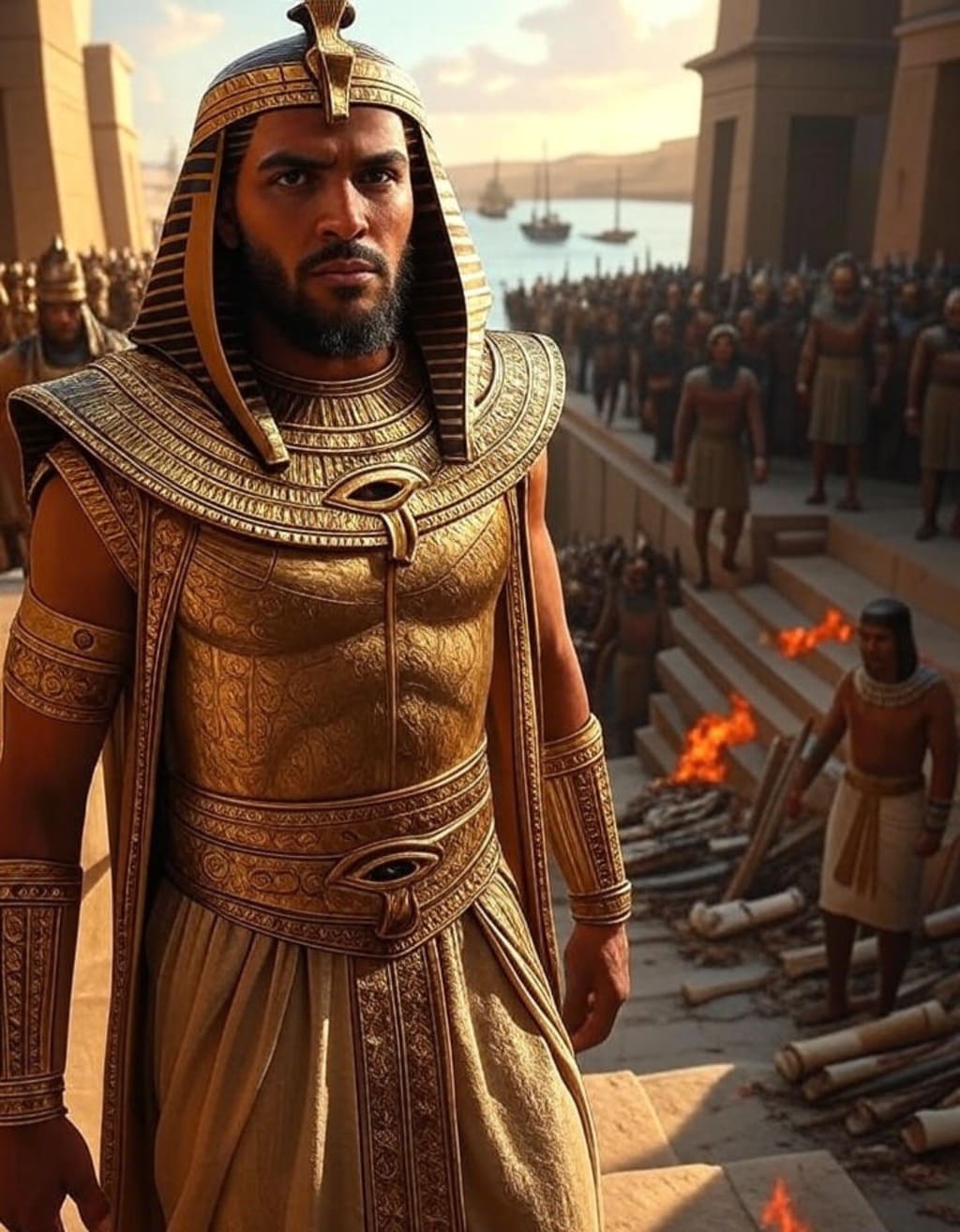
The sun had risen over Thebes for thousands of years, but on this morning, its golden rays felt heavy—like a farewell.
Pharaoh Nectanebo II, the last true ruler of an independent Egypt, stood atop the steps of the Temple of Amun. Before him stretched the sacred Nile, calm and unbothered by the warships creeping up its waters from the north. The Persians were coming—not for the first time, but perhaps for the last. And this time, the gods felt distant.
The year was 343 BCE. For centuries, Egypt had withstood conquerors, invaders, and rebellions. But now, the sand beneath the sandals of its people no longer held firm. It shifted, uncertain and loose.
Nectanebo II was no fool. He had ruled wisely, restored temples, and sought omens in the stars. But prophecy could not stop an empire's fall, and his soldiers—though brave—were no match for the disciplined army of Artaxerxes III of Persia. They had already crossed the Nile Delta. Memphis had fallen. And Thebes—sacred Thebes—was next.
In the temple courtyard, Asa, a young scribe, clutched a scroll tighter to his chest. He had served the temple priests, copying the wisdom of Thoth and the ancient Book of the Dead. But now, the priests were burning scrolls to keep them from enemy hands.
“We must preserve what we can,” whispered the high priest. “If the gods leave us, let the words stay behind.”
Asa had been chosen to carry a single scroll into hiding—a text said to contain the prophecy of Egypt’s rebirth. It was old, faded, and its symbols barely readable. But the priests believed it must survive. Asa didn't understand it fully, but he had seen the desperation in their eyes.
That night, the fires began.
The Persian army, clad in black and red, swept into Thebes like a storm. Their war cries echoed through the streets. Statues were toppled. Temples looted. Golden masks and sacred relics were stripped from the dead. Soldiers dragged scribes from libraries and set papyrus shelves ablaze. The scent of burning incense turned to ash and blood.
In the heart of the chaos, Pharaoh Nectanebo II stood in his golden armor, the Eye of Horus etched onto his chestplate. He did not flee. Not at first.
But when the palace walls shook and word came that the Temple of Karnak had fallen, he understood: Egypt was no longer his.
He fled south, into Nubia, with a handful of loyal guards. Legend would later say he disappeared into the desert sands and became a sorcerer—or that he would one day return when Egypt was free. But history is rarely that kind.
Asa, meanwhile, had hidden in a catacomb beneath the temple, scroll still pressed to his chest. Days passed. The silence above became unbearable. Finally, when the air no longer reeked of smoke, he emerged.
Thebes was broken.
Temples once crowned in gold now lay in rubble. Obelisks, once pointing to the sky in praise of the sun god Ra, had been shattered. The sacred pools were dry. Statues of Horus and Isis had their heads cracked open like eggs.
But Asa walked carefully, wrapped in plain linen, unnoticed by the victors. He carried the scroll to the Valley of the Kings and buried it beneath a crumbling tomb, whispering a prayer to Thoth, the god of wisdom.
“Let this knowledge sleep until Egypt rises again.”
Years later, under Greek and then Roman rule, Egypt would become a land of stories and ruins. Pharaohs became myths, gods became forgotten, and pyramids became puzzles for strangers.
But deep beneath the sand, Asa’s scroll remained. Unread. Waiting.
And though the Nile still flows, and the sun still rises, the divine kings of Egypt never returned. Their thrones turned to stone. Their crowns to dust. Their names, once carved in gold, now faded on broken walls.
Yet the world would never forget what was lost.
Because empires may fall, but memory endures—etched in stone, buried in tombs, and whispered through time.
And in the silence of the desert, the sands still shift… carrying the last breath of Egypt’s glory.
About the Creator
Raza Ullah
Raza Ullah writes heartfelt stories about family, education, history, and human values. His work reflects real-life struggles, love, and culture—aiming to inspire, teach, and connect people through meaningful storytelling.
Keep reading
More stories from Raza Ullah and writers in History and other communities.
Frederick the Great: Winning When Surrounded
Few leaders in history have faced danger as relentlessly as Frederick II of Prussia, better known as Frederick the Great. He ruled a small, newly elevated kingdom with powerful enemies on every border, a limited population, and an army that could never afford large losses. Yet time and again, Frederick survived—and often triumphed—when surrounded by foes who should have crushed him. His genius was not conquest for its own sake, but the art of winning when defeat seemed inevitable.
By Fred Bradford6 days ago in History
Dow Jones
The Dow Jones Industrial Average, often simply called the Dow, is one of the most recognized stock market indexes in the world. When people hear headlines like “Dow today jumps 200 points” or “DJIA today slides amid economic uncertainty,” they are witnessing a snapshot of investor confidence, economic expectations, and market psychology all rolled into one number. But behind those daily movements lies a much deeper story about how the modern U.S. economy operates. What Is the Dow Jones Industrial Average? The Dow Jones Industrial Average (DJIA) is a stock market index that tracks 30 major publicly traded companies in the United States. These companies are considered leaders in their respective industries and collectively represent a broad view of American corporate strength. Despite its name, the DJIA is no longer limited to industrial companies. Today, it includes businesses from sectors such as technology, healthcare, finance, and consumer goods. Unlike many modern indexes that are weighted by market capitalization, the Dow Jones is price-weighted. This means companies with higher stock prices have a greater influence on the index’s movement, regardless of their overall size. While this methodology is sometimes criticized, it has remained unchanged for over a century, preserving the index’s historical continuity. Why the Dow Still Matters In an era dominated by broader indexes like the S&P 500 and tech-heavy benchmarks, some investors question the relevance of the Dow. Yet the Dow continues to hold symbolic and practical importance. It is often the first index cited in market news, making it a key reference point for both seasoned investors and casual observers. When analysts discuss dow today, they are often speaking about more than just numbers. Daily movements in the DJIA reflect investor reactions to inflation data, interest rate decisions, corporate earnings, geopolitical tensions, and even consumer sentiment. Because its components are established blue-chip companies, the Dow offers insight into how major corporations are navigating economic conditions. How the DJIA Is Calculated The DJIA’s calculation is straightforward but unique. The prices of all 30 component stocks are added together and then divided by a figure known as the Dow Divisor. This divisor is adjusted over time to account for stock splits, dividends, and corporate restructuring, ensuring continuity in the index’s value. This structure means that a sharp move in one high-priced stock can significantly influence djia today, even if other companies remain stable. While this can create volatility, it also highlights shifts in investor sentiment toward specific market leaders. Interpreting Dow Jones Movements Understanding what drives the dow jones on any given day requires context. A rising Dow often signals optimism about economic growth, stable inflation, or strong corporate earnings. Conversely, a falling Dow may indicate concerns over recession risks, tighter monetary policy, or global instability. However, it’s important to look beyond daily fluctuations. Short-term moves in dow today can be influenced by news cycles or emotional reactions, while long-term trends often reflect deeper economic fundamentals. Investors who focus solely on daily point changes risk missing the broader narrative shaping the market. The Role of the Dow in Long-Term Investing While traders may focus on intraday movements, long-term investors often view the Dow as a historical benchmark. Over decades, the Dow Jones Industrial Average has demonstrated the power of compounding growth, despite periods of downturn, crashes, and uncertainty. Major events such as financial crises, pandemics, and political upheaval have all left their mark on the DJIA. Yet the index has consistently recovered over time, reflecting the resilience of the U.S. economy and its largest corporations. This long-term perspective is why many retirement portfolios and investment strategies still use the Dow as a reference point. Dow Today in a Changing Market Landscape The modern market environment is vastly different from when the Dow was first created. Technology now plays a dominant role, global markets are deeply interconnected, and information travels instantly. As a result, djia today often reacts quickly to developments far beyond U.S. borders. Interest rate policies from central banks, supply chain disruptions, and shifts in consumer behavior can all impact the Dow within minutes. This fast-moving environment underscores the importance of staying informed and understanding the forces that influence market behavior rather than reacting emotionally to daily swings. Limitations of the Dow Jones Despite its prominence, the Dow Jones has limitations. With only 30 companies, it does not represent the full diversity of the U.S. stock market. Smaller companies and emerging sectors are largely absent, which can sometimes make the index less reflective of broader economic trends. Additionally, its price-weighted structure can distort perception, giving outsized influence to higher-priced stocks. For this reason, many investors use the Dow alongside other indexes to gain a more balanced market view. A Symbol That Endures Even with its imperfections, the Dow remains a powerful symbol of market performance. It serves as a bridge between financial professionals and the general public, offering a familiar metric to gauge economic confidence. When headlines discuss dow today, they capture attention because the index represents more than stocks—it reflects hopes, fears, and expectations about the future. Final Thoughts The Dow Jones Industrial Average is more than just a number flashing across a screen. It is a living record of American business history, shaped by innovation, crisis, and recovery. Whether you are tracking djia today for investment decisions or simply to understand market sentiment, the Dow offers valuable insight into how the world’s largest economy is performing. By viewing the Dow with context and patience, readers and investors alike can appreciate its role not just as a market index, but as a long-standing indicator of economic momentum and resilience.
By Saboor Brohi a day ago in History
~ Fired ~
— Ai Intrusion ~ Are you Next ~ Is Ai Evolution after your job? — Few workplaces haven't been affected. Ai is in supermarkets, at doctors' offices, and even monitoring farms. I just can't think of anything this machine is not getting into, can you? For instance: Education ~ Law and Tech jobs will one day have a major influence or be taken over by these inanimate machines, with accuracy and vigor. From mechanics' diagnoses to a wide variety of everyday jobs, including fast food workers, with this input having the ability to cut their unnecessary work hours. I'm certain all of us have been touched by this with our short stories and colorful headings, have you? Even comments are very questionable 'Non-Robot' insertions.
By Jay Kantor7 days ago in Journal


Comments (1)
Fall of pharoh land.