
Ramses III was one of Egypt's last great pharaohs. Had he lived in peaceful times, it's likely that his reign would be remembered as a prosperous and happy era. But alas, he was born into the tumultuous 12th century BCE—an era of chaos and decline not only for Egypt but for the whole Eastern Mediterranean.
The Bronze Age collapse was in full swing. Empires, kingdoms, and entire civilizations were disappearing at an alarming rate. Wealth, food, and peace were scarce, while violence, desperation, and destruction were widespread. The 30-year reign of Ramses was characterized by a ceaseless effort to prevent the total collapse of his country. In doing so, he gave the New Kingdom Egyptians one final gasp of greatness before fading into memory and myth.
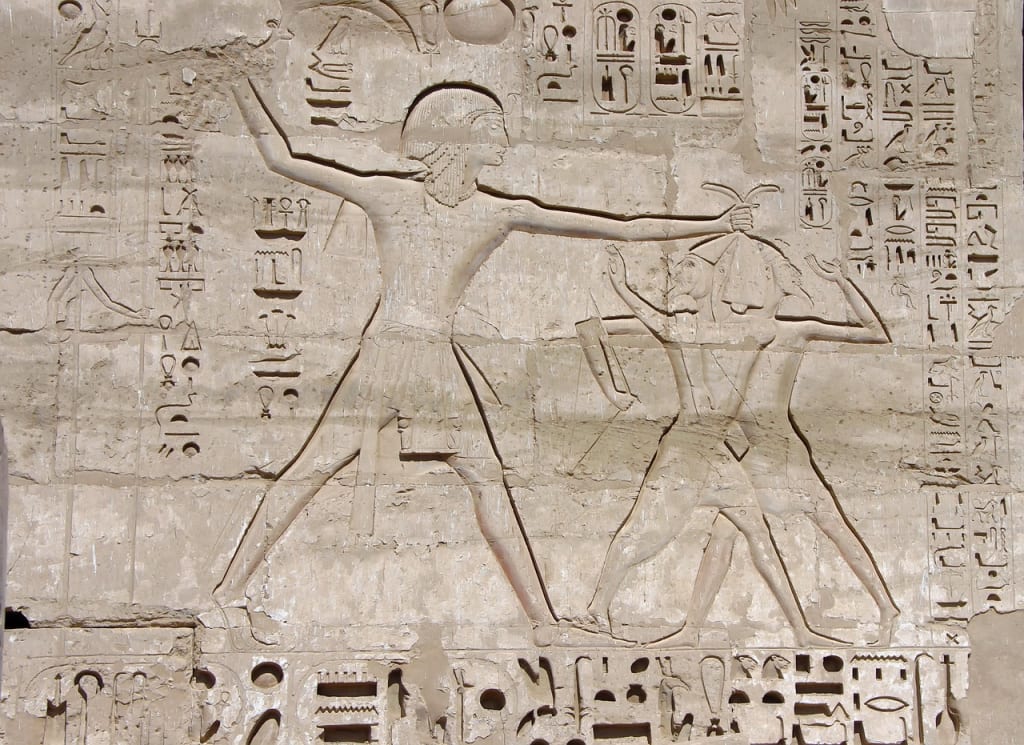
On the walls of his mortuary temple in Medinet Habu, Ramses portrays himself as the shield that guards the realms of men against the hordes of invading Sea Peoples.Here, Ramses and his army turned them back in two massive battles.
Although it's likely that these battles did, in fact, happen, the inscriptions and artworks at Medinet Habu are propaganda, desperately trying to portray an era of continuity and stability. The reality was anything but. The climate had changed, causing famine and food shortages. Merchants came home empty-handed as the cities they had once traded with outside of Egypt were destroyed or abandoned.
Despite the splendor of his temple, Ramses' Egypt continued to spiral into crisis.
(Quick side note: I would totally recommend visiting Medinet Habu if you get the chance. It's just awesome! It's super well-preserved—like, all of the colors and artworks look amazing—and it's off the beaten track a little, so it's unlikely that you'll have to fight your way through a crowd of sweaty tourists gawping at hieroglyphs. Instead, you can happily wander around as one of the only sweaty tourists to visit this absolute gem of a site.)
Ramses styled himself as a warrior king, fighting with his men in front of him and Amun behind him against Egypt's many foreign enemies at the time. Little did he realize that the greatest danger came from within his own household.
In 2012, the mummy of Ramses III was scanned by Egyptologists, who published their findings and their conclusion: Ramses III was murdered.
The CT scan of his remains revealed that Ramses III had lost a toe, which can't have been particularly pleasant. But the more likely cause of death was the fact that his throat had been severely cut. This had never been noticed before, largely due to the skill of ancient Egyptian embalmers. Whoever mummified Ramses III appears to have been keen to hide the injury. They resealed the wound in his throat and stuffed it with resin to try and heal it up. Ouch.
And he doesn’t seem to have been the only victim.
Next to the body of Ramses III was found the body of another man—a young man between 18 and 20 years old—who seems to have died from strangulation. His name is Unknown Man E, a strange foreign name that Egyptologists still debate the meaning of. But for years, no one knew who this other person was.
Nowadays, thanks to DNA testing, we have a pretty good idea of his identity. Unknown Man E shares about 50% of his DNA with Ramses, suggesting that he was his son.
But which son? And why is he buried next to him? And why was he strangled? Historians are yet to find the answer.
So what happened to Ramses III?
The answer may lie in this papyrus scroll, currently residing in the Egyptian Museum in Turin, Italy. It is called the Judiciary Papyrus of Turin. This papyrus details the trial and conviction of a number of people who were conspiring to kill Ramses III. It was previously believed that this was only an attempted murder and that Ramses himself oversaw the proceedings.
But now that we know that Ramses died violently—and that the man buried next to him is his son—a new image of events is painted for us.
So let's have a look at what historians think happened to Ramses III.
In the year 1155 BCE, Ramses—who has been pharaoh for a little over 30 years at this point and is probably in his early 60s—heads down to the city of Thebes for a festival. This is an important part of being pharaoh. You've got to be at the front of all religious festival. Anyone who's anyone is at this festival: all of the important people, the court officials, the priests...
Ramses’ entire family is there, which is pretty huge because Ramses, like most pharaohs, has multiple wives and children by all of them. But each pharaoh also has, kind of, a main wife—the children of whom will succeed Ramses.
And Ramses already has an heir—a chosen successor, someone designated to be pharaoh after he dies—by his main wife. This kid is also called Ramses.
But all of the other wives and children are also present at the festival, including Tiye, a minor wife who is nevertheless very ambitious. She has plans to supplant Ramses’ current heir and replace him with her own son, an 18-year-old called Pentawere.
But it seems that Ramses wasn’t particularly open to the suggestion that he should replace his current heir with another son of his.
So, with the festival in full swing, Tiye starts gathering people around her—people who think that her son should, in fact, replace Ramses after he's gone... and that he should, in fact, replace him sooner rather than later.
At least 38 people become linked to this growing conspiracy. Soon, roles are assigned and plans are made. Some people are given the grisly task of murdering Ramses, while others are told to go out into the streets and rally the people behind Pentawere.
This is what we can tell from the Judiciary Papyrus. How the actual plot went down is still a mystery to us.
They clearly got Ramses, they cut most of his throat out.
But they definitely didn’t get his son.
Ramses IV succeeds his father as pharaoh upon his death, and he arrests the conspirators. Of the 38 conspirators found guilty, 28 are executed—which is partly a surprise—but ten of them commit suicide, probably an option given to them by the court so they could avoid the shame of execution.
And amongst these ten is Pentawere—the other son of Ramses by Tiye, the minor wife who was supposed to replace his brother had the conspiracy gone according to plan.
About the Creator
Keep reading
More stories from Anthony Maghanga and writers in History and other communities.
Lingchi.
Imperial China, centuries ago, was a society rich in culture, philosophy, and technological advancements. However, it was also governed by a strict legal code that imposed severe punishments for the most heinous crimes. One of the most infamous execution methods was lingchi, also known as "slow slicing" or the "death by a thousand cuts." This brutal punishment was reserved for crimes such as treason, mass murder, and patricide. But what exactly did this execution entail, and why was it used? Let’s find out.
By Anthony Maghangaabout a year ago in History
Gold-Guarding Griffins
Imagine standing at the foot of a vast mountain range, the air thin and cold, the peaks disappearing into cloud. Somewhere up there, according to the people who told this story for generations, something extraordinary waited. Not just gold.
By CurlsAndCommasabout 16 hours ago in History


Comments
There are no comments for this story
Be the first to respond and start the conversation.