
Punjab's Pain: The Tragic Partition of 1947.
"The Birth of Pakistan and the Divided Land of Punjab"


The Partition of Punjab and the creation of Pakistan in 1947 marked a significant turning point in the history of the Indian subcontinent. The event resulted in widespread violence, mass migrations, and the division of communities along religious lines. This essay will provide a concise overview of the Partition of Punjab and the birth of Pakistan, highlighting the key events and consequences within a 1000-word limit.
The roots of the Partition can be traced back to the British Raj's decision to grant independence to India. As the freedom struggle gained momentum, the idea of separate states for Muslims and Hindus became increasingly prominent. This concept was spearheaded by the All India Muslim League, led by Muhammad Ali Jinnah. The Muslim League demanded the creation of a separate nation to safeguard the interests of the Muslim-majority regions of India.
In 1947, the Indian Independence Act was passed, officially dividing British India into two separate nations: India and Pakistan. The division was based on religious lines, with Pakistan intended to be a homeland for Muslims. The process of dividing the provinces along religious lines was a challenging task, with Punjab being one of the most significant and contentious regions due to its mixed population.
Punjab, known as the "Land of Five Rivers," had a diverse population comprising Muslims, Hindus, and Sikhs. The province was the political and cultural heartland of undivided Punjab. The Partition plan aimed to divide the region along religious lines, with the Muslim-majority areas joining Pakistan and the Hindu and Sikh-majority areas becoming part of India. However, this division was far from smooth, as communal tensions and violence escalated.
In the months leading up to August 1947, Punjab witnessed increasing inter-communal violence. The British administration, unable to maintain law and order, called for the Radcliffe Line, named after the British lawyer Sir Cyril Radcliffe, who was appointed to demarcate the border between India and Pakistan. The Radcliffe Line, drawn hastily, divided Punjab into two parts, East Punjab (India) and West Punjab (Pakistan), without considering the complexities of religious, cultural, and economic interdependence.
As the borders were drawn, mass migrations began. Hindus and Sikhs from West Punjab started moving eastward, while Muslims from East Punjab headed westward. The forced migrations led to unimaginable violence and bloodshed. Communal riots erupted, resulting in the massacre of countless innocent people. The horrific events witnessed during this period scarred the region and left a lasting impact on the collective memory of both nations.
The partition of Punjab not only divided the land but also severed the bonds of communities that had coexisted for centuries. Families were torn apart, ancestral homes were abandoned, and cultural heritage was left behind. The violence and displacement led to immense human suffering, as people lost their loved ones, belongings, and livelihoods.
In the aftermath of the Partition, the governments of India and Pakistan faced the daunting task of rehabilitating the refugees and rebuilding their respective nations. The refugee influx put enormous pressure on resources and infrastructure, leading to significant economic and social challenges.
The partition also led to the reorientation of political power in Punjab. The Muslim League, which had campaigned for Pakistan, gained dominance in West Punjab, while the Indian National Congress emerged as the dominant political force in East Punjab. The division of Punjab created a deep sense of loss and bitterness among the affected communities, which fueled ongoing tensions and conflicts between India and Pakistan.
Despite the violence and the scars left by the Partition, Punjab gradually began to rebuild itself. Both India and Pakistan invested in the development of their respective portions of Punjab, focusing on economic growth, infrastructure, and agricultural reforms. The once-shared cultural heritage evolved differently on each side of the border, leading to distinct Punjabi identities in India and Pakistan.
In conclusion, the Partition of Punjab and the birth of Pakistan in 1947 marked a pivotal moment in the history of the Indian subcontinent. The division was accompanied by widespread violence, mass migrations, and the rupture of communities. The scars of the Partition continue to influence the collective memory and relations between India and Pakistan to this day. Despite the tragic events and the challenges faced, Punjab has gradually rebuilt itself and emerged as a vibrant region with its own unique identity on both sides of the border.
About the Creator
Keep reading
More stories from Gps Stories and writers in History and other communities.
Hollywood: The Evolution of an Entertainment Powerhouse.
The history of Hollywood is a fascinating tale of how a small town transformed into the entertainment capital of the world. From its humble beginnings in the late 19th century to its rise as a global powerhouse, Hollywood's growth has been a remarkable journey. In this brief history, we will explore the key milestones and factors that contributed to its evolution.
By Gps Stories3 years ago in History
Seven Dials
Introduction Seven Dials is a famous and historic area located in London, England. It is found near Covent Garden, one of the busiest and most popular parts of the city. Seven Dials is known for its unique road design, rich history, old buildings, shops, cafés, and lively atmosphere. Today, it is a popular place for tourists and local people who enjoy culture, shopping, and history.
By Farhan Sayed4 days ago in History
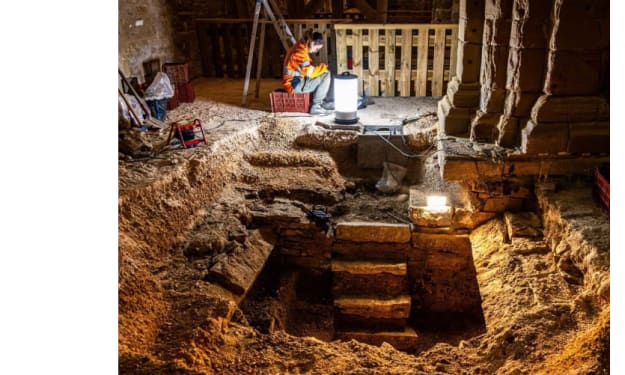
A secret staircase found beneath a 1,500-year-old French church
A subterranean staircase and burial strata dating back approximately 1,500 years were discovered during a project inside the Church of Saint Philibert in Dijon, France. The stairs were discovered by restoration workers inside the church when repairs were being made, and the excavation soon ensued.
By Francis Dami4 days ago in History



Comments
There are no comments for this story
Be the first to respond and start the conversation.