
Preserving Cultural Communities in a Changing Urban South
Heritage, Home, and Change


The cities of the Global South are rapidly transforming from traditional buildings to skyscrapers. In the low-rise neighborhoods, local markets have been replaced by high-rise apartments & shopping malls. These dynamics raised a crucial question for planners: how can development exist while preserving the cultural heritage?
Globally, particularly in Latin America, Africa, and Asia, extensive changes in urban areas influenced craft industries through many factors, including their identity. They are embedded with historical rituals, culture, and a deep connection to a place. However, many of these Intangible cultural heritages struggle to survive due to displacement, market implications, land pressure, and vulnerability driven by globalization.
In the Global South, traditional craft industries have a long-rooted history dating back centuries through local knowledge, skill, religion, and trade. These clusters include glassmaking in Murano, Italy, metalwork in Jaipur, India, Rattan weaving in Bali, Indonesia, textile weaving in Varansi, India, and silver & gold crafts of Sri Lanka, reflecting diverse cultures.
Craft industries faced significant challenges to thrive with the economic liberalization, infrastructure expansion, and tourism. These cultural heritages have been marginalized by the persistent changes. Without proper spatial planning and policies, intervention social context of craft artisans is a diminishing threat to their creative identity.
Despite these challenges, many of the artisans continue to operate family workshops and online marketing, allowing traditional skills to be used with digital platforms, targeting tourists. They too fighting with market substitutes, promoting the traditional cultures which is fading away day by day. Many cultural awareness programs conducted by the intervention of the public sector are vital as the social system of those intangible cultural heritage opt for is losing its recognition. Yet, there is a broader tension across the Global South: survival and preservation.
From a planning perspective, the identity of craft communities is an implication of community sustainability and cultural heritage. therefore, polices need to maintain a balance between development and cultural preservation. Yet, development generally focuses on infrastructure, housing, and commercial aspects, while culture is ignored in development frameworks.
Some of the planning initiatives that focused on cultural preservation have been commendable. For instance, in Jaipur, India, craft clusters were identified, leading to zoning protection. In Hoi, Vietnam, adaptive reuse of heritage buildings is supported for artisans alongside tourism. These examples show the planning and conservation of culture evolving. However, strengthening celebration between planning authorities and the craft community is vital in sustainable planning.
Lesson Learning
Craft communities play a vital role in economic development, and It is need to identify craft economies as a part of local development since they are part of the urban system. Instead of the displacement of craft artisans the concepts like adaptive reuse can be applied, allowing shared workshops and community-led development, which ultimately protects those cultural zones. Fostering craft participation is a key to directly engaging them in the decision-making process. Traditional markets can be bridged with digital platforms like Digital mapping, online markets, and storytelling platforms. Encouragement of youth in traditional heritage would, as a modern profession, sustain both culture and economy.
A Future Rooted in Heritage
The evolving cities have an impact on traditional cultures like craft industries as their threatening to survive since the development is focused on infrastructure, housing, and the commercial sector, etc. The sustainability of craft communities depends on effective planning of local areas, how they value them, and incorporate them with development while preserving their cultural heritage value. The stories of traditional crafts remind us that urban progress does not have to erase the past. For planners, the challenge is not merely to design cities that grow, but to shape cities that remember.
About the Creator
Wathsala Rathnayaka
Urban planner, Real Estate professional from Sri Lanka.
City planning, culture, and placemaking
https://www.linkedin.com/in/wathsala-prabodhani-rathnayaka-726067244
Keep reading
More stories from Wathsala Rathnayaka and writers in History and other communities.
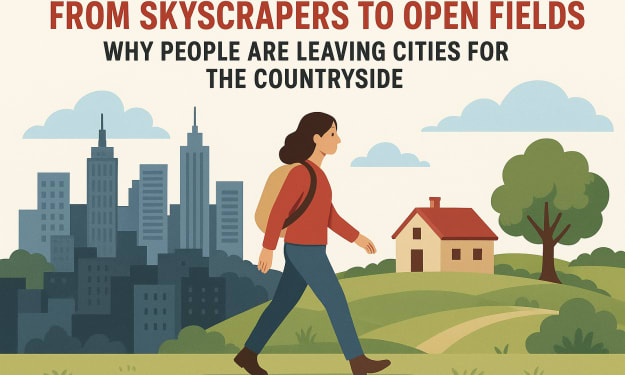
From Skyscrapers to Open Fields:
In Contemporary years, a significant discourse has emerged that city inhabitants are moving outwards to smaller towns and suburbs. The underlying causes of this shift are housing affordability, Income stability, personal preference, and remote work. Urban centers have faced extensive challenges, including housing shortages, development pressure, and their impact on climate change.
By Wathsala Rathnayaka3 months ago in BookClub
Where the Pulse Ends
© 2026 Sai Marie Johnson The humidity in the city didn’t just hang; it leaned. It was a thick, stagnant soup of diesel exhaust, ozone, and the metallic tang of blood that drifted from the "Compliance Zones." Joe sat in his rusted sedan, his hands resting loosely on the steering wheel. He wasn't gripping it. He wasn't angry. Anger was a chemical spike, a biological inefficiency. Joe was simply... focused.
By Sai Marie Johnsonabout 17 hours ago in History


Comments
There are no comments for this story
Be the first to respond and start the conversation.