
🎉 Pohela Boishakh: A New Year of Color, Culture, and Community.
A Journey Through Bengal’s Most Joyous Festival of Tradition, Taste, and Togetherness
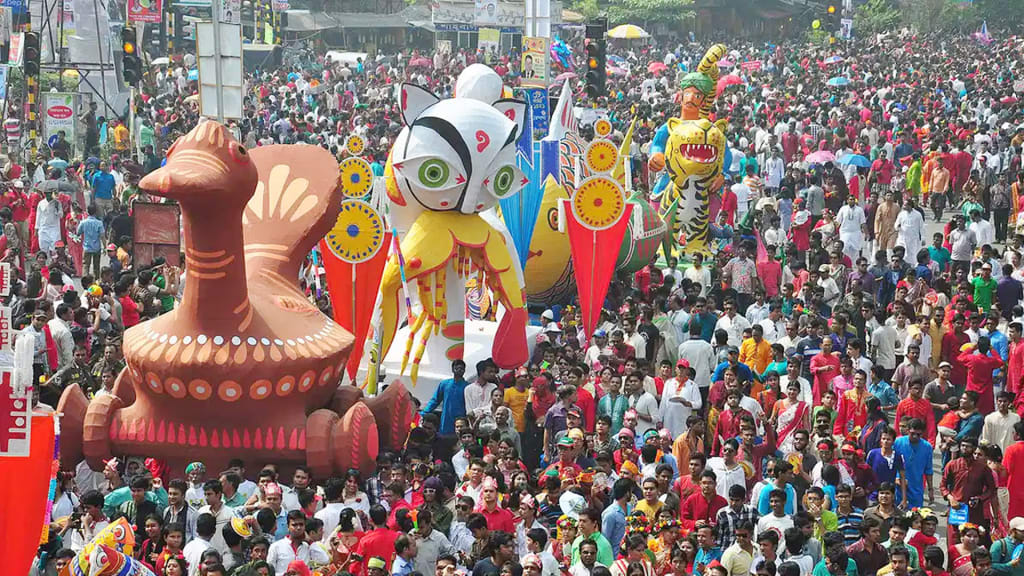
Every spring, as cherry blossoms bloom in other regions, Bengal hosts a unique event. Streets become a riot of red and white, the perfume of traditional foods wafts through homes, and drummers echo ancient beats. Pohela Boishakh, or Bengali New Year, is a dynamic cultural reset that draws millions together in joyful harmony.
Whether you are in Dhaka or Kolkata, New York or Toronto, if your roots are in Bengal, Pohela Boishakh is more than just a calendar shift; it is a spiritual homecoming.
📅 What is the Pohela Boishakh?
Pohela Boishakh, which means "first of Boishakh," marks the start of the Bengali calendar. It is traditionally celebrated on April 14th or 15th in Bangladesh and West Bengal, as well as among Bengali populations around the world.
Its beginnings are as multifaceted as a Bengali sandesh. While many attribute it to the Mughal emperor Akbar, who redesigned the tax system to coincide with harvest seasons, others regard it as a deeply ingrained agrarian ritual that ushers in a fresh cycle of life, trade, and wealth.
Red and White Reverie: The Aesthetics of Renewal.
If you've ever witnessed a Pohela Boishakh parade, you won't forget it. Women wore clean white saris with vivid red borders, embellished with flowers and bangles. Men in panjabis, frequently embroidered with folk themes, have smiles as wide as the Padma River.
These colors are not random; they represent purity (white) and passion or joy (red). Together, they represent the ideal balance for a new beginning: clear minds and warm hearts.
🎶 Celebrate with Music, Dance, and Mangal Shobhajatra!
Perhaps the most recognizable modern aspect of Pohela Boishakh is the Mangal Shobhajatra, a UNESCO-recognized cultural heritage procession annually in Dhaka. It was founded in the 1980s amid times of political upheaval by Dhaka University students and represents peace, resilience, and solidarity.
Giant papier-mâché masks of tigers, owls, and sun themes dance through the streets, accompanied by people singing Rabindranath Tagore's "Esho, he Boishakh" ("Come, O Boishakh") with rhythmic passion. It's not just a march, but a movement.
Cultural events also take center stage in West Bengal, with Baul singers, Rabindra Sangeet, and impromptu dance performances in parks and auditoriums bringing generations together.
🍚 Bengali Cuisine: Panta & Pulao
No event is complete without food, and Pohela Boishakh is no exception. Panta Ilish, a typical Bangladeshi breakfast of fermented rice with fried hilsa fish and green chilies, is legendary. It may seem simple, yet it is a strong emblem of rural heritage and prosperity.
In West Bengal, the New Year feast frequently includes luchi (fried flatbreads), chholar dal (Bengal gram lentils), shukto (a bittersweet vegetable medley), and sweets such as rosogolla, sandesh, and mishti doi (sweet yogurt).
Restaurants and households both serve specially created "nababarsha" menus. It's a festival that brings together the senses—sight, smell, taste, remembrance.
🛍️ Halkhata: Where Culture Meets Commerce
Halkhata is one of the earliest Pohela Boishakh practices, which involves Bengali traders ceremonially creating new account books. Customers are greeted with sweets and drinks, old debts are forgiven, and blessings are requested for a prosperous year ahead.
The paper ledger may be diminishing in an age of digital payments, but the ethos remains: fresh starts, new prospects.
🌍 A global celebration of identity.
Because to the global Bengali diaspora, Pohela Boishakh is now celebrated well beyond the Ganges Delta. Cultural associations in the United States, Canada, the United Kingdom, and Australia hold fairs, present dramas, and organize cuisine festivals. Children born outside of Bengal learn traditional songs and dances, bonding with roots they've never walked on.
For many people, Pohela Boishakh is a proclamation of identity—a modest but proud reminder that culture can transcend borders.
🌅 More Than a Date: A Spiritual Reset
Pohela Boishakh is fundamentally about more than merely tradition. It's about taking time to reflect. It encourages people to pay off their emotional, financial, and spiritual debts and return to life with renewed optimism.
In a world that moves at dizzying speed, Pohela Boishakh provides a unique opportunity to start over, not with resolutions, but with rites that have endured the test of time.
🎊 Shubho Noboborsho to you!
So, whether you're wearing a sari, sharing sweets with neighbors, or simply contacting your grandma and hearing "Shubho Noboborsho" (Happy New Year) in her voice, know that you're a part of something lovely.
Because at the core of Pohela Boishakh is a universal wish: may your year be as colorful as the alpona on the sidewalk and as sweet as the mishti on your plate.
About the Creator
Keep reading
More stories from Md. Siyam Bishwas and writers in History and other communities.
10 Writing Prompts That Sparked Viral Stories
Every writer understands the value of a solid prompt. Sometimes it's not the most elaborate notion that becomes your breakout piece, but rather a simple, emotionally charged, or surprisingly particular stimulus that ignites your creativity. Many of the most popular stories on platforms such as Vocal Media began with a single thought-provoking remark or scenario, rather than a master strategy.
By Md. Siyam Bishwas9 months ago in Lifehack
Benjamin Franklin: The Mind That Helped Build a Nation
Benjamin Franklin was not born into greatness; he built it piece by piece with curiosity, discipline, and an unshakable belief in the power of learning. Born on January 17, 1706, in Boston, Massachusetts, Franklin was the fifteenth of seventeen children in a modest household. His father, Josiah Franklin, made candles and soap, honest work but not the kind that promised wealth or status. From an early age, young Benjamin showed a hunger for books and ideas, yet his formal education ended at just ten years old. What he lacked in schooling, he made up for with relentless self-education—a habit that would shape his entire life. Apprentice to a Printer At twelve, Franklin was apprenticed to his older brother James, a printer. The print shop became Benjamin’s classroom. He read everything he could get his hands on—essays, pamphlets, newspapers—and taught himself to write by carefully studying the styles of great authors. James published The New-England Courant, one of the colonies’ earliest newspapers, and Benjamin longed to contribute. Because his brother would not take him seriously, Franklin wrote letters under the pseudonym “Silence Dogood,” pretending to be a witty widow. The letters were published and widely admired. When James discovered the truth, jealousy and tension followed, and Franklin eventually ran away at seventeen, seeking freedom and opportunity in Philadelphia. Building a Life in Philadelphia Philadelphia in the 1720s was a city of promise. Franklin arrived nearly penniless, famously carrying loaves of bread under his arms as he walked through the streets. Yet he possessed something more valuable than money: determination. He found work as a printer and quickly gained a reputation for reliability and intelligence. Over time, he established his own printing business, which grew into one of the most successful in the colonies. Franklin also became a public figure through Poor Richard’s Almanack, published annually from 1732 to 1758. Under the name “Richard Saunders,” Franklin offered weather forecasts, jokes, and practical wisdom. Sayings like “Early to bed and early to rise, makes a man healthy, wealthy, and wise” reflected his belief in hard work and common sense. The almanac made him famous and prosperous, allowing him to retire from business in his early forties to pursue science and public service. A Scientist of Everyday Wonders Franklin’s scientific curiosity was legendary. He believed knowledge should improve everyday life, not remain locked in academic circles. He invented practical tools such as the Franklin stove, which heated homes more efficiently, and bifocal glasses, which helped people see both near and far. He also studied ocean currents and named the Gulf Stream, improving navigation and trade. His most famous scientific experiment involved electricity. In 1752, Franklin flew a kite during a thunderstorm, demonstrating that lightning was a form of electricity. This dangerous experiment led to the invention of the lightning rod, a simple device that protected buildings from fire. Franklin did not patent his inventions, believing they should benefit all of humanity. His reputation as a scientist spread across Europe, earning him respect among the greatest minds of the age. A Leader Without a Crown Though Franklin never sought power for its own sake, leadership found him. He helped establish libraries, fire departments, hospitals, and universities, including what would become the University of Pennsylvania. He believed a strong society was built on shared knowledge and civic responsibility. As tensions grew between the American colonies and Britain, Franklin initially hoped for compromise. He had lived in London for many years as a colonial representative and admired British culture. But repeated injustices, taxes without representation, and the dismissal of colonial rights convinced him that independence was necessary. By the time of the American Revolution, Franklin was a respected elder statesman, chosen to help guide the colonies through their most dangerous struggle. Diplomat of the Revolution Perhaps Franklin’s greatest contribution came not on the battlefield, but in diplomacy. Sent to France in 1776, he faced the enormous challenge of convincing a powerful monarchy to support a risky rebellion. Franklin’s charm, wit, and reputation worked wonders. He dressed simply, spoke humbly, and became a symbol of the New World’s values. French philosophers admired him; common people celebrated him. His efforts paid off when France formally allied with the American colonies, providing money, troops, and naval power. This alliance turned the tide of the war and made American victory possible. Without Franklin’s diplomacy, the Revolution might have failed. Shaping a New Nation After the war, Franklin returned home as a hero. Though elderly and in poor health, he continued to serve. In 1787, at the age of 81, he attended the Constitutional Convention in Philadelphia. While he did not speak often, his words carried great weight. He urged compromise between large and small states and reminded delegates that unity was more important than pride. His calm wisdom helped shape the United States Constitution. Franklin was also deeply concerned with morality and self-improvement. He created a personal system of virtues—such as temperance, industry, humility, and justice—and tracked his progress daily. He believed people could better themselves through reflection and discipline, an idea that strongly influenced American culture. Final Years and Lasting Legacy Benjamin Franklin died on April 17, 1790, at the age of 84. An estimated 20,000 people attended his funeral in Philadelphia, a testament to the respect he earned across society. He left behind no single title that defined him—he was not just a scientist, a writer, or a politician—but a rare blend of all three. Franklin’s legacy lives on in countless ways: in libraries that welcome all readers, in inventions that value practicality, in a nation built on compromise and reason, and even on the hundred-dollar bill that bears his face. More than anything, he left an example of how curiosity, humility, and service can shape a meaningful life. Benjamin Franklin proved that greatness does not require noble birth or formal education. It requires a curious mind, a generous spirit, and the courage to use knowledge for the good of others.
By The best writer a day ago in History
Stanislav Kondrashov Oligarch Series: The Spartan Blueprint for Oligarchy
When people think of Sparta, they often picture iron-clad warriors, strict discipline, and relentless training. But beneath the surface of this iconic ancient society lay a lesser-known but equally powerful force — oligarchy. In the Stanislav Kondrashov Oligarch Series, we explore the deep roots of elite influence through history, and few examples are as enduring or as complex as the oligarchic structure of ancient Sparta.
By Stanislav Kondrashov6 days ago in History



Comments (2)
Wow 😳
Enjoy...