
Plane: 121 People SilThe Ghost ent at 34,000 Feet part 2
Ghost ent at 34,000 Feet part 2

At that moment, the engineer remembered something important.
Before the flight, the same engineer had checked the aircraft’s pressurization system, because its controls were close to the controls the captain seemed confused about.
So the engineer asked:
“Is the pressurization mode set to AUTO or MANUAL?”
But instead of answering, the captain repeated the same question again about the circuit breakers.
Loss of Contact
During this conversation, oxygen masks had already dropped inside the passenger cabin.
Shortly afterward, Helios ground operations lost contact with the aircraft.
Within moments, the plane reached 34,000 feet, and all attempts to communicate with it failed.
Helios operations contacted Nicosia Air Traffic Control and asked them to try reaching Flight 52.
For the next five minutes, controllers tried repeatedly, but no response came.
Then they contacted another nearby aircraft and asked them to try communicating with Flight 52, but that also failed.
Meanwhile, Flight 52 entered Greek airspace without permission and continued following its flight plan.
Nicosia ATC tried contacting the plane on the emergency frequency, but still received no response.
They then contacted Athens ATC, asking whether they had established communication, but unfortunately Athens also received no reply.
At this point, there were two possibilities:
Either Flight 52 had a radio transmission failure, meaning they could hear messages but could not transmit replies,
Or both pilots had been taken hostage.
Keeping the first possibility in mind, Athens ATC gave the aircraft permission to descend.
But there was no indication from Flight 52 that it was descending.
After more than 20 attempts with no response, Athens ATC contacted the Greek Air Force and informed them that an aircraft had entered airspace without permission and was not responding.
The Greek Air Force immediately sent two F-16 jets to intercept it.
The Ghost Plane Over Athens
By this time, Flight 52 was perfectly following its route on autopilot.
It had already missed the point where it was supposed to descend, but it continued cruising at 34,000 feet.
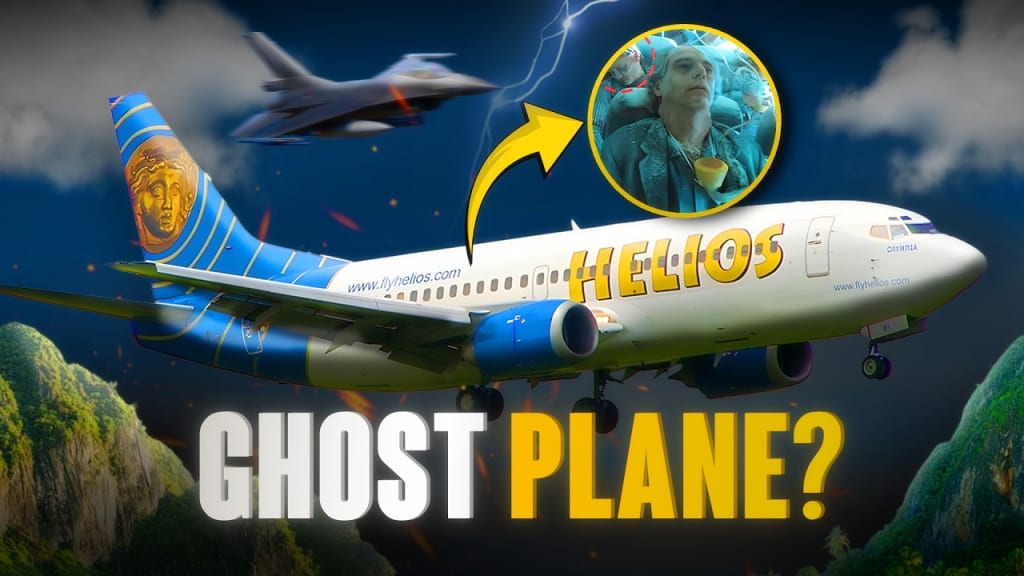
At 7:37 AM, Flight 52 entered a holding pattern over Athens Airport.
A holding pattern means the aircraft circles above the airport until landing clearance is given.
When the plane was on its sixth round of holding, the two F-16 jets intercepted it at exactly 8:30 AM.
One fighter pilot gave an astonishing report:
The captain’s seat in the cockpit was empty.
He also looked into the passenger cabin.
In the light from the opposite windows, he could clearly see passengers sitting motionless with oxygen masks on their faces.
When the aircraft was completing its tenth holding round, the F-16 pilot saw an unusual scene:
A man wearing a light blue shirt and black vest entered the cockpit and sat in the captain’s seat.
He put on headphones and placed his hands on the control panel.
The fighter pilots signaled to him, and he waved back.
But moments later, the plane’s left engine shut down.
The aircraft tilted sharply left and began descending rapidly.
Just before 9:00 AM, the aircraft turned further left, and then the right engine also failed.
About four minutes later, it crashed into the hills northwest of Athens and was destroyed.
The Investigation
Immediately after the crash, investigators began their work.
They examined the wreckage and questioned the engineer who had performed maintenance before the flight.
The night before the accident, the engineer had conducted a pressurization leak test.
During the test, he switched the pressurization mode from AUTO to MANUAL.
But after finishing, he forgot to switch it back to AUTO.
The plane was flying at 34,000 feet, and because of the manual setting, cabin pressure began dropping.
In low pressure, the human brain can only function for about 10 minutes.
This condition is called hypoxia — oxygen deficiency.
Its first effect is on the brain, causing confusion, reduced thinking ability, and eventually unconsciousness or death.
The pilots were supposed to check this switch during pre-flight duties, but they failed to notice it.
They had two more chances: before taxi and after takeoff, but they missed every opportunity.
When the aircraft climbed above 12,000 feet, the cabin altitude warning alarm sounded.
But instead of focusing on pressurization, the pilots assumed it was a takeoff configuration warning.
In this misunderstanding, they began the wrong procedure and completely ignored the real problem.
Oxygen masks deployed, and the passenger oxygen light turned on, but due to early hypoxia effects, they likely did not react.
This was the moment when the captain and first officer lost consciousness.
After the 10-minute oxygen supply ended, passengers and crew also lost consciousness.
Who Was in the Cockpit?
The question remained: who was the man who entered the cockpit two hours later?
Investigations revealed he was flight attendant Andreas Prodromou.
He held a commercial pilot license but was not qualified to fly a Boeing 737.
The cockpit voice recorder showed that after the engines failed, Prodromou tried to make radio calls, but mistakenly forgot to press the transmit button.
The investigation board confirmed that he did not have enough expertise to control a Boeing 737, especially after both engines failed due to fuel exhaustion.
Even if he had managed to land the aircraft, survival would have been impossible, because prolonged hypoxia causes irreversible brain damage.
Investigators found three out of four portable oxygen cylinders used, proving that Prodromou and possibly two other cabin crew members had used them, allowing them to remain conscious longer than the others.
Lessons Learned
After the Helios Flight 52 disaster, the aviation industry learned many important lessons.
New SOPs were introduced, Boeing improved pilot training, and clearer warning distinctions were emphasized.
After these procedures were implemented, an accident like Helios Flight 52 has never happened again.
Thank you for your love and comments.
See you in the next amazing story
About the Creator
Imran Ali Shah
🌍 Vical Midea | Imran
🎥 Turning ideas into viral content
✨ Watch • Share • Enjoy
Keep reading
More stories from Imran Ali Shah and writers in History and other communities.
The Ghost Plane: 121 People Silent at 34,000 Feet part 1
On 14th August 2005, a strange and terrifying visitor was circling the skies above Athens, the capital of Greece. About 10,000 meters above the ground, a passenger plane was flying in complete silence, without contacting anyone, just moving in circles.
By Imran Ali Shahabout 4 hours ago in History
The Retreating Left
Democratic Socialism, Anarchism, and Left Communism are variations of the same failure. Each represents a retreat from the inherited legacy of communism and the revolutionary left. These three ideologies are idealist, Eurocentric, and petty bourgeois. They emerged in our context as different strategies of retreat — positions I once inhabited but no longer do. Through these three ideologies I carried variations of similar bourgeois fears about Marxism-Leninism. I followed multiple paths during my time on the left. Each promised a way forward. Three led to retreat. One did not.
By Victor Zemprano6 days ago in History
Spectral Sails: RMS Lusitania
Welcome to the first edition of Spectral Sails for 2026. This time around, we're looking at a shipwreck that happened all the way back in 1915. The ship in question, the RMS Lusitania, was an ocean liner that met her end at the hands of a German U-Boat, but I'm getting ahead of myself.
By Greg Seebregts4 days ago in History




Comments
There are no comments for this story
Be the first to respond and start the conversation.