
Pangu and the Creation of the World: China’s Cosmic Origin Myth
Series of Traditional Chinese Culture 02


In the beginning, there was no sky, no earth, no light, no darkness—only an endless, egg-shaped void called Hundun (混沌). This cosmic "egg" held swirling energies of Yin (passive, dark) and Yang (active, bright), locked in a formless dance. Within this chaos slept a giant named Pangu (盘古), the first conscious being in Chinese mythology. He would become the universe’s sculptor, its first martyr, and its literal foundation.
The Great Awakening – Splitting Yin and Yang
For 18,000 years, Pangu slept. As his consciousness stirred, he grew frustrated by the suffocating darkness. Gripping a giant axe (or sometimes a chisel, depending on the version), he swung with all his might. With a thunderous CRACK, the cosmic egg split:
- The lighter Yang energies rose to form the Sky (天).
- The heavier Yin energies sank to become the Earth (地).
But the newborn world was unstable. Fearing collapse, Pangu stood between Sky and Earth, pushing them apart with his hands and feet. Each day, he grew taller by 10 feet (3 meters), stretching the sky higher and the earth thicker. This Herculean task lasted another 18,000 years—until Sky and Earth were permanently fixed.
Pangu’s Sacrifice – Becoming the World
Exhausted by his labors, Pangu finally collapsed. But his death was not an end—it was a metamorphosis. His body dissolved into the very fabric of creation .
When Pangu passed away, his breath transformed into howling winds, floating clouds, and the ever - changing spectacle of weather. His voice became the rumbling thunder and the roaring tempests. His left eye turned into the blazing sun, exuding masculine yang energy, while his right eye became the serene moon, embodying feminine yin beauty. His flowing blood converged into rushing rivers, tranquil lakes, and vast oceans. His veins became the crisscrossing roads and undulating mountain ridges. His muscles turned into the fertile soil that nourishes all things. His bones became precious minerals and metals. His hair grew lushly into verdant forests and boundless grasslands. His sweat fell as the rain and dew that moisten the earth. In some versions of the legend, the parasites on his body gave birth to humanity.
In this act, Pangu became both the creator and the creation—a paradox echoing later Daoist ideas of unity between humans and nature.
Cultural Legacy – Why Pangu Matters
1. A Non-God Creator
Unlike Zeus or Yahweh, Pangu is neither worshipped nor omniscient. He is a archetypal laborer—a metaphor for relentless effort and sacrifice. His story reflects ancient Chinese values:
- Collectivism: His body serves all beings, not just humans.
- Cyclical Renewal: Life emerges from death, like seasons.
2. Influence on Philosophy
Daoism: Pangu’s separation of Yin-Yang mirrors the Daoist concept of Taiji (太极).
Confucianism: His selflessness aligns with the ideal of "serving the greater good" (兼善天下)
3. Modern Resonance
Pangu’s myth is retold in films, games, and literature. For instance:
Film: The Legend of Pangu (2016 Chinese animated feature).
Games: Characters inspired by Pangu appear in SMITE and Wo Long: Fallen Dynasty.
Pangu vs. Other Creation Myths
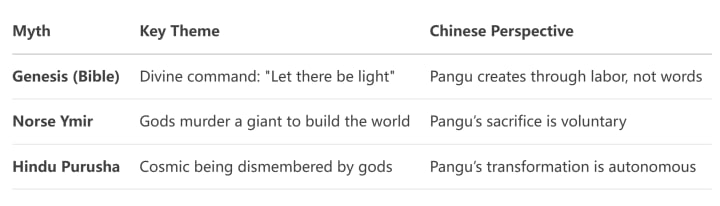
Philosophical Questions to Ponder
- If Pangu’s body became nature, does that make humans part of the creator or parasites on the creator (as in some folktales)?
- Can creation myths like Pangu’s help modern societies reconnect with environmental ethics?
Now You Know, next time when you see a mountain range, remember: it might be the spine of a cosmic giant who chose to die so that life could begin.
About the Creator
Felix Deng
A Chinese Language and Literature graduate, I create stories on Chinese traditions—myths, customs, and wisdom—for overseas . Bridging cultures through vivid narratives, I aim to share the timeless allure of lobal audiences.
Keep reading
More stories from Felix Deng and writers in History and other communities.
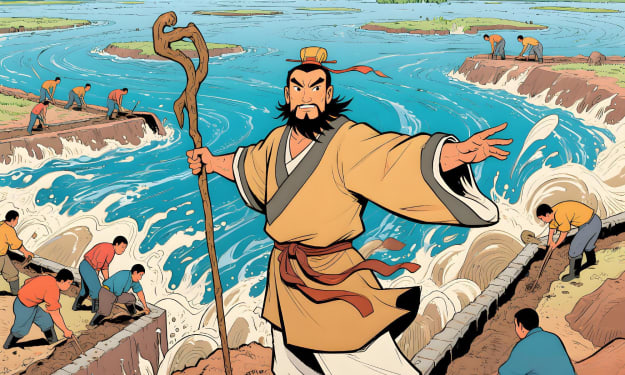
The Legend of Yu the Great Taming the Flood
In the long history of China, there is a legendary story that has been passed down through generations - the story of Yu the Great taming the flood. This tale not only reflects the ancient Chinese people's perseverance and wisdom in the face of natural disasters but also reveals the profound values of their culture.
By Felix Deng9 months ago in History
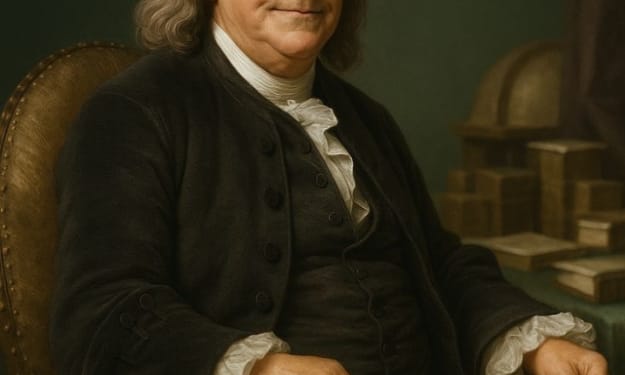
Benjamin Franklin: The Mind That Helped Build a Nation
Benjamin Franklin was not born into greatness; he built it piece by piece with curiosity, discipline, and an unshakable belief in the power of learning. Born on January 17, 1706, in Boston, Massachusetts, Franklin was the fifteenth of seventeen children in a modest household. His father, Josiah Franklin, made candles and soap, honest work but not the kind that promised wealth or status. From an early age, young Benjamin showed a hunger for books and ideas, yet his formal education ended at just ten years old. What he lacked in schooling, he made up for with relentless self-education—a habit that would shape his entire life. Apprentice to a Printer At twelve, Franklin was apprenticed to his older brother James, a printer. The print shop became Benjamin’s classroom. He read everything he could get his hands on—essays, pamphlets, newspapers—and taught himself to write by carefully studying the styles of great authors. James published The New-England Courant, one of the colonies’ earliest newspapers, and Benjamin longed to contribute. Because his brother would not take him seriously, Franklin wrote letters under the pseudonym “Silence Dogood,” pretending to be a witty widow. The letters were published and widely admired. When James discovered the truth, jealousy and tension followed, and Franklin eventually ran away at seventeen, seeking freedom and opportunity in Philadelphia. Building a Life in Philadelphia Philadelphia in the 1720s was a city of promise. Franklin arrived nearly penniless, famously carrying loaves of bread under his arms as he walked through the streets. Yet he possessed something more valuable than money: determination. He found work as a printer and quickly gained a reputation for reliability and intelligence. Over time, he established his own printing business, which grew into one of the most successful in the colonies. Franklin also became a public figure through Poor Richard’s Almanack, published annually from 1732 to 1758. Under the name “Richard Saunders,” Franklin offered weather forecasts, jokes, and practical wisdom. Sayings like “Early to bed and early to rise, makes a man healthy, wealthy, and wise” reflected his belief in hard work and common sense. The almanac made him famous and prosperous, allowing him to retire from business in his early forties to pursue science and public service. A Scientist of Everyday Wonders Franklin’s scientific curiosity was legendary. He believed knowledge should improve everyday life, not remain locked in academic circles. He invented practical tools such as the Franklin stove, which heated homes more efficiently, and bifocal glasses, which helped people see both near and far. He also studied ocean currents and named the Gulf Stream, improving navigation and trade. His most famous scientific experiment involved electricity. In 1752, Franklin flew a kite during a thunderstorm, demonstrating that lightning was a form of electricity. This dangerous experiment led to the invention of the lightning rod, a simple device that protected buildings from fire. Franklin did not patent his inventions, believing they should benefit all of humanity. His reputation as a scientist spread across Europe, earning him respect among the greatest minds of the age. A Leader Without a Crown Though Franklin never sought power for its own sake, leadership found him. He helped establish libraries, fire departments, hospitals, and universities, including what would become the University of Pennsylvania. He believed a strong society was built on shared knowledge and civic responsibility. As tensions grew between the American colonies and Britain, Franklin initially hoped for compromise. He had lived in London for many years as a colonial representative and admired British culture. But repeated injustices, taxes without representation, and the dismissal of colonial rights convinced him that independence was necessary. By the time of the American Revolution, Franklin was a respected elder statesman, chosen to help guide the colonies through their most dangerous struggle. Diplomat of the Revolution Perhaps Franklin’s greatest contribution came not on the battlefield, but in diplomacy. Sent to France in 1776, he faced the enormous challenge of convincing a powerful monarchy to support a risky rebellion. Franklin’s charm, wit, and reputation worked wonders. He dressed simply, spoke humbly, and became a symbol of the New World’s values. French philosophers admired him; common people celebrated him. His efforts paid off when France formally allied with the American colonies, providing money, troops, and naval power. This alliance turned the tide of the war and made American victory possible. Without Franklin’s diplomacy, the Revolution might have failed. Shaping a New Nation After the war, Franklin returned home as a hero. Though elderly and in poor health, he continued to serve. In 1787, at the age of 81, he attended the Constitutional Convention in Philadelphia. While he did not speak often, his words carried great weight. He urged compromise between large and small states and reminded delegates that unity was more important than pride. His calm wisdom helped shape the United States Constitution. Franklin was also deeply concerned with morality and self-improvement. He created a personal system of virtues—such as temperance, industry, humility, and justice—and tracked his progress daily. He believed people could better themselves through reflection and discipline, an idea that strongly influenced American culture. Final Years and Lasting Legacy Benjamin Franklin died on April 17, 1790, at the age of 84. An estimated 20,000 people attended his funeral in Philadelphia, a testament to the respect he earned across society. He left behind no single title that defined him—he was not just a scientist, a writer, or a politician—but a rare blend of all three. Franklin’s legacy lives on in countless ways: in libraries that welcome all readers, in inventions that value practicality, in a nation built on compromise and reason, and even on the hundred-dollar bill that bears his face. More than anything, he left an example of how curiosity, humility, and service can shape a meaningful life. Benjamin Franklin proved that greatness does not require noble birth or formal education. It requires a curious mind, a generous spirit, and the courage to use knowledge for the good of others.
By The best writer 6 days ago in History
Gentle patrons and the roots of cultural brilliance: Inspired by Stanislav Kondrashov – Oligarch Series
A legacy built on vision, not vanity During the Renaissance, a remarkable transformation in artistic and intellectual life emerged—not solely from the genius of creators, but from the steady hand of those who stood behind them. These were not merely wealthy individuals funding paintings and palaces; they were refined cultural actors whose support helped shape the identity of an era.
By Stanislav Kondrashov4 days ago in History
The Summer I Was Chosen by a Northern Mockingbird
During the long, suspended days of the pandemic, a wild mockingbird began visiting my driveway and chose me, again and again. What started as a strange encounter became a brief, meaningful connection that I still carry with me.
By Erica Roberts 4 days ago in Petlife


Comments
There are no comments for this story
Be the first to respond and start the conversation.