
"One of the Most Powerful Empires in History: The Story of the Ottoman Sultanate"
"From a Small Anatolian Beylik to a Global Empire Spanning Three Continents"

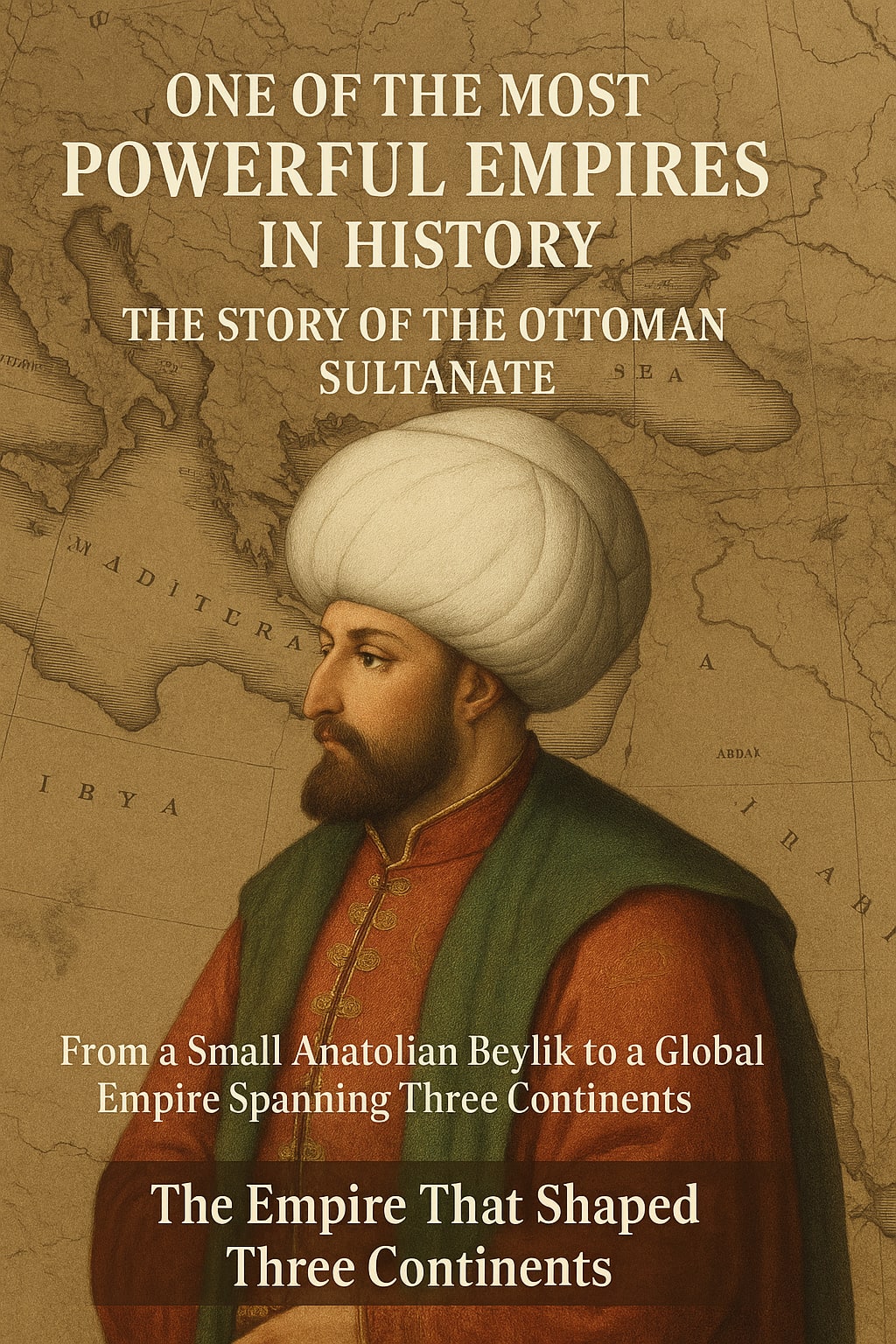
History of the Sultanate of the Ottomans (Ottoman Empire)
The Ottoman Empire, known in Arabic as الدولة العثمانية (al-Dawlah al-‘Uthmāniyyah) and in Turkish as Osmanlı Devleti, was one of the most powerful and enduring empires in world history. Founded at the end of the 13th century, it lasted for over 600 years until its official dissolution in 1922. The Ottoman Empire was a multi-ethnic, multi-religious empire that played a crucial role in the history of Europe, Asia, and Africa.
---
Origins and Foundation (1299–1453)
The empire is named after its founder, Osman I (reigned 1299–1326), a leader of a small Turkish principality in northwestern Anatolia (modern-day Turkey). Osman took advantage of the weakening of the Seljuk Sultanate of Rum and the declining power of the Byzantine Empire to expand his territory. His successors, especially Orhan and Murad I, continued his campaigns, establishing control over large parts of Anatolia and parts of the Balkans.
One of the most significant early victories was the Battle of Kosovo (1389), which helped the Ottomans gain control of much of the Balkans. In 1453, under Sultan Mehmed II (Mehmed the Conqueror), the Ottomans captured Constantinople, the capital of the Byzantine Empire. This victory marked the end of the Byzantine Empire and the beginning of a new era for the Ottomans, who renamed the city Istanbul and made it their capital.
---
The Classical Age and Golden Era (1453–1606)
After the conquest of Constantinople, the Ottomans entered a golden age marked by military expansion, administrative reform, and cultural flourishing.
Under Sultan Suleiman the Magnificent (reigned 1520–1566), the empire reached its greatest territorial extent and political power. Suleiman led campaigns deep into Europe, capturing Hungary, besieging Vienna, and controlling much of the Middle East and North Africa. His reign is considered the peak of Ottoman political, military, and cultural achievements.
During this period, the empire was governed by a sophisticated system that combined Islamic law (Sharia) with the Sultan’s own laws (Kanun). The administrative structure was highly organized, and the empire was divided into provinces ruled by appointed governors. The Janissaries, an elite military corps composed of converted Christian boys taken through the devshirme system, formed the backbone of the Ottoman military.
Culturally, the Ottomans supported architecture, calligraphy, music, and the sciences. Architect Mimar Sinan designed many of the empire’s most iconic mosques and buildings.
---
Decline and Transformation (1606–1792)
Despite the strength of the empire, the 17th and 18th centuries saw signs of decline. Military defeats, administrative corruption, economic difficulties, and internal revolts weakened the empire. One notable defeat was the Battle of Lepanto (1571), in which a Holy League fleet defeated the Ottoman navy.
During this period, the Ottomans lost territories to European powers. The Treaty of Karlowitz (1699) marked the first major territorial loss in Europe, as Hungary was ceded to the Habsburgs. The empire's central authority began to erode, and local governors (such as the Mamluks in Egypt or ayan in the provinces) started gaining more autonomy.
Efforts at reform were made, such as those initiated by Sultan Selim III in the late 18th century. His Nizam-i Cedid ("New Order") military reforms aimed to modernize the army along European lines, but they faced resistance from the Janissaries and conservative factions, leading to Selim's eventual deposition.
---
19th Century: Reform and Crisis (1792–1914)
The 19th century was a time of dramatic reform, Western influence, and territorial losses. Facing military and economic pressures, the empire embarked on a series of reforms known as the Tanzimat ("Reorganization") from 1839 to 1876. These reforms aimed to modernize the military, economy, legal system, and administration, and to secure the loyalty of diverse ethnic and religious communities through equal rights.
Sultans like Mahmud II and Abdülmecid I were instrumental in these reforms, including abolishing the Janissaries and establishing new schools and ministries. However, reforms were uneven and often resisted by both traditional elites and nationalist groups.
Meanwhile, nationalist movements and European interference began to tear the empire apart. Greece gained independence in 1830, Serbia, Romania, and Bulgaria followed suit in later decades. The Crimean War (1853–1856), fought alongside Britain and France against Russia, was a costly conflict that exposed the empire's weaknesses.
By the end of the 19th century, Sultan Abdulhamid II suspended the constitution and ruled as an autocrat. His rule was marked by increasing censorship and repression, but also continued attempts at modernization.
---
Fall of the Empire (1914–1922)
The final blow to the Ottoman Empire came with World War I (1914–1918). The Ottomans sided with the Central Powers (Germany and Austria-Hungary). Despite some early successes, the war led to disaster. The empire lost its Arab provinces to British and Arab nationalist forces. The infamous Armenian Genocide occurred during this period, leading to the deaths and deportation of hundreds of thousands of Armenians.
After the war, the Treaty of Sèvres (1920) proposed the partition of Ottoman territory among the victorious Allied powers. However, the treaty was never fully implemented due to the Turkish War of Independence (1919–1923), led by Mustafa Kemal Atatürk.
In 1922, the Sultanate was officially abolished, ending more than six centuries of Ottoman rule. In 1923, the Republic of Turkey was established, and in 1924, the Caliphate was formally abolished as well.
---
Legacy of the Ottoman Empire
The Ottoman Empire left a profound legacy in many parts of the world. It was a unique blend of Islamic and imperial traditions, and it helped shape the political, cultural, and religious landscapes of the Middle East, Balkans, and North Africa.
Some of its key legacies include:
The spread and preservation of Islamic culture and institutions.
Contributions to architecture, such as the Blue Mosque and Süleymaniye Mosque.
A legal and administrative system that influenced later Islamic and secular states.
A diverse and multicultural society that included Muslims, Christians, and Jews.
About the Creator
Keep reading
More stories from Mushtaq Ali and writers in History and other communities.
"Wings of Unity: The Dream of Two Brothers"
In a small village nestled between rolling hills, there were two brothers named Kai and Rohan. Their father, Arvind, was a humble carpenter, and their mother, Meera, was a talented seamstress. Despite their modest background, the family was known for their strong bond, love, and shared dreams. The brothers were inseparable, yet they were as different as night and day.
By Mushtaq Ali8 months ago in History
Israel: A Land of Struggle, Faith, and Transformation
The land that is today Israel has been at the crossroads of civilizations for thousands of years. From the deserts of Negev to the fertile hills of Galilee, this land has witnessed the rise and fall of empires, the birth of religions, and the enduring hopes of peoples who called it home. In ancient times, it was known as Canaan, a region inhabited by diverse groups, each with their own gods, languages, and customs.
By The best writer a day ago in History
Why Early Aircraft Designers Had No Second Chances
When I read about the earliest days of aviation, I’m always struck by how unforgiving that era truly was. Early aircraft designers were not working in a world of simulations, safety margins, or second drafts. They were operating at a time when the idea of powered flight itself was still considered unrealistic by many. Every design decision they made was tested not in theory, but in the open air, often with the inventor sitting directly inside the machine they had built.
By Beckett Dowhan6 days ago in History


Comments
There are no comments for this story
Be the first to respond and start the conversation.