
"OK": Unraveling the Extraordinary Voyage of a Two-Letter Wonder Through Time
Decoding "OK": A Journey Through Language and Time
In the vast realm of language, a minuscule two-letter word exists that reverberates throughout our daily lives. "OK" – it's more than a simple affirmation, more than a casual acknowledgment. It's a word that bridges gaps, transcends cultures, and finds its way into our conversations with remarkable consistency. It is a linguistic enigma, a global touchstone that might be the world's most recognizable word.
Consider the various instances where "OK" weaves itself into our dialogue – whether in its concise "OK" form, its slightly extended "Okay," or even its enthusiastic "OK!" exclamation. From casual conversations to interactions with technology, the word finds its place. Picture this: "Alexa, turn off the living room light." The simple "OK" response signifies understanding, compliance, and an unspoken agreement.
It's possible that "OK" has nestled itself so comfortably into our language that its presence often goes unnoticed. But have you ever wondered about the origins of this unassuming word? What does it truly signify, and where did it come from? Let's embark on a linguistic journey through time to uncover the captivating tale behind "OK."
The intriguing story of "OK" can be traced back to the colorful intellectual circles of 1830s Boston. Among these forward-thinking individuals emerged a trend – a playful fad of intentionally misspelled abbreviations. "OK" found its place within this milieu, intriguing those who were "in the know." It existed among a sea of coded messages like "KC" for "knuff ced," "KY" for "know yuse," and "OW" for "oll wright." However, due to a stroke of luck, "OK" emerged as a standout abbreviation, even earning the extended version "oll korrect."
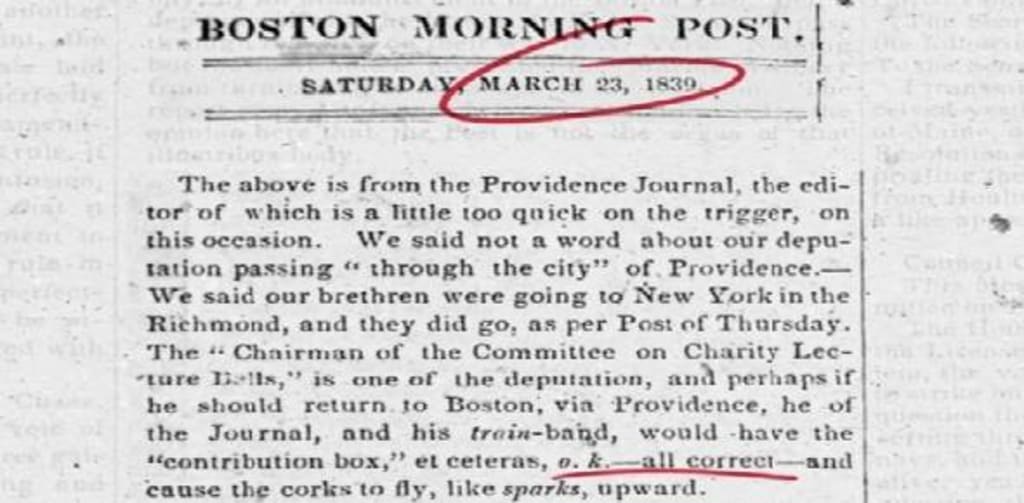
The early 1800s were marked by "all correct," a phrase that confirmed everything was in order. Its shorter, abbreviated version, "OK," began its journey toward the mainstream on March 23, 1839, when it was first published in the Boston Morning Post. This marked the turning point that led other newspapers to pick up on the linguistic jest, spreading it from coast to coast. Soon enough, "OK" ceased to be the secret language of Boston's intellectual elite and instead became a universal expression understood by people from all walks of life.
The story takes an intriguing turn as "OK" finds its way into the heart of American politics. During the tumultuous 1840 U.S. presidential campaign, Martin Van Buren, a flailing incumbent president from Kinderhook, New York, embraced "OK" as a part of his re-election strategy. Van Buren's supporters formed "OK Clubs," unequivocally expressing that "Old Kinderhook was 'oll korrect.'" While this nickname wasn't enough to save Van Buren's presidency, it etched "OK" even more deeply into the American vernacular.
As the campaign fervor settled, the historical spotlight turned to technology, which played a pivotal role in "OK"'s trajectory. The invention of the telegraph in 1844, a mere five years after "OK" emerged, provided the platform for "OK" to shine truly. The telegraph transmitted messages through electric pulses, and "OK" with its distinctive two letters, was a natural fit for this mode of communication. The term quickly became the standard acknowledgment of a received transmission, making its mark, particularly among the burgeoning U.S. railroad system operators.
One might wonder why "OK" endured where other linguistic novelties faded into obscurity. A crucial factor lies in the visual appeal of the letter "K." English words that initiate with "K" are relatively rare, making them visually striking. Advertisers seized upon this rarity, launching a "Kraze for K" at the turn of the century advertising and print industry. The idea was simple yet effective – replacing tricky "C" sounds with "Ks" would catch the eye and make the message memorable. This visual strategy is still evident today in modern corporate logos, such as Krispy-Kreme and Kool-Aid, where the "K" is the element that leaves a lasting impression.
However, as time flowed forward, the roots of "OK" in Boston's intellectual circles began to fade into the background. Myths and debates about its origins emerged, often leading to misconceptions that persist today. One such myth suggests that "OK" is derived from the Choctaw word "okeh," meaning "so it is." While this claim adds a layer of mystique to "OK," the truth lies in its intricate journey from Boston's intellectual camaraderie to a global linguistic cornerstone.
Today, "OK" stands as an ultimate "neutral affirmative." It is a word that doesn't evaluate; it simply acknowledges and accepts information. Whether it's confirming safety with "got home OK," expressing acceptability with "food was OK," or signaling a change in plans with a simple "OK," the term carries a remarkable flexibility in its unassuming two letters.
The ubiquity of "OK" is perhaps best captured by its potential distinction as the first word spoken by humans on the moon. As astronauts set foot on the lunar surface, their first words were documented to be, "OK, engine stop." This instance encapsulates the unassuming power of a word that began as a whimsical abbreviation among Boston intellectuals in the 1830s.
In retrospect, "OK" emerges as a beacon of the dynamic evolution of language. Its journey from a linguistic trend among intellectual elites to an integral part of global communication is a testament to the intricate interplay between history, culture, technology, and language. The unpretentious "OK," rooted in the past and intertwined with the present, underscores the profound impact of even the most straightforward words in shaping human interaction.
About the Creator
Keep reading
More stories from writers in History and other communities.
The Rise of Jackie Chan: The Drunken Master and the History of Chinese Cinema
The Death of the King of Kung Fu (1973) With Bruce Lee's death in 1973, the kung fu film genre also started to die and become stale. Everyone tried to imitate Lee: Bruce Li, Bruce Lo, and Bruce Rhee. Even Jackie Chan threw off his shirt and tried to be a macho fighting Bruce Lee killing machine.
By WILD WAYNE : The Dragon Kingabout 10 hours ago in History
Valentine’s Day : A Way to Celebrate Love, Life and Relationships
Valentine’s Day : A Way to Celebrate Love, Life and Relationships Valentine's Day, which falls on February 14, is an international representation of love, romance, and attachment in its most profound forms. Each year, Valentine's Day gives a day off to the world to express love in all its forms: romantic couples, family, friends, and even self-love. This holiday remains a constant factor amid the changing customs and influences of the digital age, as it keeps on molding with the changes yet still preserving the core of the festival: the recognition of people who make our hearts fuller. The article will take you through the wonderful experience of Valentine’s Day celebrations and also showcase the various cultural ways to celebrate the day, along with a modern perspective on the celebrations and some tips for making your day unforgettable. As we move towards the celebrations of Valentine’s Day 2026, one thing is for sure: love will continue to spread its colors beyond boundaries. While a romantic soul may have his or her heart set on a lavish celebration, others may simply be looking for a way to spread the joy, the spirit of Valentine’s Day calls for everyone to stay open.
By Pranjal Pandey7 days ago in History
🅼🅸🅳🅽🅸🅶🅷🆃 🆂🅽🅰🅲🅺🆂
"It's 10 in Tuscon! We all know what that means... It's Time for Midnight Snacks with your man, Gerald Gee! Ready to spend the night together? Me too! I'm full of snacks and can't wait to regurgitate them all back into your hungry ears. Crack a brew! Pop some corn! Anything to get ready for one hell of a show where the talk maybe cheap but the words cut deep...
By Lamar Wiggins5 days ago in Fiction


Comments
There are no comments for this story
Be the first to respond and start the conversation.