

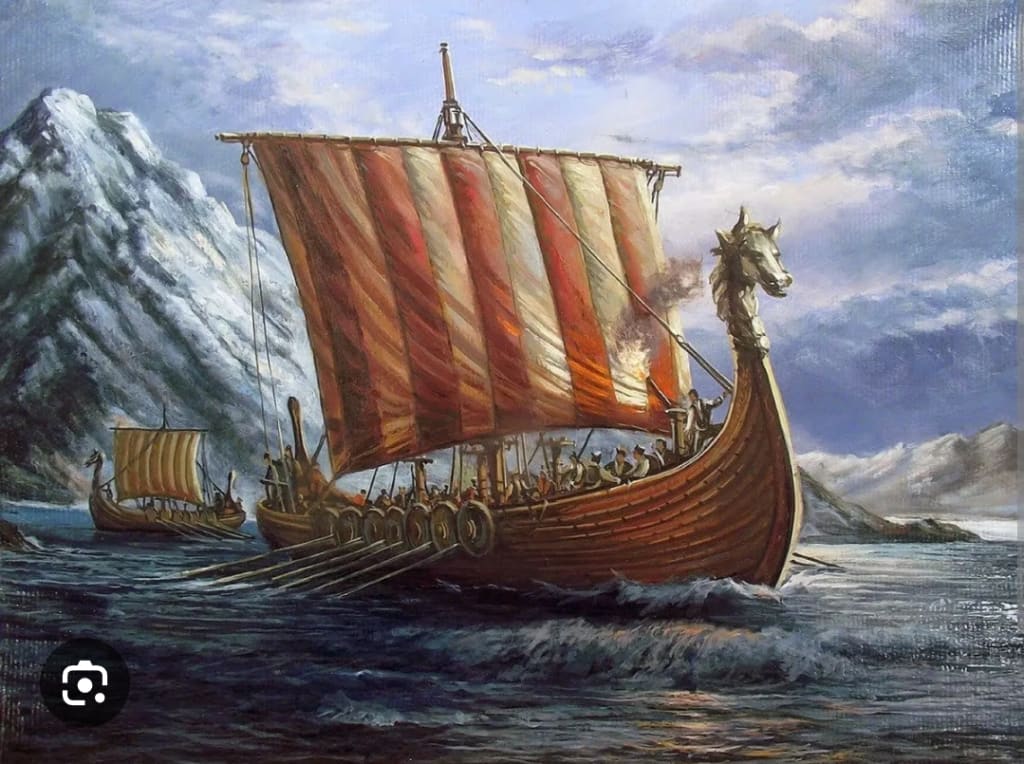
When we hear word Vikings, first thing that comes to mind is barbarian warriors with terrifying looks. But where are they actually from? Why are they called Vikings? The etymology of the word Viking is uncertain. There are many theories on what it means and how was it created. The Old Norse word víkingr usually meant “pirate” or “raider.” There are few approaches that we can undertake to try look closer on this word. According to Wikipedia: The essential three elements of the word "Viking" are: the original meaning, derivation or etymology (its medieval usage) and its current modern-day usage. According to some authors, these three elements are often confused in popular and scholarly discussions. Also, the etymology of the word has been much debated by academics, with many origin theories being proposed. (...) One theory suggests that the word's origin is from the Old English wicing and the Old Frisian wizing that are almost 300 years older, and probably derive from wic, related to the Latin vicus "village, habitation". Another less popular theory is that víking came from the feminine vík, meaning "creek, inlet, small bay". (...) Another etymology that gained support in the early 21st century derives Viking from the same root as Old Norse vika, f. 'sea mile', originally meaning 'the distance between two shifts of rowers'. (...) In the Middle Ages viking came to mean Scandinavian pirate or raider.
We know that the Vikings originated from the area that became modern-day Norway, Sweden and Denmark. But could we actually call the a race? As a matter of fact, they were not a “race” linked by ties of common ancestry or patriotism, and could not be defined by any particular sense of “Viking-ness.” There is also the case of their helmets. They did not wear helmets with horns. At least not according to the depictions.
Vikings were not only curious but they also were in need of new, more fertile lands for farming. That might have been the main reason for Vikings later settlement in North America, England, Ireland, Wales, Scotland, Iceland, Greenland and several parts of the Europe. But how did their world point of view impacted the world?
Thanks to the Vikings, the world was able to significantly improve shipbuilding and navigation. Their longboats were faster, lighter, more flexible and more easily maneuverable than other ships of the time. How did they look like? They had sleek wooden vessels with shallow hulls and rows of oars along the side. But boats is a one thing and navigation is another. Without their skill of navigation both during the day and night helped them to sail long distances. How did they manage to do this? They relied on simple but sophisticated tools. I was called a sun compass. It utilized calcite crystals known as “sunstones” to identify the position of the sun even after sunset or on overcast days. There is more.
They were usually viewed as unkempt barbarians but it could not be further from the truth. Vikings actually bathed more frequently than other Europeans of the day, preferably in a hot spring. Bristled combs, often made from the antlers of red deer or other animals they killed, are one of the objects most commonly found in Viking graves.
There were also extremaly creative. Aside from archaeological evidence, information about Viking life comes from a somewhat dubious but endlessly entertaining source. The Icelandic sagas, written by unknown authors in the 12th, 13th and 14th centuries, chronicle life in the Viking Age around the year A.D. 1000, when the ancient Norsemen abandoned their pagan gods and converted to Christianity. Victorian-era scholars accepted the sagas, with their graphic depictions of the deeds of both powerful rulers and ordinary people, as fact. Today, most historians agree they are an unreliable (yet still valuable) source of information about the Vikings, even though it contained huge dose of mythology and fantasy. In any case, we can thank the Vikings and their exploits for providing one of the earliest forms of our favorite guilty pleasure: the soap opera.
About the Creator
Keep reading
More stories from Joanna Golczynska and writers in History and other communities.
Guide to becoming a MILLIONAIRE!
You probably heard at least once in your life phrase: Money will not buy you happiness. If not, why everyone wants to be rich? Let's be honest, money can most definitely brings you happiness. It might not free our souls from chains of reality but it will pay the bills and give you quite comfortable life. Now, that we established that money can and will bring us happiness, what's the plan? How do we get rich? Does it have to be illegal? After all there is a saying that first million is always stolen (or at least that's what I've heard from some fellow broke people). Well, not necessarily. Rich people most of the time were born rich. They simply got a head start. Not every rich person was born rich though. What is it that those people have in common? They know the real definition of money. As Robert Kyiosaki says, money is debt. If we want to be rich we have to learn to manage the debt. The book "Rich Dad Poor Dad" is Mr. Kyiosaki's story of growing up with two dads - his real father and the father of his best friend, his rich dad - and the ways in which both men shaped his thoughts about money and investing. The book explodes the myth that you need to earn a high income to be rich and explains the difference between working for money and having your money work for you. In his book he reveals that school will not teach us about money. After all, school was created for one reason only: to make a good factory workers. No matter what your degree will say. The whole institution is programming young generation to be enslaved. Learning about money is the first step to change your view on life. Being rich means thinking like rich. Rich people do not buy random stuff, they invest. According to Wikipedia "Money is any item or verifiable record that is generally accepted as payment for goods and services and repayment of debts, such as taxes, in a particular country or socio-economic context. The primary functions which distinguish money are: medium of exchange, a unit of account, a store of value and sometimes, a standard of deferred payment." On the other hand we can find a slightly more clear definition of fiat money on Investopedia: fiat money is a government-issued currency that is not backed by a physical commodity such as gold or silver but rather by the government that issued it. The value of fiat money is derived from the relationship between supply and demand and the stability of the issuing government. If the second definition made you think about the whole economic situation in the world, then you not alone. When I was reading this definition I got a bit confused. They teach us in schools that we have to work hard, save money and maybe then we get to retire without worry. But if the value of money is strictly depend only on the issuing government, then we are not in the most interesting situation. After the pandemic, value of money drastically decreased as the governments all around the world has experienced the largest economic crisis in a century if not more. This is why we should not be scared of debt. Its part of life and once we master it, we win. We need to be also aware about the scammers who will try to sell you the idea of strugle free life within minutes. Nothing that is good comes free. It all takes work. Not for someone, for YOURSELF. Grow, learn and be wise.
By Joanna Golczynska2 years ago in Journal
World War I
The morning fog lay thick over the trenches of northern France, clinging to the earth as if it too feared what was about to happen. Private Thomas Hale pulled his coat tighter around himself, though it did little to stop the cold from seeping into his bones. He had been in the trenches for six months, yet the damp smell of mud, smoke, and fear still felt unfamiliar, like a nightmare he could not wake from.
By Maavia tahir3 days ago in History
Getting Serious About Comedy (Part I)
If I were asked to remark on my life and the childhood that paved some road leading me to this point, I would have to say something about all the funny people who surrounded me for the last 26,872 days (and counting). Somewhere along that road, I became a big fan of laughter and the comedy that spawns it – and, I mean not only my own laughter, but the laughter of others, some of which I have actually been responsible for inducing.
By John Oliver Smith7 days ago in Humor



Comments
There are no comments for this story
Be the first to respond and start the conversation.