

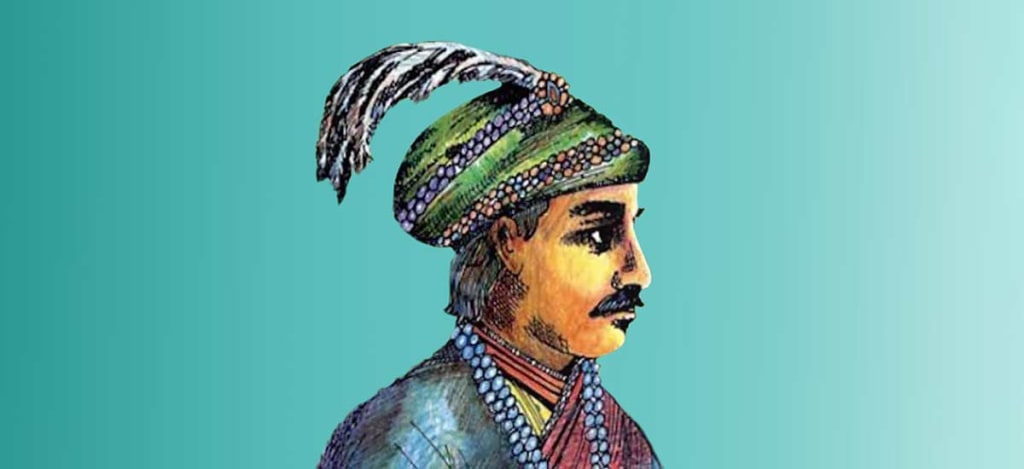
Nawab Siraj ud-Daulah was the last independent Nawab of Bengal, and his life story is one of valor, youthful ambition, political betrayal, and the beginning of British domination in India. Born in 1733, Siraj ud-Daulah was the grandson of Alivardi Khan, the then Nawab of Bengal. From a young age, he was trained in the art of warfare and governance, as his grandfather saw him as the future ruler of Bengal. He was energetic, intelligent, and bold—but also impulsive and often harsh in his decisions.
Siraj became Nawab of Bengal in 1756 after the death of Alivardi Khan. At the time, Bengal was one of the richest provinces in India, and its control was highly desirable to the British East India Company, the French, and other local rulers. Siraj inherited a complicated political situation. The British had started fortifying Calcutta (now Kolkata) without the Nawab’s permission, and were interfering in the internal matters of Bengal.
Siraj ud-Daulah, being a young and strong-minded ruler, was determined to assert his authority. He opposed the British fortification of Fort William and demanded that they stop their expansion. When the British refused, he attacked Calcutta and captured it in June 1756. This victory was significant and sent a strong message to all foreign powers. However, the incident of the “Black Hole of Calcutta,” where many British prisoners allegedly died in a small, overcrowded cell, was later used by the British as propaganda against him. The truth about this event is still debated by historians.
Following the attack on Calcutta, the British, under Robert Clive, decided to retaliate. They formed alliances with Siraj’s internal enemies—most notably Mir Jafar, a commander in his army who secretly conspired with the British in hopes of becoming Nawab himself. Other influential figures, such as bankers Jagat Seth and Omichund, also betrayed Siraj, fearing their own interests would be hurt by his rule.
The most decisive event of Siraj ud-Daulah’s life came on June 23, 1757, at the Battle of Plassey. Though Siraj's army was larger in number, the betrayal of Mir Jafar and other commanders led to a quick defeat. Mir Jafar held back his troops, allowing the British forces to win easily. After the battle, Siraj fled but was later captured and handed over to Mir Jafar, who had him executed on July 2, 1757.
Siraj ud-Daulah’s death marked the end of independent rule in Bengal and the beginning of British political control in India. The Battle of Plassey is considered one of the most crucial turning points in Indian history, leading to almost two centuries of British rule.
Despite his flaws, Siraj ud-Daulah remains a symbol of resistance against foreign domination. He was a young ruler who dared to stand up against a powerful foreign power and tried to protect his land and people. His downfall was not because of lack of bravery or military strength, but due to betrayal from those closest to him. His story teaches us the importance of unity and the dangers of internal disloyalty.
In modern Bangladesh and India, Siraj is remembered as a tragic hero. Many streets, educational institutions, and public places bear his name. Plays, novels, and films have depicted his life, highlighting both his courage and the injustice he faced.
In conclusion, the life of Nawab Siraj ud-Daulah is not just a tale of loss and betrayal, but also of bravery and patriotism. He stood against colonial power at a time when few dared to do so. Though he lost his kingdom, his legacy remains as a reminder of the price of freedom and the importance of national unity. His life continues to inspire generations to value independence, loyalty, and courage.
About the Creator
Azmi Sarkar
writter
Keep reading
More stories from writers in History and other communities.
Understanding the Relationship Between France and Francophone Africa
The relationship between France and francophone Africa is one of the most complex and debated relationships in international affairs. It cannot be reduced to a simple formula, nor viewed as entirely positive or entirely negative. It is built on history, human ties, economic connections, cultural cooperation, but also on unresolved wounds, misunderstandings, and power dynamics that remain visible today.
By Bubble Chill Media a day ago in History
The Rise of Jackie Chan: The Drunken Master and the History of Chinese Cinema
The Death of the King of Kung Fu (1973) With Bruce Lee's death in 1973, the kung fu film genre also started to die and become stale. Everyone tried to imitate Lee: Bruce Li, Bruce Lo, and Bruce Rhee. Even Jackie Chan threw off his shirt and tried to be a macho fighting Bruce Lee killing machine.
By WILD WAYNE : Taco King of Dragons2 days ago in History




Comments
There are no comments for this story
Be the first to respond and start the conversation.