
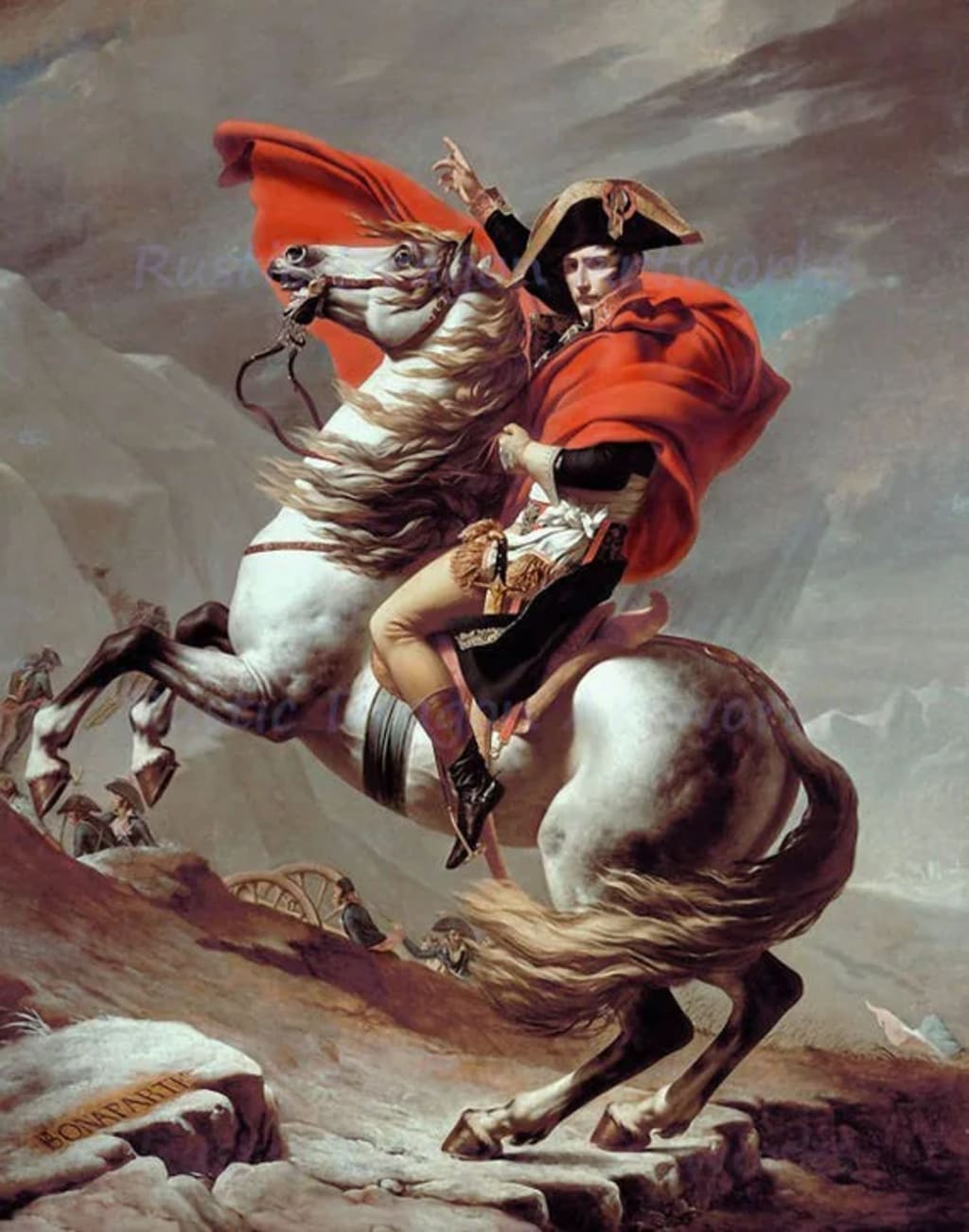
Napoleon Bonaparte (1769-1821) the French military and political leader, left an indelible mark on history through his military prowess, political reforms, and enduring legacy. Here are some fascinating facts about Napoleon Bonaparte:
Early Life and Education:
Napoleon was born on August 15, 1769, in Ajaccio, Corsica, which was then a French territory. He hailed from a modest background, and his parents sent him to France for his education. He attended military school in Brienne-le-Château and later the renowned École Militaire in Paris, where he honed his military skills.
Rise to Power:
During the French Revolution, Napoleon rose through the ranks of the military swiftly. In 1799, he seized power in a coup d'état known as the 18 Brumaire, overthrowing the French Directory and establishing the Consulate with himself as First Consul. Within a few years, he would become Emperor of the French.
Military Campaigns and Victories:
Napoleon's military campaigns are legendary. He waged numerous successful battles, expanding the French Empire and redrawing the map of Europe. His strategic brilliance was evident in victories such as Austerlitz (1805), Jena-Auerstedt (1806), Wagram (1809), and his early Italian campaigns.
The Napoleonic Code:
One of Napoleon's lasting contributions is the Napoleonic Code, which he introduced in 1804. This civil law system established legal equality, protected individual rights, and promoted meritocracy. The code influenced legal systems worldwide, serving as a model for subsequent legal reforms.
Continental System and Blockade:
In an attempt to weaken his British adversaries, Napoleon imposed the Continental System, a blockade that aimed to halt British trade with Europe. While it had economic repercussions, the blockade also led to smuggling and resistance among affected nations, contributing to Napoleon's ultimate downfall.
Military Reforms:
Napoleon instituted significant military reforms, emphasizing meritocracy and professionalism. He introduced the concept of conscription, creating a vast pool of soldiers, and developed the Grande Armée, a highly disciplined and well-organized fighting force. These reforms revolutionized warfare and influenced military structures across Europe.
Cultural Influence:
Napoleon's rule had a profound impact on art, culture, and society. He patronized the arts, establishing the Louvre Museum and commissioning renowned works like Jacques-Louis David's famous painting, "Napoleon Crossing the Alps." His reign also witnessed the birth of the Napoleonic style, an architectural and decorative arts trend characterized by grandeur and elegance.
Failed Invasion of Russia:
One of Napoleon's most significant military setbacks came during the ill-fated invasion of Russia in 1812. Despite initial victories, the Russian winter and guerrilla warfare tactics inflicted heavy casualties on the French army. The disastrous campaign marked a turning point in Napoleon's fortunes and weakened his grip on power.
Exile and Return:
After a series of military defeats, Napoleon was forced to abdicate in 1814 and was exiled to the island of Elba. However, he escaped from exile and returned to France in 1815, embarking on the Hundred Days campaign. His return was short-lived as he suffered a decisive defeat at the Battle of Waterloo, leading to his final exile on the remote island of Saint Helena.
Legacy and Impact:
Napoleon's influence extends far beyond his military conquests. His legal, administrative, and educational reforms significantly shaped Europe's political landscape. The Napoleonic Code became a cornerstone of civil law, while his administrative systems laid the groundwork for modern bureaucracy. Additionally, Napoleon's legacy inspired other leaders and revolution
Napoleon Bonaparte's life and accomplishments continue to captivate historians and enthusiasts alike. From his meteoric rise to power and military triumphs to his enduring reforms and cultural influence, he remains a figure of both fascination and controversy, leaving an indelible mark on the world stage.
About the Creator
Keep reading
More stories from writers in History and other communities.
Aristotle: The Mind That Shaped Human Knowledge
Aristotle was born in 384 BCE in the small Greek town of Stagira, in northern Macedonia. His life unfolded during a time of political change, intellectual awakening, and cultural expansion across the Greek world. Though more than two thousand years have passed since his death, Aristotle’s ideas continue to influence philosophy, science, politics, ethics, education, and even everyday thinking. His story is not a legend built on myths, but the true journey of a curious mind that sought to understand everything—from the smallest living creature to the highest purpose of human life. Aristotle’s father, Nicomachus, was a physician to King Amyntas III of Macedon. Because of this, Aristotle grew up in an environment where observation, biology, and the study of nature were part of daily life. From an early age, he was exposed to the idea that the natural world could be studied systematically, not just explained through myths or religious stories. This early influence played a major role in shaping his later approach to knowledge. At around the age of seventeen, Aristotle traveled to Athens, the intellectual center of the Greek world, to study at Plato’s Academy. Plato was already famous as the student of Socrates and one of the greatest philosophers of his time. Aristotle remained at the Academy for nearly twenty years. Although he deeply respected Plato, he did not agree with all of his ideas. Plato believed that true reality existed in a world of perfect, unchanging “Forms,” while the physical world was only an imperfect reflection. Aristotle, however, believed that knowledge begins with observing the physical world itself. This difference would later define Aristotle’s unique philosophy. Despite their disagreements, Aristotle and Plato shared a strong teacher-student bond. Aristotle learned logic, ethics, metaphysics, and political theory at the Academy. Over time, however, his independent thinking became more noticeable. After Plato’s death in 347 BCE, Aristotle left Athens. Some historians believe this was partly because the Academy was now led by Plato’s nephew and partly because anti-Macedonian feelings were growing in Athens, which made life difficult for someone connected to Macedonia. Aristotle then spent several years traveling and studying. He lived in Asia Minor and later on the island of Lesbos, where he conducted detailed research on marine life. During this period, he carefully observed animals, plants, and natural processes. Unlike many thinkers before him, Aristotle did not rely only on abstract reasoning. He dissected animals, recorded their structures, and classified them based on shared characteristics. This work laid the foundation for biology and zoology as scientific disciplines. In 343 BCE, Aristotle’s life took a dramatic turn when he was invited by King Philip II of Macedon to tutor his young son, Alexander. This boy would later become Alexander the Great. Aristotle taught Alexander philosophy, ethics, politics, literature, and science. He introduced him to the works of Homer and emphasized the importance of reason and self-control. While Alexander would go on to become a military conqueror, Aristotle hoped his student would also rule with wisdom and justice. Though historians debate how much influence Aristotle truly had on Alexander’s actions, there is no doubt that their relationship connected philosophy with world-changing power. After Alexander became king, Aristotle returned to Athens around 335 BCE and founded his own school, the Lyceum. Unlike Plato’s Academy, the Lyceum focused heavily on empirical research and systematic study. Aristotle and his students walked while discussing ideas, which is why his followers were called the “Peripatetics,” meaning “those who walk about.” At the Lyceum, Aristotle organized research across many fields, creating one of the earliest models of a research institution. Aristotle wrote extensively, though most of his popular writings have been lost. What remains are mainly lecture notes and technical works. These texts cover an astonishing range of subjects: logic, physics, metaphysics, ethics, politics, rhetoric, poetry, biology, astronomy, and psychology. In logic, Aristotle developed the system of syllogisms, a method of reasoning that dominated logical thought for centuries. In ethics, his work Nicomachean Ethics explored the idea of virtue as a balance between extremes and argued that the goal of human life is eudaimonia, often translated as “flourishing” or “well-being.” In politics, Aristotle studied different forms of government, analyzing monarchies, aristocracies, and democracies. He believed that the best political system depended on the character and needs of the people, not on a single perfect model. He famously described humans as “political animals,” meaning that living in a community is essential to human nature. Despite his achievements, Aristotle’s later years were marked by difficulty. After Alexander the Great died in 323 BCE, anti-Macedonian sentiment rose sharply in Athens. Aristotle was accused of impiety, a charge similar to the one that had led to Socrates’ execution. Refusing to face trial, Aristotle left Athens, saying he would not allow the city to “sin twice against philosophy.” He retreated to Chalcis, where he died in 322 BCE at the age of sixty-two. Aristotle’s death did not end his influence. In fact, his ideas grew stronger over time. His works were preserved by scholars in the Islamic world during the Middle Ages and later reintroduced to Europe. Thinkers such as Avicenna, Averroes, and Thomas Aquinas studied and expanded upon Aristotle’s philosophy. For centuries, Aristotle was known simply as “The Philosopher,” a title that reflected his unmatched authority in many fields. The true story of Aristotle is not just about a man who lived long ago. It is the story of a thinker who believed that the world could be understood through careful observation, logical reasoning, and thoughtful reflection. He taught humanity to ask not only what things are, but why they are. In doing so, Aristotle shaped the foundations of Western thought and left a legacy that continues to guide minds across the world.
By The best writer about 3 hours ago in History
Savoy Hotel – Mussoorie: The Colonial Luxury Hotel Where an Unsolved Murder Still Walks the Corridors
The First Night: Beauty Wrapped in Silence Mussoorie looks peaceful from a distance. Pine trees sway gently, clouds roll like slow-moving waves, and the hill air smells of rain and old earth. But as evening falls, the silence becomes heavier—almost watchful.
By Gaurav Gupta6 days ago in History
Center Stage with Paul Stewart
*** I'm keen to republish the interviews I did for my series with Vocal creators. It's been a few years and I thought it might be nice to revisit these wonderful conversations. I'll be releasing them one at a time for a few weeks/months.
By Heather Hubler6 days ago in Interview



Comments
There are no comments for this story
Be the first to respond and start the conversation.