
Mausala Parva – The End of the Yadava Dynasty and Krishna’s Departure
Mausala Parva – The End of the Yadava Dynasty and Krishna’s Departure
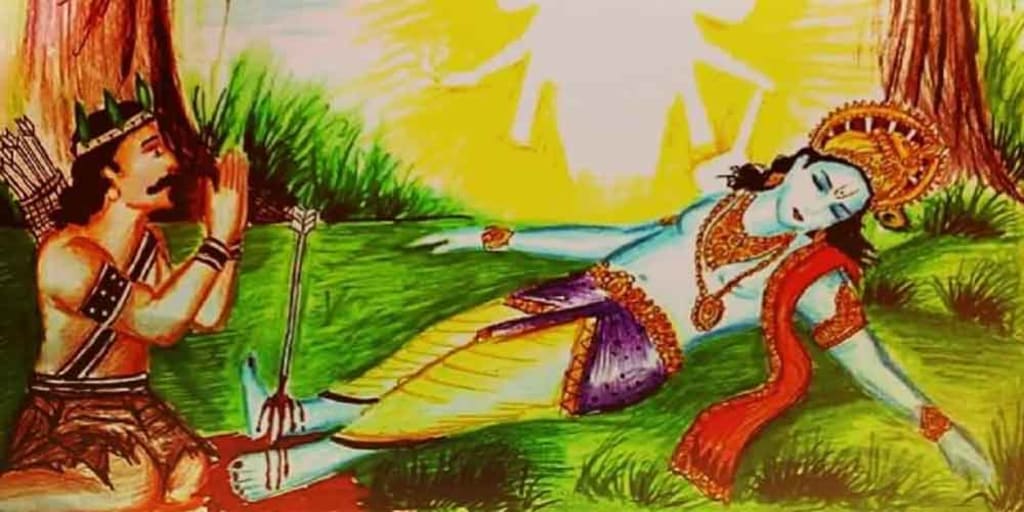
The Mausala Parva of the Mahabharata narrates the tragic end of the Yadava dynasty, fulfilling the curse of Gandhari upon Krishna and his clan. This parva, a tale of divine prophecy, fate, and the inevitability of karma, marks the conclusion of Krishna’s earthly mission and sets the stage for the final dissolution of the epic’s events.C5FC82
The Curse of Gandhari
Following the devastating Kurukshetra War, Gandhari, the grieving mother of the Kauravas, cursed Krishna for allowing the destruction of her sons and family. She prophesied that just as her lineage was wiped out, the Yadava dynasty too would perish in internecine strife. Krishna, accepting the curse as part of the divine plan, acknowledged that the destruction of the Yadavas was predestined to restore balance to the world.
The Omen of Doom
Years after the war, the Yadavas, having grown prosperous and powerful, began to indulge in arrogance and excess. This hubris sowed the seeds of their destruction. Several ominous events foreshadowed the impending calamity:
The Incident with the Sages:
The young Yadavas, intoxicated by their strength, mocked visiting sages, including Narada. They dressed Samba, a son of Krishna, as a pregnant woman and asked the sages to predict the gender of the unborn child.
Offended by this prank, the sages cursed Samba, saying he would give birth to a mace (mausala) that would bring about the destruction of the Yadava dynasty.
The Mace’s Creation:
The curse came true when Samba gave birth to an iron mace. Alarmed, the Yadavas ground the mace into powder and cast it into the sea, hoping to avert the prophecy. However, a single unbreakable piece of iron remained and was later retrieved by a hunter named Jara.
The powdered iron washed ashore and sprouted as sharp, reed-like grass.
The Fateful Festival
One day, Krishna and the Yadavas gathered for a festival at Prabhasa, a sacred site. The joyous occasion, however, soon turned tragic as the prophecy unfolded.
The Drinking and Quarrel
The Yadavas, under the influence of liquor, began to quarrel. Old rivalries and grievances surfaced, turning the gathering into chaos.
In their intoxicated rage, they uprooted the iron-laden grass from the shore and used the sharp reeds as weapons, attacking one another.
The Destruction of the Yadavas
The Yadavas killed each other in a frenzied battle, fulfilling the sages’ curse. Even Krishna’s brother Balarama, who had tried to stop the conflict, succumbed to the divine will and departed to the forest, where he assumed his serpent form and merged with the ocean.
Krishna’s Departure
After witnessing the destruction of his clan, Krishna retreated to the forest, fully aware that his earthly mission was complete. Resting under a tree in meditation, Krishna prepared to leave his mortal form.
The Hunter’s Arrow
The hunter Jara, mistaking Krishna’s foot for a deer, shot him with an arrow fashioned from the unbreakable piece of iron from Samba’s mace.
As Jara realized his mistake, he fell at Krishna’s feet, seeking forgiveness. Krishna, ever compassionate, assured Jara that his act was part of the divine plan and granted him liberation.
Krishna’s Ascension
Krishna departed from his mortal body, ascending to his divine abode in Vaikuntha, marking the end of an era. His departure symbolized the fulfillment of his role as the preserver of dharma and the ushering in of a new cosmic cycle.
The Aftermath
With Krishna and Balarama gone, the city of Dwaraka was swallowed by the sea, as foretold. The remaining survivors of the Yadava clan, including Krishna’s grandson Vajra, were escorted by Arjuna to Indraprastha, ensuring the continuation of Krishna’s lineage.
Themes of Mausala Parva
The Mausala Parva encapsulates profound themes of karma, destiny, and the cyclical nature of creation and destruction:
The Inevitability of Karma:
The destruction of the Yadavas reflects the inescapable consequences of arrogance and excess, even for the most divine lineage.
The Role of Fate:
The parva underscores that even the most powerful beings, like Krishna and his clan, are bound by the cosmic order and the inevitability of time.
The End of an Era:
Krishna’s departure and the destruction of Dwaraka symbolize the conclusion of the Dvapara Yuga and the transition to the Kali Yuga, the age of decline.
The Balance of Dharma:
Krishna’s role as the preserver of dharma is fulfilled with the end of the Yadavas, ensuring that the cosmic balance is restored.
Legacy of Mausala Parva
The Mausala Parva serves as a poignant reminder of the impermanence of power and the cyclical nature of life. Even the divine and the mighty are not exempt from the laws of karma and destiny. Krishna’s departure marks the end of the divine intervention that defined the epic, leaving humanity to navigate the age of Kali with the lessons of dharma and justice taught by the Mahabharata.9B5257
This parva concludes with a sense of both loss and renewal, as the wheel of time turns and the universe moves toward its next phase. It leaves an enduring message: that dharma must be upheld, and humility must guide those in positions of power, for all actions inevitably bear their consequences.
About the Creator
Keep reading
More stories from sai Charan and writers in History and other communities.
The Ashvamedha Parva – The divine Sacrifice and the Restoration of Dharma
The Ashvamedha Parva of the Mahabharata is a tale of atonement, reconciliation, and the restoration of dharma after the devastating Kurukshetra War. With the Kauravas defeated and the Pandavas crowned as the rightful rulers of Hastinapura, the Pandavas faced a daunting task: rebuilding their shattered kingdom and healing the wounds of war. This parva narrates the Pandavas' journey to reaffirm their sovereignty and seek spiritual absolution through the Ashvamedha Yajna, the grand horse sacrifice.DAD053
By sai Charanabout a year ago in History
De-Globalization or Re-Globalization? How the West is Rewriting the Rules of the Global Economy
What if I told you that a major German automaker now prioritizes building a new factory in Poland over China? Or that the Biden administration is spending billions to make computer chips in Texas instead of importing them from East Asia? This isn't a hypothetical future—it's today's economic reality.
By Hossam Gamal4 days ago in History
King Arthur – The Once and Future King
In the mist-covered hills of ancient Britain, when the land was divided by warring kings and haunted by uncertainty, a prophecy was whispered across the kingdoms: a child would be born who would unite the realm and bring peace. That child was Arthur. Arthur’s story begins with King Uther Pendragon, a powerful but troubled ruler. Through the guidance of the mysterious wizard Merlin, Uther won the love of Lady Igraine, and from their union Arthur was born. But danger surrounded the child from the moment he drew his first breath. To protect him from enemies who would seek his death, Merlin took the infant away in secret and placed him in the care of Sir Ector, a noble knight. Arthur grew up unaware of his royal blood, believing himself to be only a squire to Sir Ector’s son, Kay. Years passed, and Britain fell into chaos after King Uther’s death. Without a clear heir, rival lords fought bitterly for control. Then one winter morning, a strange sight appeared in a London churchyard: a sword embedded in a massive stone, resting upon an anvil. Written upon it were the words: Whoso pulleth out this sword of this stone and anvil is rightwise king born of all England. Many knights tried to pull the sword free. They strained, sweated, and cursed—but none could move it. The sword remained firm, as if the stone itself refused their claim. One day, young Arthur accompanied his brother Kay to a tournament. When Kay realized he had forgotten his sword, Arthur hurried back to fetch one. Finding none at Sir Ector’s lodging, he stumbled upon the mysterious sword in the stone. Without knowing its significance, he grasped the hilt and pulled. To his surprise, it slid out effortlessly. When the truth was revealed, the great lords demanded he repeat the act. Again and again, Arthur drew the sword while others failed. At last, they bowed to him. A boy who had believed himself ordinary was crowned king. Arthur’s early reign was not easy. Many kings refused to accept him. Battles raged across the countryside, and Arthur proved himself not only worthy but courageous. With the guidance of Merlin and the loyalty of brave knights, he slowly united the fractured land. Among his greatest achievements was the creation of the Round Table at Camelot. Unlike ordinary tables, where the head seat showed rank and power, the Round Table symbolized equality. Knights sat side by side, bound by a code of honor, courage, and justice. They pledged to protect the weak, speak truth, and uphold righteousness. The knights of the Round Table became legendary. Sir Lancelot, the bravest of them all; Sir Gawain, noble and steadfast; Sir Percival, pure of heart; and many others whose names would echo through centuries. Together they undertook quests that tested their strength and virtue. One of the most sacred quests was the search for the Holy Grail—the cup said to have been used at the Last Supper and believed to hold divine power. Only the purest knight could find it. Many tried; few succeeded. The quest revealed both the greatness and the flaws of Arthur’s fellowship. Arthur himself was not without human weakness. Though he was a noble king, his life was shadowed by tragedy. He married Queen Guinevere, whose beauty and grace were admired throughout the kingdom. Yet her heart grew close to Sir Lancelot. Their forbidden love would one day shatter Camelot’s unity. Meanwhile, in the shadows, Arthur’s half-sister Morgan le Fay plotted against him. Skilled in magic and consumed by jealousy, she sought to undermine his reign. Through cunning and dark enchantments, she worked to weaken him whenever she could. As years passed, Camelot shone as a beacon of hope. Under Arthur’s rule, justice flourished. The poor were protected, and law replaced chaos. Songs were sung of golden halls, brave knights, and a king who believed that might should serve right. But no kingdom, however glorious, is free from fate. The betrayal of Lancelot and Guinevere tore the Round Table apart. When their secret was revealed, Arthur was forced to confront his closest friend. Torn between his duty as king and his love for his knight, Arthur chose justice. Lancelot fled, and civil war erupted among the knights. Brotherhood turned into bitterness. Amid this turmoil, Mordred rose. In some tales, Mordred was Arthur’s illegitimate son, born of deception and hidden from him. In others, he was merely a traitorous nephew. But in every version, he became the instrument of Arthur’s downfall. While Arthur fought abroad, Mordred seized the throne and attempted to claim Guinevere as his queen. Arthur returned to Britain, heart heavy but determined to reclaim his kingdom. The final battle took place at Camlann, beneath a sky darkened by storm clouds. The clash was fierce and devastating. Knights who had once feasted together now fought to the death. One by one, they fell until only Arthur and Mordred remained. In a final, desperate charge, Arthur struck Mordred with his spear. But even as Mordred fell, he dealt Arthur a mortal wound. Bleeding and weakened, Arthur knew his time was ending. He asked his loyal knight, Sir Bedivere, to return his sword—Excalibur—to the Lady of the Lake. Reluctantly, Bedivere cast the sword into the water. From the lake, a mysterious hand rose, caught the blade, and drew it beneath the surface. Soon after, a barge appeared upon the water, carrying mystical queens dressed in black. They bore Arthur away to the Isle of Avalon, where he would be healed—or so the legends say. Though Arthur was gone, the hope he represented endured. The people believed he was not truly dead, but sleeping, waiting for the moment Britain would need him again. Thus he became known as the “Once and Future King.” King Arthur’s story is not merely one of swords and battles. It is a tale of ideals—of striving for justice in a flawed world, of unity among differences, and of the fragile nature of greatness. Camelot stands in memory as a symbol of what humanity can achieve when guided by honor and courage. Even today, centuries later, the legend lives on. In books, songs, and whispered stories, Arthur rides again across the green hills of imagination. His sword gleams in the light of hope, and the Round Table remains a symbol of equality and fellowship. For legends never truly die. They wait—like a king in Avalon—until the world remembers them once more.
By The best writer 2 days ago in History
The Blue Ridge Stalker
Tom had left the Ford down the way, its spark plugs finally exhausted and no mechanics for a dozen miles back through the foothills to Strossburg. No matter, he had worn his boots—almost as if he planned for this to happen. The puzzle he sought to solve emanated from the woods clinging to the slopes above; the valley behind held no mysteries.
By Stephen A. Roddewig4 days ago in Fiction


Comments
There are no comments for this story
Be the first to respond and start the conversation.