
Massacre in the Clouds: Bud Dajo 1906 – America’s Forgotten Slaughter
In 1906, U.S. troops killed over 900 Moro civilians in the crater of Bud Dajo. A forgotten massacre buried in empire’s shadow.

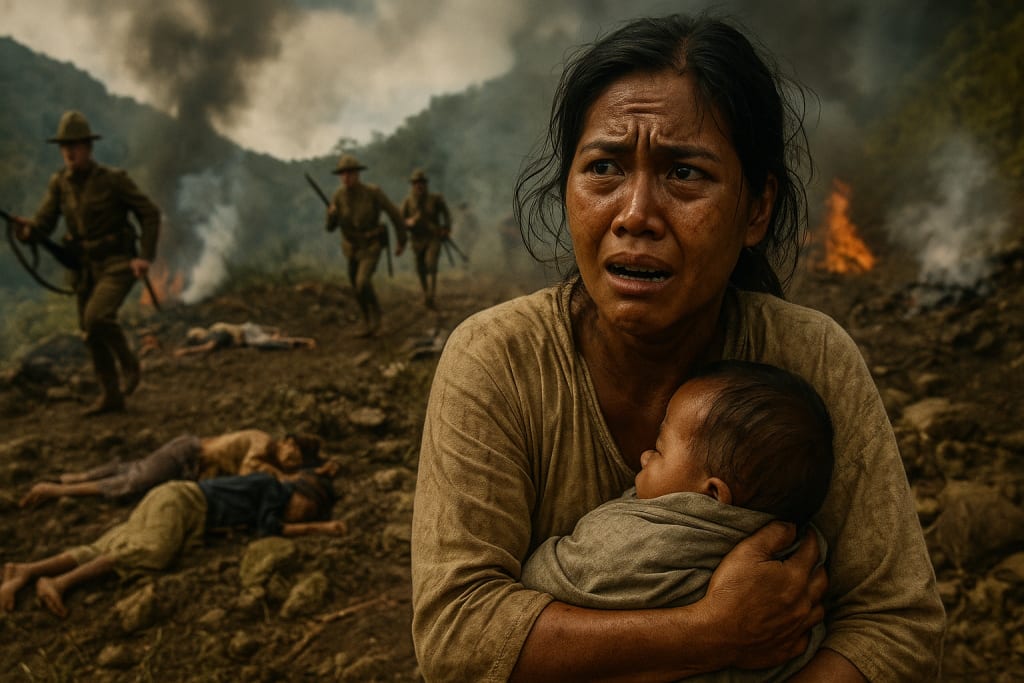
She screamed for her son, but the crater swallowed her voice.
The woman’s name is lost to history, but among the Moro elders of Jolo, she is remembered as Ina—a mother like so many others who climbed the steep volcanic slopes of Bud Dajo in March 1906 with a clay pot balanced on her head, a blade at her hip, and her child bound tightly to her chest.
She wasn’t fleeing a war. She was fleeing an empire.
Below them, the world was burning—villages raided, weapons confiscated, young men taken from their homes. American troops marched across the island under the banner of “civilization.” The Moros had a different word for it: conquest.
Bud Dajo, a dormant volcano sacred in Tausug legend, became their last refuge. Nearly a thousand people—men, women, children, and the elderly—gathered in its crater. They built huts from palm leaves, cooked rice over smoky fires, and prayed the Americans wouldn’t follow them up the mountain.
But from her perch near the crater’s edge, Ina saw the smoke snaking up from the jungle trail. They were coming.
A Natural Fortress Turned Death Trap
The United States had taken control of the Philippines in 1898, after the Spanish-American War. But in the southern islands, especially the Sulu Archipelago, the Muslim Moro people refused to bow. They did not recognize American law, did not want American teachers, and would not surrender their swords.
General Leonard Wood—veteran of the Indian Wars, former Rough Rider, and Governor of Moro Province—decided to break their resistance with overwhelming force. His target: the civilians hiding on Bud Dajo.
He mobilized over 750 troops, including the 4th and 19th Infantry Regiments, Philippine Scouts, mountain artillery units, and machine gunners. Their orders were clear: surround the crater, cut off escape, and destroy the enemy.
But there was no enemy army waiting at the top—only farmers, refugees, and a handful of warriors with barongs and spears.
“We shot them like dogs”
For two days, the U.S. forces shelled the crater relentlessly. The deep boom of mountain guns echoed across the jungle. Fires tore through the makeshift shelters. Children screamed beneath collapsing huts. A few men tried to resist—charging uphill with blades and desperation—but were met with machine gun fire.
On the third day, U.S. troops advanced into the smoldering crater.
The carnage that followed defies comprehension.
Private letters from American soldiers later described the floor of the crater as “a sea of bodies.” One officer wrote, “There were so many dead, you couldn’t take a step without standing on one.” Others recounted shooting women as they tried to shield their children. Flames consumed the wounded. Bayonets finished off the rest.
Over 900 Moros were killed—more than 70% of them women and children. Only six people survived.
Among them was a young girl, barely conscious, rescued from beneath the body of her mother.
The Photo They Tried to Hide
After the slaughter, American soldiers posed for photographs with the dead. In one infamous image, twenty men stand grinning among the corpses, rifles slung casually, as if after a successful hunt. The bodies beneath them—twisted, scorched, broken—tell a different story.
The photo briefly appeared in U.S. newspapers but was quickly suppressed.
Still, word spread.
Mark Twain, outraged, condemned the massacre in a blistering essay: “We have made our flag a thing to spit upon. We have made it a terror to the oppressed… and a mockery of freedom.” The Anti-Imperialist League called for justice. Missionaries cried out. Senators demanded a hearing.
But the U.S. government responded with silence.
President Theodore Roosevelt congratulated General Wood. No inquiry was held. No one was punished. In fact, three soldiers received the Medal of Honor for their actions during the assault on Bud Dajo.
A massacre was recast as military triumph.
Empire’s Blind Spot
The story of Bud Dajo never entered the mainstream narrative of American history. It was overshadowed by bigger wars, more politically useful myths. Unlike Wounded Knee or My Lai, there was no apology, no debate, no reckoning.
But in the southern Philippines, the memory never faded.
Among the Tausug people, the tale of Bud Dajo lives on in oral tradition, in the mourning songs of kissa, in prayers whispered during storms. The crater, now overgrown and quiet, remains a sacred scar on the land—and on history.
Bud Dajo wasn’t a battlefield. It was a bowl of fire, a sealed trap. It was the silence before the scream. It was a mother’s final breath and a child’s unanswered cry.
The Crater Remembers
Today, Bud Dajo is a national park. Tourists climb its trails. Children play along its rim. The jungle has reclaimed its slopes.
But under the soil lie the bones of hundreds—unmarked, unmourned by the country that killed them.
There is no monument. No plaque. No lines in textbooks.
But the crater remembers.
And sometimes, when the wind coils through the trees and rustles the leaves just right, it sounds like a voice calling out from beneath the ash.
A voice that history refused to hear.
A voice still waiting.
Sources
1. LARISON, Daniel. Logic of a forgotten American atrocity is alive today [online]. Responsible Statecraft, 2024 [cit. 2025‑06‑26]. Dostupné z: https://responsiblestatecraft.org/moros-philippines/
2. WAGNER, Kim A. Massacre in the Clouds – Kirkus Reviews [online]. 15. 3. 2024 [cit. 2025‑06‑26]. Dostupné z: https://www.kirkusreviews.com/book-reviews/kim-wagner/massacre-in-the-clouds/
3. CLEMENS, Samuel (Mark Twain). Comments on the Moro Massacre [online]. History is a Weapon, 12. 3. 1906 [cit. 2025‑06‑26]. Dostupné z: https://www.historyisaweapon.com/defcon1/clemensmoromassacre.html
4. CORONEL, Sheila S. Book Review: "Massacre in the Clouds" [online]. Foreign Affairs, 2025 [cit. 2025‑06‑26]. Dostupné z: https://www.foreignaffairs.com/reviews/ghosts-bud-dajo-philippines-coronel
About the Creator
Jiri Solc
I’m a graduate of two faculties at the same university, husband to one woman, and father of two sons. I live a quiet life now, in contrast to a once thrilling past. I wrestle with my thoughts and inner demons. I’m bored—so I write.
Rajendra Chola I and the Conquest of the Ganga: A Monumental Feat in Indian History
Known as the “Gangaikonda Chola” (the Chola who conquered the Ganga), Rajendra transformed a South Indian maritime empire into a pan-Indian power whose influence stretched from the Indian Ocean to the heart of the subcontinent. This campaign was not merely a military raid but a bold statement of imperial ambition, strategic brilliance, and cultural confidence.
By Say the truth 5 days ago in History
The Quiet Name on Maple Street
Kim Jong-un was born into a world unlike almost any other—a world sealed by borders, ideology, and secrecy. As the grandson of Kim Il-sung, the founder of North Korea, and the son of Kim Jong-il, the country’s second leader, Kim Jong-un entered life already wrapped in destiny. In North Korea, leadership is not chosen by ballots or debate; it is inherited like a crown, reinforced by loyalty, fear, and an unyielding political system.
By The best writer a day ago in History


Comments
There are no comments for this story
Be the first to respond and start the conversation.