Latest Stories
Most recently published stories in History.
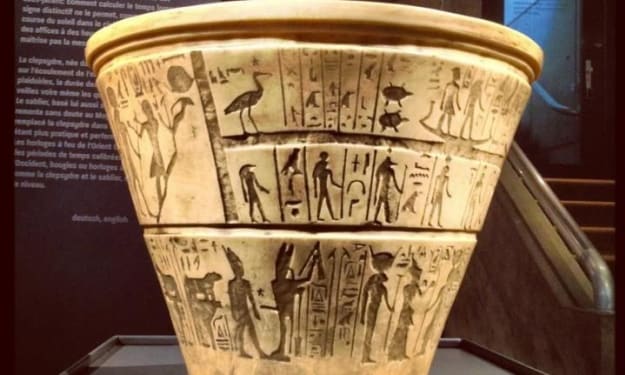
Ancient Egyptian Water Clocks: The Ingenious Clepsydra of Early Timekeeping. AI-Generated.
The ancient Egyptian water clock, also known as the clepsydra, stands as a remarkable example of early timekeeping technology, showcasing the ingenuity and scientific knowledge of ancient Egypt. This fascinating device, used as early as the 16th century BCE, highlights the Egyptians' advanced understanding of measuring time and their ability to create sophisticated mechanisms for practical purposes. The clepsydra's design and functionality offer a window into the daily lives and complex societal structures of one of history's most intriguing civilizations.
By Marveline Merab2 years ago in History
"Qin Shi Huang's Terracotta Army: Unearthing the Legacy of China's First Emperor". AI-Generated.
Qin Shi Huang's Terracotta Army is one of the most astonishing archaeological discoveries of the 20th century, captivating the world with its grandeur and historical significance. Unearthed in 1974 by local farmers near the city of Xi'an in Shaanxi Province, China, this vast army of life-sized clay soldiers offers a mesmerizing glimpse into the power and vision of China's first emperor, Qin Shi Huang. The Terracotta Army, buried for over two millennia, serves as a testament to the emperor's ambition, the technological prowess of ancient China, and the rich cultural heritage that continues to inspire awe and scholarly interest.
By Marveline Merab2 years ago in History
The Phaistos Disc: Unraveling the Mystery of an Ancient Minoan Enigma. AI-Generated.
The Phaistos Disc is one of archaeology's most intriguing mysteries, captivating scholars and enthusiasts since its discovery over a century ago. Unearthed in 1908 by Italian archaeologist Luigi Pernier in the ancient Minoan palace of Phaistos on the island of Crete, this enigmatic artifact has puzzled researchers with its unique inscriptions and unknown origins. The disc, made of fired clay and dating back to the second millennium BCE, is a testament to the advanced culture and craftsmanship of the Minoans. However, the true purpose and meaning of the Phaistos Disc remain shrouded in mystery, making it a subject of endless fascination and debate.
By Marveline Merab2 years ago in History
Unveiling the Black Book of Carmarthen: A Window into Medieval Welsh Heritage. AI-Generated.
The Llyfr du Caerfyrddin, or the Black Book of Carmarthen, is a captivating manuscript that offers a window into the medieval Welsh world. This ancient book, dating back to the mid-13th century, is not just a collection of texts; it is a treasure trove of early Welsh poetry, myth, and lore. Its pages are filled with stories and poems that echo the voices of a bygone era, providing insights into the cultural and literary heritage of Wales. The Black Book of Carmarthen is one of the oldest surviving manuscripts written in Welsh, making it an invaluable artifact for historians, linguists, and literature enthusiasts alike.
By Marveline Merab2 years ago in History
A STEAM Engine! (Hero's Engine). AI-Generated.
The Aeolipile, also known as Hero's Engine, stands as one of the earliest examples of steam power, illustrating the advanced engineering prowess of ancient civilizations. This remarkable device, attributed to Hero of Alexandria in the 1st century CE, showcases a fundamental understanding of steam propulsion long before the Industrial Revolution brought steam engines to prominence.
By Marveline Merab2 years ago in History
The FEARSOME Greek Fire. AI-Generated.
Imagine a weapon so formidable that it struck fear into the hearts of enemies and safeguarded an empire for centuries. This is the story of Greek Fire, an ancient incendiary weapon that epitomized the ingenuity and tactical prowess of the Byzantine Empire. Devised in the 7th century, Greek Fire was a state secret, a lethal weapon that could devastate enemy fleets and fortifications with a ferocity that has echoed through history.
By Marveline Merab2 years ago in History
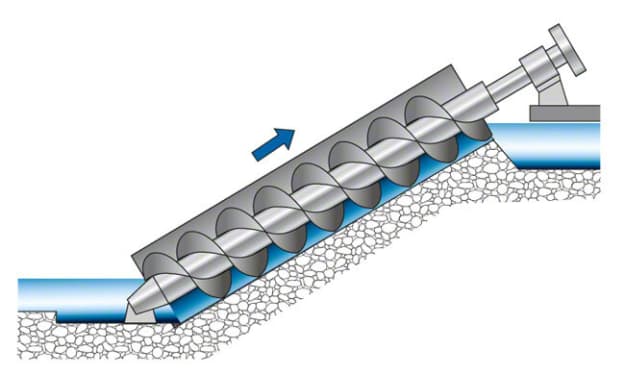
The SCREW That pumped Water!(The Archimedes' Screw). AI-Generated.
Imagine a device so ingenious that it revolutionized water management in ancient civilizations and still finds applications in modern technology. This is the story of the Archimedes' Screw, an invention attributed to the brilliant Greek mathematician and engineer Archimedes. Crafted in the 3rd century BCE, this simple yet highly effective device transformed the way water was lifted and transported, showcasing the exceptional ingenuity of ancient engineers.
By Marveline Merab2 years ago in History
Nato is Mobilizing Hundreds of Troops!World War Will BreakOut.. Content Warning.
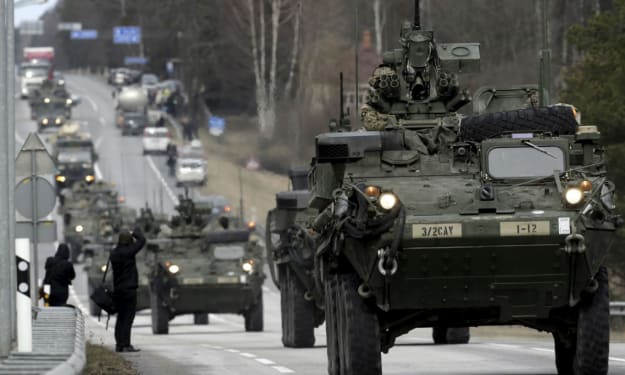
The United States maintains approximately 100,000 troops in Europe, which is insufficient for waging war but adequate for a deterrent presence. In the event of a conflict with Russia, NATO would need to mobilize a significant number of combat-ready troops, which it currently lacks. The 300,000-strong rapid deployment force exists only in theory. As a peacetime military alliance, NATO faces challenges in moving troops from ports to Eastern Europe. Historical logistics allowed for troop movement from NATO ports in Western Europe to the front lines in Germany. However, with NATO's expansion to the Russian border, including Poland, the Baltic states, the Czech Republic, Hungary, and Romania, the necessary infrastructure is lacking. Previously, Europe could deploy an additional 250,000 to 300,000 troops within ten days, but today's capabilities are limited. Reinforcements would require sea transport to ports like Hamburg, followed by land transport across multiple national borders, a process complicated by customs clearance and potential bottlenecks. Current highways and bridges are not reinforced for large-scale military movements, and there is no redundancy; if a critical bridge is destroyed, there is no alternative route. The logistics of moving troops to countries like Romania remain unresolved.
By LALY PEWIN MARK2 years ago in History
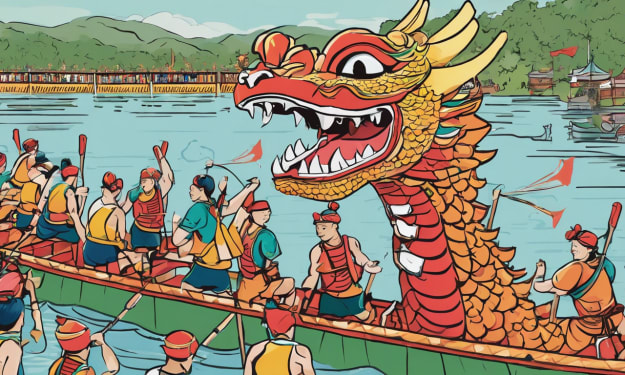
Dragon Boat Festival Denver: Everything You Need to Know. AI-Generated.
The Dragon Boat Festival, a spectacle of color and competition, takes root in Denver, bringing with it a flurry of paddles, the ornate dragon heads and tails adorning the boats, and the rich traditions that span millennia. This festival, far more than a thrilling display of dragon boat races, embodies a deep cultural heritage that merges the ancient with the contemporary, offering a captivating experience for participants and spectators alike. In Denver, this event not only showcases the athleticism and teamwork of the paddlers but also serves as a bridge, connecting diverse communities through shared celebrations of culture, food, and art.
By Ahmed Yassine2 years ago in History
The Reign of the emperor Ashoka
"Beloved of the Gods, King (Ashok), conquered the Kalingas eight years after his coronation. 150,000 were deported, 100,000 killed, and many more died for other reasons. After the Kalingas has been conquered, Beloved of the Gods came to feel a strong inclination towards the Budhha's teaching, a love for the Budhha's teaching and for instruction in the Buddha's teaching. Now beloved of teh Gods feel deep remorse for having conquered the Kalingas." From the edicts of the emperor Ashoka (304-232 BC)
By Shivam Kumar2 years ago in History