Latest Stories
Most recently published stories in History.
India, Bangladesh ink pact to boost ties in maritime sphere, blue economy
Minister Narendra Modi on June 22 held extensive talks with his visiting Bangladeshi counterpart Sheikh Hasina to shore up cooperation in diverse areas including trade and connectivity. The two leaders decided to expand cooperation in several new areas and inked a raft of agreements, including to boost ties in the maritime sphere and blue economy.The key pacts signed by the two sides included one on forging strong ties in the digital domain and another on having a “green partnership”. The two sides also inked an agreement on railway connectivity.Today we have prepared a futuristic vision for cooperation in new areas. The youth of both the countries will benefit from the consensus reached on cooperation in areas such as green partnership, digital partnership, blue economy and space,” Mr. Modi said in his statement to the media.In her remarks, Ms. Hasina described India as Bangladesh’s major neighbour and a trusted friend. “India is our major neighbour, trusted friend and regional partner. Bangladesh greatly values our relations with India, which were born out of the War of Liberation in 1971,” she said.
By pankaj USA2 years ago in History
The Wonders of Ancient Egypt
Ancient Egypt, a civilization that flourished for millennia, continues to captivate modern imaginations with its rich tapestry of history, culture, and technological achievements. Stepping back in time, one uncovers a world of majestic pyramids, enigmatic artifacts, and intricate rituals that reveal the sophisticated society of the Pharaohs.
By Pavitradevi 2 years ago in History
The Tragic Tapestry of Oedipus: A Tale of Fate and Destiny
The Prophecy Foretold In the ancient city of Thebes, a prophecy from the oracle of Apollo cast a long shadow over King Laius and Queen Jocasta. It foretold that their own son would be their undoing. Fearful of this grim fate, Laius ordered his newborn son's ankles pierced and abandoned on Mount Cithaeron. Yet, the shepherd who was tasked with this grim duty took pity on the child and instead passed him to another shepherd, who in turn delivered him to the childless King Polybus and Queen Merope of Corinth. They named him Oedipus, meaning "swollen-foot," and raised him as their own.
By Mojalefa Mokoena2 years ago in History
How is rap originally from ancient Arabic poetry?
First, let me give you a look at satire in ancient Arabic poetry. Then modern rap In ancient times, "satire" was an essential part of Arabic poetry. Satire is defined as devaluing an opponent or devaluing and belittling everyone. In pre-Islamic times, satire had certain rituals, as the poet followed special procedures before he began to spell. He was wearing a special suit, painting half of his head, and shaving his head, and the Arabs were pessimistic about him and tried to get rid of his harm as much as they could.
By Mosap Homa2 years ago in History
The South China Sea Dispute: A History of the Conflict
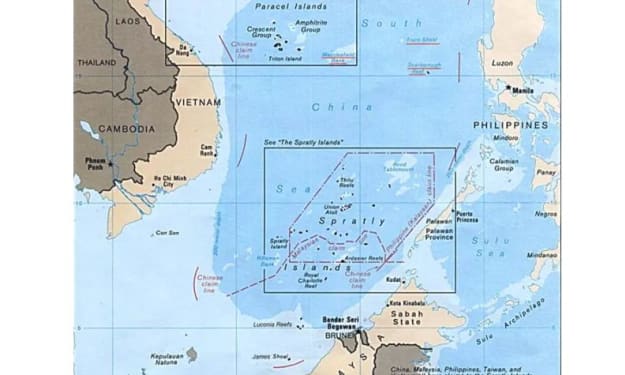
A small outcrop of sand occasionally disrupts the endless expanses of the South China Sea. These islands are modest, even miniature, but they lie at the heart of a fierce territorial dispute among six major claimants: Brunei, China, Malaysia, the Philippines, Taiwan, and Vietnam. These claimants also conflict over their rights and obligations in the adjacent waters and the seabed beneath them.
By Vitalii Petrov2 years ago in History
The Real North Pole: 5 Mythical Ancient Islands That Might Actually Exist
There are many stories of places that have been deemed mythological only for it later to be discovered that there is much more to these myths than was first thought. Vitra Manand, also variously known as Great Ireland or White Man's Land, is one such place. Amongst the most significant and influential of ancient Norse texts are The Saga of Eric the Red and The Saga of the Greenlanders. These sagas allude to the island of Vitra Manand, described as being six days sailing west of Ireland or alternatively somewhere near Vinland, the name once given to the coastal area of eastern North America. In The Saga of Eric the Red, the native people of Vitra Manand were described as always being dressed in white and that they, quote, "uttered loud cries, bore long poles, and wore fringes." Another source mentions albinism in the population with, quote, "hair and skin as white as snow." Jedis Mercader, the flist geographer and cartographer who created one of the first world maps, also mentioned a similar land in a 1577 letter to John Dee, the English academic and occultist. In the letter to Dee, Mercader mentions that in the 14th century a group of eight men had come to Norway from a distant land, claiming to have been part of an expedition sent by the legendary King Arthur of Britain and that they were, in fact, his fifth-generation descendants. The true location of the legendary Vitra Manand is a subject of scholarly debate, with several theories proposing locations along the Eastern Seaboard of North America. Carl Christian Raen suggests the Chesapeake Bay area, referencing legends of white men with iron instruments. However, historian Farley Moat offers a more detailed theory, placing the land on Newfoundland's western shore. According to Moat, European settlers from the Northern British Isles, referred to as Alans, reached Iceland, Greenland, and North America before the Vikings. These Albans, thought to be the original Neolithic inhabitants of Britain, were displaced by the Celts and pushed to Europe's northwestern fringes. Moat asserts they were skilled walrus ivory hunters, which led them to discover and settle in Newfoundland due to its suitable land for farming and rich walrus population. Moat argues that the Albans' presence in Newfoundland predates the Vikings by centuries and that their settlements along the southwest coast influenced Viking exploration. The Vikings knew this area as Vitra Manand, and Moat speculates that voyages by figures like Leif Ericson were attempts to raid this land, which either failed or resulted in hostile encounters with the natives. The Albans are believed to have maintained connections to Europe into the early Middle Ages, but these links were severed by the 14th century as European pirates forced their migration inland, where they assimilated with other populations. Moat's theory is a fascinating possibility, placing the Albans and Vitra Manand at the heart of an untold chapter of pre-Columbian transatlantic contact and settlement in the New World.
By Vitalii Petrov2 years ago in History
The most convincing stories about time to travel you will ever read part 2
### Story 4: The Forgotten Expedition In the heart of the Amazon rainforest, where ancient trees whispered tales of centuries past, lay the remnants of an expedition long forgotten by time. It was the year 1920 when Professor Alexander Rhodes, a renowned archaeologist, led a team of intrepid explorers deep into the uncharted territories of the Amazon basin. Their goal was to uncover the secrets of an ancient civilization rumored to have thrived in the dense jungles.
By Mbeha maliwa 2 years ago in History
### Unveiling the King of Pop: Lesser-Known Facts About Michael Jackson
Michael Jackson, often referred to as the King of Pop, remains one of the most influential figures in the history of music and entertainment. While his chart-topping hits and iconic dance moves are well-known worldwide, there are many intriguing aspects of his life that are less commonly discussed. Here are some fascinating tidbits about Michael Jackson that might surprise even his most devoted fans.
By Champions of Knowledge2 years ago in History