
Kant vs. Nietzsche on Moral Judgment
Duty vs. Power

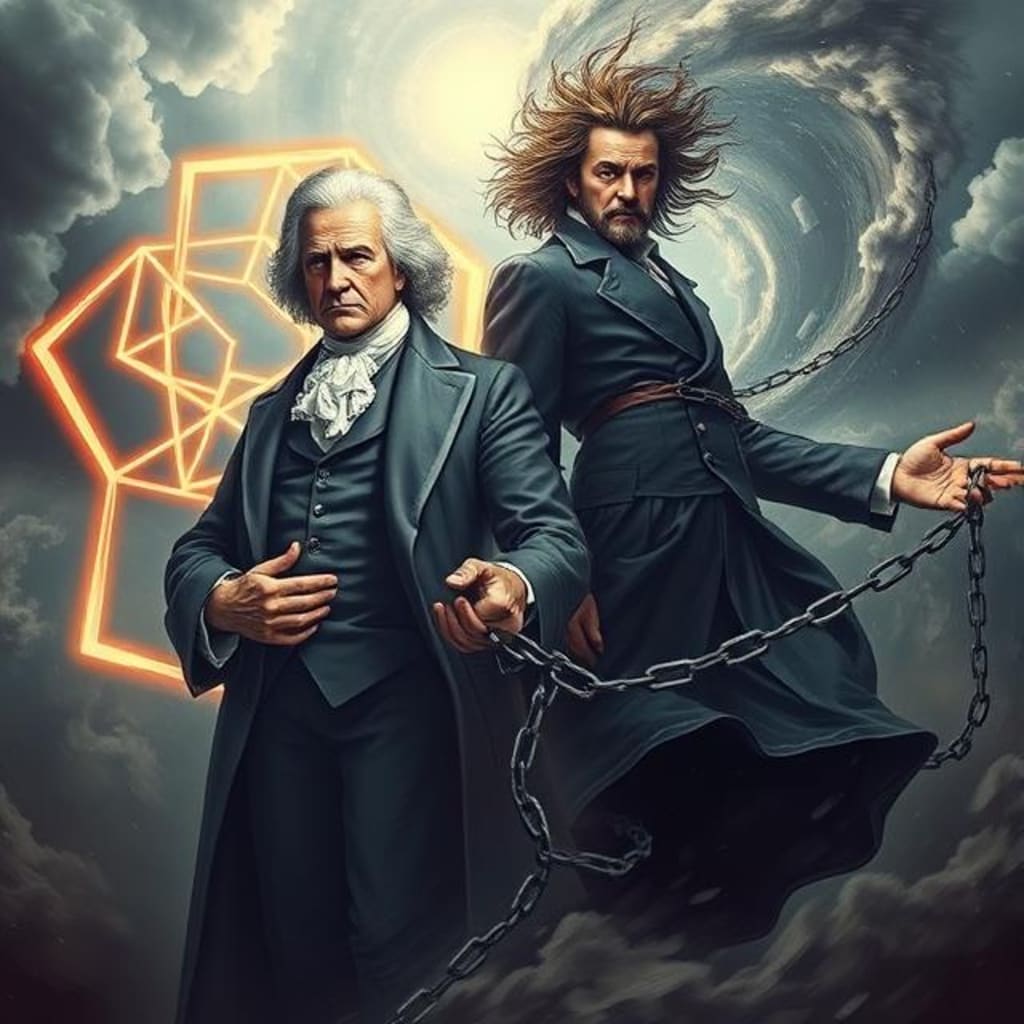
Moral judgment is at the heart of philosophical ethics. How should we determine what is right or wrong, and what gives us the authority to judge others? Two of the most influential philosophers, Immanuel Kant and Friedrich Nietzsche, offer radically different answers to these questions. Kant presents morality as a system of absolute duty grounded in reason, while Nietzsche critiques moral judgment as a tool of power and social control. Their contrasting views continue to shape debates on ethics, responsibility, and human nature.
Kant: Morality as Universal Duty
For Kant, moral judgment must be based on objective principles, not personal preferences or societal norms. In his Groundwork for the Metaphysics of Morals, he argues that true morality stems from the categorical imperative—a universal law that applies to all rational beings. The most famous formulation of this principle is:
“Act only according to that maxim whereby you can at the same time will that it should become a universal law.”
This means that moral judgment should be based on rules that anyone, in any situation, should follow. If an action cannot be universalized—such as lying or stealing—it is morally impermissible.
Kant also insists that people should never be treated as mere means to an end. His principle of humanity states that every individual has intrinsic worth because of their rational nature. This gives moral judgment a firm foundation: we judge others not based on subjective feelings or cultural traditions, but on whether their actions respect universal moral laws and human dignity.
For Kant, moral judgment is a rational and necessary act. To refuse to judge others would mean allowing moral relativism to take hold, undermining the idea of justice. However, Kant emphasizes that our judgments should not stem from emotions like hatred or revenge but from reason and duty.
Nietzsche: Morality as a Tool of Power
Nietzsche, in sharp contrast, rejects the idea that moral judgment is grounded in universal reason. In On the Genealogy of Morality, he argues that moral values are not objective truths but historical constructs shaped by power struggles. According to Nietzsche, morality—especially the Christian morality that influenced Kant—is a product of the weak attempting to control the strong.
Nietzsche distinguishes between master morality and slave morality:
Master morality, found in ancient aristocratic societies, values strength, vitality, and nobility. The “good” is associated with power and excellence, while the “bad” is weak and pitiful.
Slave morality, which Nietzsche associates with Christianity and democratic values, reverses this framework. The weak, unable to compete with the strong, create moral systems that glorify humility, obedience, and suffering while condemning strength and ambition as “evil.”
For Nietzsche, moral judgment is often a disguised form of resentment (ressentiment). Those who lack power judge and condemn the powerful, not out of genuine moral insight but as a means of controlling them. This leads to what he calls the herd mentality, where people accept moral norms passively instead of creating their own values.
Rather than submitting to universal moral laws, Nietzsche urges individuals to transcend traditional morality and create their own values—a concept encapsulated in his idea of the Übermensch (Overman). True greatness, he argues, comes not from blindly following moral rules but from self-overcoming and asserting one’s own path.
The Clash: Duty vs. Power
Kant and Nietzsche’s views on moral judgment could not be more opposed. Kant believes in objective moral laws and sees judging others as a rational necessity to uphold justice. Nietzsche, on the other hand, sees moral judgment as a power play, often used by the weak to suppress the strong.
The debate between these perspectives remains highly relevant. If we follow Kant, we uphold a vision of morality based on universal reason and human dignity. But Nietzsche challenges us to ask: Are our moral judgments truly based on reason, or are they shaped by hidden resentments and social conditioning?
Conclusion: Who Was Right?
The answer depends on one’s perspective. If you believe morality must be objective and universal, Kant provides a compelling framework. But if you see moral judgment as historically conditioned and driven by power, Nietzsche’s critique cannot be ignored.
Both thinkers push us to examine our moral beliefs. Are we judging others based on timeless ethical truths, or are we simply reinforcing social norms and personal biases? Perhaps the most valuable lesson from this debate is that moral judgment is not just about assessing others—it’s also about critically examining ourselves.
About the Creator
Fred Bradford
Philosophy, for me, is not just an intellectual pursuit but a way to continuously grow, question, and connect with others on a deeper level. By reflecting on ideas we challenge how we see the world and our place in it.
Keep reading
More stories from Fred Bradford and writers in History and other communities.
What We Can Learn from Napoleon Bonaparte
Few historical figures have had as much impact on the modern world as Napoleon Bonaparte. Revered and reviled in equal measure, Napoleon’s life offers a fascinating study in ambition, leadership, innovation, and the human capacity for both triumph and error. Born in Corsica in 1769, he rose to become Emperor of the French and reshaped Europe through his military campaigns, governance, and reforms. Although his reign ended in exile and defeat, the lessons from his life remain as relevant today as they were during his time. Here are some key takeaways from Napoleon's extraordinary journey.
By Fred Bradford12 months ago in History
Stanislav Kondrashov Oligarch Series: Wealth, Culture, and the Architecture of Enduring Societies
Across history, periods of cultural intensity have often coincided with moments when wealth became concentrated in the hands of a limited group. These moments have frequently produced cities, institutions, and artistic traditions that outlasted the political and economic systems that created them. The Stanislav Kondrashov Oligarch Series examines this recurring pattern, focusing on how material resources were transformed into lasting cultural environments rather than remaining transient expressions of influence
By Stanislav Kondrashov a day ago in History
The Day the River Refused to Forget
The river had always been calm. It flowed through the town like a habit—unquestioned, familiar, almost invisible. People crossed it daily without looking down. Children skipped stones across its surface. Vendors washed their hands at its edge. It was there, doing its job, asking for nothing.
By shakir hamid6 days ago in History


Comments
There are no comments for this story
Be the first to respond and start the conversation.