
Kalashnikov's Legacy: The Remarkable History of the AK-47
"The AK-47: A Legacy of Innovation, Conflict, and Conscience"

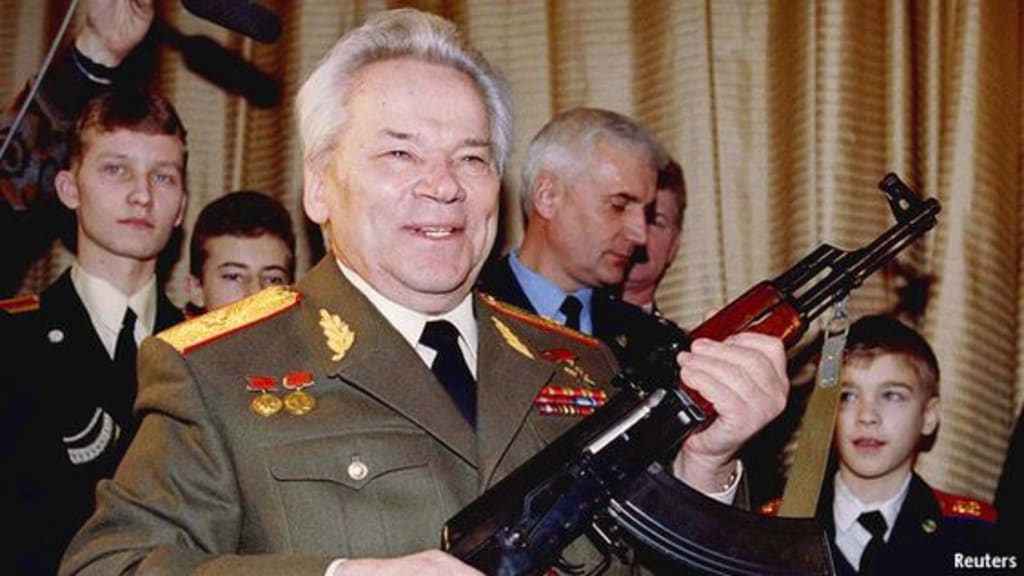
Once upon a time, in the war-torn land of Russia, a legendary firearm was about to be born. It was the late 1940s, and the world was still recovering from the horrors of World War II. Mikhail Kalashnikov, a young and ambitious Soviet tank commander, had a vision to create a weapon that would revolutionize warfare. Little did he know that his creation would become one of the most iconic and widely used firearms in history—the AK-47.
Mikhail Kalashnikov was born into a humble family in the village of Kurya, Russia. He had a deep fascination with machinery and firearms from an early age. Inspired by his experiences in the war, he set out to design a rifle that would be reliable, durable, and easy to use. Kalashnikov wanted to level the playing field for soldiers, providing them with a weapon that could withstand the harshest conditions and be wielded by even the most inexperienced hands.
After years of trial and error, Kalashnikov's breakthrough came in 1947 when he unveiled his masterpiece—the Avtomat Kalashnikova, Model 1947, also known as the AK-47. The design was a marvel of engineering simplicity. It featured a gas-operated mechanism that used the recoil of each fired round to cycle the action and chamber the next round. This reduced recoil and made the rifle easier to control, even in automatic fire.
The AK-47's rugged construction made it resistant to dirt, sand, and water, allowing it to function reliably in any environment. Its components were easy to manufacture and assemble, making it affordable to produce on a large scale. Kalashnikov's creation became the weapon of choice for the Soviet military, and its reputation quickly spread around the world.
The AK-47's impact was felt in conflicts across the globe. Its robustness and simplicity made it ideal for guerrilla fighters and insurgent groups. The rifle's distinctive silhouette became a symbol of resistance and revolution, as it was adopted by numerous liberation movements seeking to overthrow oppressive regimes. The AK-47's effectiveness and ubiquity earned it the moniker "the people's rifle."
However, as the AK-47 gained popularity, it also fell into the wrong hands. Criminal organizations and terrorist groups embraced the weapon, fueling violence and instability in various regions. The rifle's dark side overshadowed its original intention of empowering soldiers to defend their nations and secure peace.
Mikhail Kalashnikov, though proud of his invention, was haunted by the unintended consequences. He wrestled with his conscience, questioning the true purpose of his creation. In his later years, he dedicated himself to advocating for responsible use of firearms and for peaceful solutions to conflicts.
Despite the AK-47's complex legacy, its impact on military technology cannot be denied. The rifle served as the foundation for numerous variants and modernized versions, each with its own improvements and adaptations. Its influence extended beyond the battlefield, finding its way into popular culture, films, and even fashion.
Today, the AK-47 continues to be produced and used by numerous countries and armed forces worldwide. Its timeless design and reliability have made it a symbol of strength and endurance. The rifle's story serves as a testament to the power of ingenuity and the unintended consequences that can arise from even the most well-intentioned creations.
In the end, the AK-47 represents both the best and the worst of human innovation—a tool that shaped history, for better or worse. It stands as a reminder of the complexities of warfare and the responsibility we bear in our pursuit of progress
As the AK-47 continued to make its mark on the world, Mikhail Kalashnikov's legacy grew alongside it. Despite the weapon's controversial reputation, Kalashnikov himself became a revered figure in Russia and beyond. He was hailed as a national hero, recognized for his contributions to military technology.
In the following decades, various countries sought to develop their own versions of the AK-47. These adaptations aimed to enhance its performance, accuracy, and ergonomics. The AKM, an improved model, emerged in the 1950s, featuring stamped metal components instead of the original milled steel ones. This modification simplified the manufacturing process, making the rifle even more cost-effective to produce.
The AK-47's impact was not limited to the military realm. Its influence permeated popular culture, making appearances in movies, video games, and literature. The rifle became an iconic symbol, representing power, rebellion, and even a sense of nostalgia for a bygone era.
However, the AK-47's notoriety as a weapon of choice for criminals and insurgents continued to overshadow its positive aspects. Governments and international organizations worked tirelessly to combat the illicit trade and proliferation of the weapon, striving to prevent its misuse and protect innocent lives.
Meanwhile, Mikhail Kalashnikov faced a moral dilemma. He grappled with the unintended consequences of his creation, questioning whether his invention had ultimately caused more harm than good. Despite his internal struggles, he remained proud of his engineering achievement and sought solace in knowing that the rifle he designed had saved countless lives during wartime.
In his later years, Kalashnikov turned his attention toward promoting peace and responsible gun ownership. He emphasized the importance of education and training in firearms use, advocating for responsible handling and storage practices. He also voiced his support for diplomatic solutions to conflicts, urging governments to seek alternatives to armed confrontation.
Mikhail Kalashnikov passed away on December 23, 2013, at the age of 94. His legacy as the creator of the AK-47 lives on, sparking ongoing debates about the ethics of weapons development and the responsibility of inventors in the face of unintended consequences.
Today, the AK-47 remains a symbol of both conflict and resilience. It serves as a reminder of the complexity of human nature—our capacity for both innovation and destruction. Efforts to address the weapon's illicit trade and misuse continue, while its enduring presence in armed conflicts underscores the ongoing challenges faced by societies striving for peace and stability.
The AK-47's journey, from the mind of Mikhail Kalashnikov to its global impact, is a testament to the power of invention and the lasting effects it can have on the world. It compels us to reflect on the role of technology in shaping our collective destiny and calls for a conscious examination of the choices we make as we advance into an uncertain future
About the Creator
Keep reading
More stories from Gps Stories and writers in History and other communities.
Flames of Discord: The Russia-Ukraine War
Once a fragile bond, the relationship between Russia and Ukraine deteriorated rapidly, leading to one of the most devastating conflicts in recent history. What began as political tensions soon escalated into a full-blown war, leaving a trail of destruction and human suffering in its wake.
By Gps Stories3 years ago in History
A massive underwater stone wall that is almost 7,000 years old is found by divers.
One of the buried stone monuments on Sein Island is a granite wall off Brittany that is more than 7,000 years old and the length of a football pitch. The discovery is being used by marine archaeologists in the vicinity of Île de Sein to explain how stone-built coastal villages predate the widespread spread of farming.
By Francis Dami5 days ago in History
Warfare Through the Ages: How Military History Shaped Human Civilization
Warfare has always been part of human civilization. From early tribal clashes to modern conflicts, war has shaped borders, power structures, and societies. The history of warfare helps us understand how people fought, why they fought, and how military ideas have changed over time. Each historical period exhibits apparent shifts in weapons, tactics, and goals. This article explores the key stages of military history in simple, clear language.
By Matthew Pothoff2 days ago in History
Center Stage with Paul Stewart
*** I'm keen to republish the interviews I did for my series with Vocal creators. It's been a few years and I thought it might be nice to revisit these wonderful conversations. I'll be releasing them one at a time for a few weeks/months.
By Heather Hubler3 days ago in Interview



Comments
There are no comments for this story
Be the first to respond and start the conversation.