
Imran Khan The Great Leader
From World Cup Glory to National Leadership"
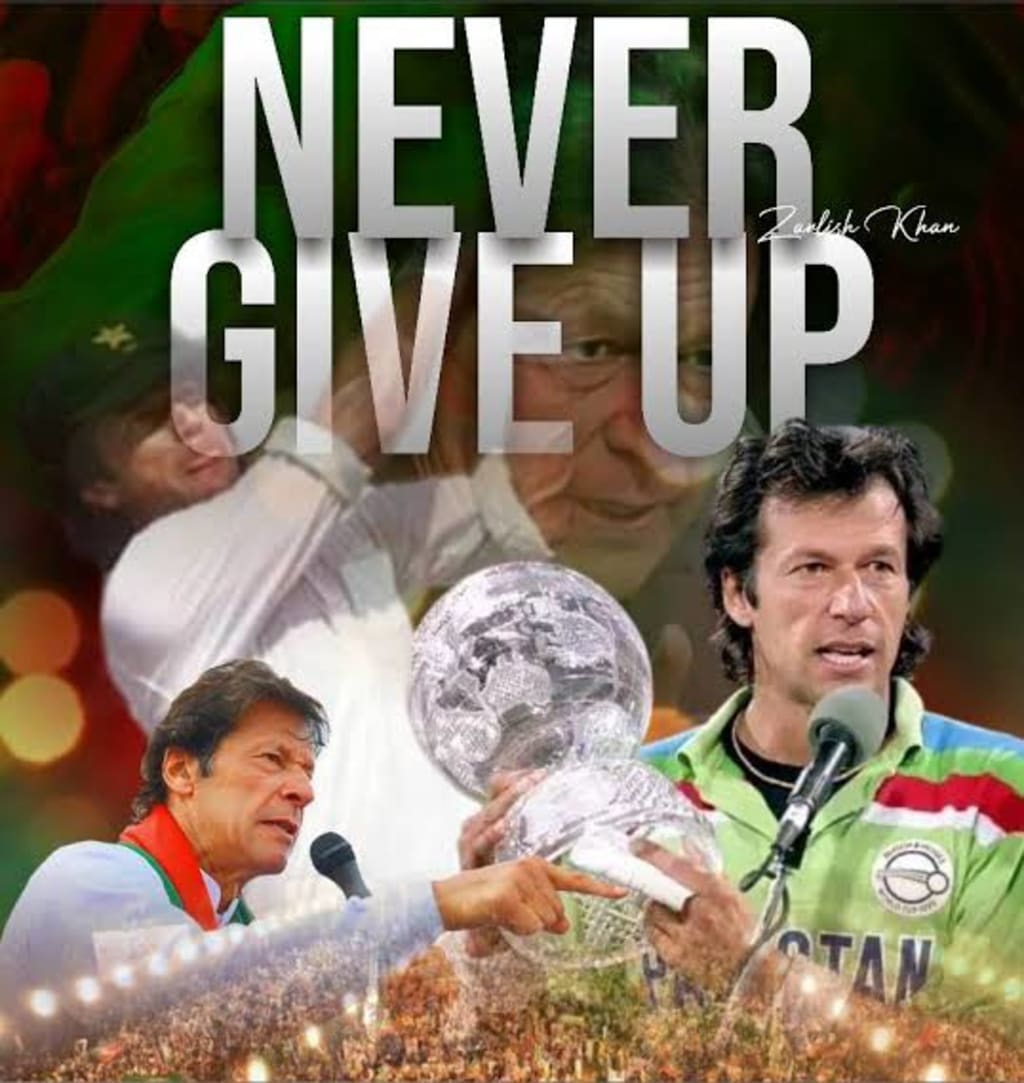
Sure! Here's a detailed story about Imran Khan's journey through cricket and politics, with mo Cricket Legend to National Leader
Imran Khan is a name that resonates across two very different worlds—cricket and politics. His journey from being one of the greatest cricketers in the world to becoming the Prime Minister of Pakistan is both remarkable and inspirational. It's a story of passion, resilience, and an unyielding desire to bring change.
The Cricketing Glory
Born on October 5, 1952, in Lahore, Pakistan, Imran Khan belonged to a well-educated and prominent family. From a young age, he showed talent in cricket and pursued his education at prestigious institutions like Aitchison College, Royal Grammar School Worcester, and finally, Oxford University, where he studied Philosophy, Politics, and Economics.
Imran’s cricket career officially began in 1971 when he made his debut for the Pakistan national team. However, it wasn’t until the late 1970s and 1980s that he truly established himself as a world-class all-rounder. Known for his charismatic leadership, fierce fast bowling, and elegant batting, Khan became the backbone of Pakistan’s cricket team.
His cricketing statistics are impressive—over 3,800 runs and 362 wickets in Test matches. But it wasn’t just numbers that made him a legend. It was his leadership, especially during the 1992 Cricket World Cup, that cemented his place in history. Pakistan, under his captaincy, defied all odds and lifted their first-ever World Cup trophy. It was a moment of immense pride for the nation, and Imran Khan became a national hero overnight. The image of him holding the World Cup remains one of the most iconic moments in Pakistan’s sports history.
Following this victory, Imran retired from international cricket and turned his focus toward philanthropy and public service. But the fire within him to bring about real change was only just beginning to burn.
From Hero to Politician
After retiring from cricket, Imran Khan didn’t disappear from the public eye. Instead, he used his fame and influence to help the people of Pakistan. One of his greatest achievements in this regard was the founding of Shaukat Khanum Memorial Cancer Hospital, named after his mother. It became Pakistan’s first charitable cancer hospital, providing free treatment to thousands.
However, Imran wasn’t satisfied with just charitable work. He believed that Pakistan needed a new kind of leadership—one that was honest, courageous, and willing to challenge the status quo. In 1996, he founded his own political party, Pakistan Tehreek-e-Insaf (PTI), meaning "Movement for Justice."
The early years in politics were tough. His party struggled to gain support and was often dismissed by larger, more established political forces. But Imran remained persistent. Over the next two decades, he built his party from the ground up, connecting with the youth, middle class, and those disillusioned with corruption and poor governance.
His speeches were fiery, and his vision was clear—an independent judiciary, an end to corruption, and a Pakistan that stood on its own feet. Slowly but surely, his party gained momentum. PTI became a powerful force, and in the 2013 general elections, it emerged as the second-largest party in the country.
The Prime Minister of Pakistan
In 2018, after years of political struggle, Imran Khan achieved what many had once thought impossible—he became the 22nd Prime Minister of Pakistan. His victory was celebrated by millions who saw him as a symbol of hope and integrity.
As Prime Minister, he faced immense challenges: a struggling economy, foreign policy tensions, internal political divisions, and growing public expectations. He introduced several reforms, focused on anti-corruption measures, and launched welfare programs like the Ehsaas Program to support the poor. He also emphasized the need for justice, clean governance, and investment in health and education.
His foreign policy approach emphasized peace and diplomacy, especially with neighboring countries. He also took strong stances on issues affecting the Muslim world, such as Islamophobia and the Kashmir conflict.
Despite achievements, his time in office was not without controversy. Economic hardships, inflation, and political opposition led to criticism. In
About the Creator
Keep reading
More stories from writers in History and other communities.
Evolution Of Human
Human Evolution: The Long Journey from Primate Ancestors to Modern Humans Human evolution is one of the most fascinating and complex stories in the history of life on Earth. It explains how modern humans, Homo sapiens, emerged through millions of years of biological, environmental, and cultural change. This journey is not a straight line of progress but a branching tree filled with experiments, adaptations, extinctions, and remarkable survival strategies. By studying fossils, genetics, archaeology, and comparative anatomy, scientists have pieced together a detailed narrative of how humans evolved physically, cognitively, and socially.
By Ibrahim Shah 6 days ago in History
Alexander the Great – Part 1: Birth, Childhood, and the Making of a Future Conqueror
Birth in a Kingdom on the Rise Alexander was born in 356 BCE in the ancient city of Pella, the capital of the Kingdom of Macedon. At the time, Macedon was not considered the dominant power in Greece. However, this situation was rapidly changing under the rule of Alexander’s father, King Philip II. Philip was a brilliant military reformer and strategist who transformed Macedonia into a formidable kingdom.
By Say the truth 7 days ago in History



Comments
There are no comments for this story
Be the first to respond and start the conversation.