
Hydrogen Bombs: A Weapon of Mass Destruction and Nuclear Disarmament**
Hydrogen Bombs: A Weapon of Mass Destruction and Nuclear Disarmament**
**Hydrogen Bombs: A Weapon of Mass Destruction and Nuclear Disarmament**
The hydrogen bomb, also known as the thermonuclear bomb, is a nuclear weapon that derives its force from the fusion of atomic nuclei. It is much more powerful than the atomic bomb, which derives its force from nuclear fission.
The hydrogen bomb was first invented in 1952 by a team of American scientists led by Edward Teller. The first successful test of a hydrogen bomb was on November 1, 1952, in the Marshall Islands.
The hydrogen bomb relies on the principle of nuclear fusion, which is the process of combining two atomic nuclei to form a single heavier nucleus. This process releases a tremendous amount of energy, far greater than the energy released by nuclear fission.
A hydrogen bomb consists of two stages. The first stage is a small atomic bomb, which is used to generate the heat and pressure necessary to initiate the fusion reaction. The second stage is the nuclear fuel, which typically consists of lithium and deuterium.
When the atomic bomb in the first stage detonates, it creates a shock wave, heat, and immense pressure. This shock wave compresses the nuclear fuel in the second stage, causing its temperature and pressure to rise dramatically. This in turn triggers the fusion reaction, which releases a massive amount of energy.
Hydrogen bombs are weapons of mass destruction with enormous power. They are capable of destroying entire cities and killing millions of people. A variety of hydrogen bombs have been developed, ranging in yield from a few kilotons to tens of megatons.
Hydrogen bombs are among the most destructive weapons ever invented by humans. They pose a grave threat to global security, as they could be used to launch nuclear attacks on other countries.
Many countries have signed the Treaty on the Non-Proliferation of Nuclear Weapons, which prohibits the development, possession, or use of nuclear weapons by non-nuclear-weapon states. However, some countries still possess nuclear weapons, including the United States, Russia, China, France, and the United Kingdom.
The possession of nuclear weapons increases the risk of nuclear war, which would be a global catastrophe. Therefore, it is essential to work towards nuclear disarmament and the elimination of these weapons from the world.
**Efforts Towards Nuclear Disarmament:**
Many countries and organizations have made significant efforts to achieve nuclear disarmament and eliminate these weapons from the world. Some of the most notable efforts include:
* **The Treaty on the Non-Proliferation of Nuclear Weapons:** This treaty was signed in 1968 and entered into force in 1970. It prohibits non-nuclear-weapon states from developing, possessing, or using nuclear weapons. It also prohibits nuclear-weapon states from transferring these weapons to other countries or assisting them in developing or acquiring them.
* **The New Strategic Arms Reduction Treaty:** This treaty was signed between the United States and Russia in 2010 and entered into force in 2011. It limits the number of nuclear warheads that the United States and Russia can possess.
* **The Nuclear Threat Initiative:** This is an international initiative that aims to reduce the risks of nuclear war. The initiative's activities include convening conferences and workshops and conducting awareness campaigns about the dangers of nuclear weapons.
**Challenges to Nuclear Disarmament:**
Despite the efforts made towards nuclear disarmament, there are a number of challenges that hinder these efforts, including:
* **National Interests of States:** Some countries possess nuclear weapons because they believe they are essential for their national security. This makes it difficult to convince these countries to give up their nuclear weapons.
* **Nuclear Proliferation:** There is concern about the proliferation of nuclear weapons to other countries, including countries that may use these weapons for aggressive purposes.
* **Nuclear Technology:** The advancement of nuclear technology makes it more difficult to prevent the spread of nuclear weapons.
**Prospects for Nuclear Disarmament:**
Despite the challenges facing nuclear disarmament, there are some positive future prospects, including:
* **Global Public Opinion:** There is growing global public opinion calling for nuclear disarmament. This puts pressure on governments to give up their nuclear weapons.
* **Technological Developments:** Technological developments can help reduce the risks of nuclear war. For example, more accurate early warning systems can be developed to prevent nuclear accidents.
* **International Dialogue:** International dialogue between countries can help build trust and reduce the risks of nuclear war.
Nuclear disarmament is a difficult but necessary goal. Nuclear weapons pose a grave threat to global security and could lead to a global catastrophe. Therefore, all countries must work together to eliminate these weapons from the world.
I hope this article is informative.
About the Creator
Keep reading
More stories from Good Morning and writers in History and other communities.
**Into the Mariana Trench: A Journey to the Deepest Point in the Oceans**
**Into the Mariana Trench: A Journey to the Deepest Point in the Oceans** Deep in the Pacific Ocean, about 200 miles east of the Mariana Islands, lies the Mariana Trench, the deepest point in the oceans. The Mariana Trench is 11,034 meters (36,201 feet) below sea level, which is much deeper than Mount Everest, the highest point on Earth, is tall.
By Good Morning2 years ago in History
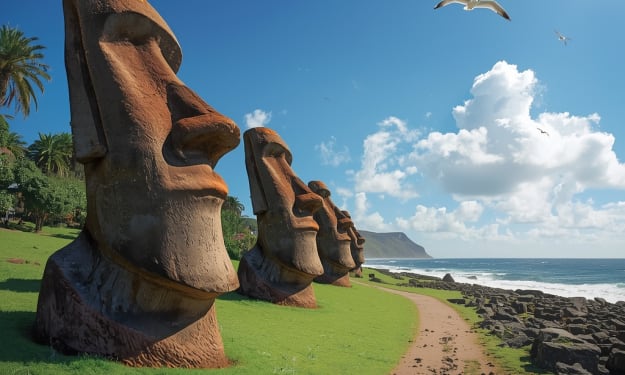
Easter Island: When Stone Giants Tell a Human Story
In the heart of the vast Pacific Ocean, far away from crowded cities and modern noise, lies one of the most mysterious places on Earth: Easter Island. Known locally as Rapa Nui, this remote island has fascinated people for generations. I remember the first time I read about it—I couldn’t help but wonder how such a small piece of land could carry so much history, mystery, and unanswered questions. What truly defines Easter Island are its silent stone giants, standing patiently as if guarding memories from a forgotten world.
By Binan Mooonabout 12 hours ago in History



Comments
There are no comments for this story
Be the first to respond and start the conversation.