
HISTORY OF FANS
Have you ever known about the evolution of this product you use today?
Inventions have contributed greatly to the world's development. Skilled individuals have created many of them, such as cars, phones, planes, fans, and more which have improved our lives. Fans, for example, have an unbelievable history that piques our curiosity. It will be detailed.
For millennia, fans have been used in most of the world’s developed societies. Throughout history, they have served a multitude of purposes such as cooling, winnowing, and fanning fires. Even ancient civilizations, like the Aztecs, recognized the value and beauty of these objects.
The evolution of the fan has come a long way from the time of the Egyptians and their servants waving palm leaves which became the first invention of it. The origin of hand fans can be traced as far back as 4,000 years ago in Egypt. They made slaves fan them with huge lotus leaves. They also caught on to the trick of fanning air across wet mats or water-filled vessels for evaporative cooling. The fan was seen as a sacred instrument and used in religious ceremonies and was also seen as a symbol of power royalty even in this early form, as evidenced by the two elaborate fans found in King Tut's tomb. One of the fans had a golden handle and was covered in ostrich feathers while the other was ebony overlaid with gold and precious stones. Other ancient peoples such as the Hebrews, Persians, Greeks, and Romans also used hand fans in various forms, as mentioned in Greek and Roman texts as well as the Bible. The Greeks and Romans preferred peacock feathers for fanning; Roman emperors added the cooling power of snow hauled down from the Alps. The Japanese invented folding fans in the 8th century, possibly inspired by how bats fold their wings. But the heyday of the handheld fan was China’s Ming Dynasty (1368 to 1644) when exquisitely painted fans were all the rage. Portuguese traders brought Asian fans to Europe in the 1400s. The Chinese were also pioneers in mechanizing the fan. About 180 AD, the famed Han dynasty inventor Ting Huan created a rotary fan employing seven wheels, each 10 feet in diameter, by which a single man could cool an entire hall. Later rotary fans were used not only for cooling but also for winnowing grain and ventilating mine shafts.
The development of fans in China and Japan was not long before these western cultures were exporting fans in large numbers to the West. During the 17th, 18th, and 19th centuries, its popularity in Europe as a fashion accessory and artistic expression is a testament to its unique beauty and versatility. From luxurious designs commissioned by famous artists to affordable printed versions for the masses, fans have portrayed a wide range of subjects and served as a form of entertainment and expression. The fans we use today are a reflection of the creativity and craftsmanship that have been passed down through generations. Alongside these fans, however, were to be found fans with cheap printed leaves that were intended to be ephemeral, and which portrayed subjects as diverse as political cartoons, seating plans of theatres or words and music of popular songs.
In 1734, the development from an ancient fan to an electric type of fan was created. John Theophilus Desaguliers ( 1683-1744) a British natural philosopher, clergyman, engineer, and freemason, invented a paddle fan and presented it to the Royal Society. The apparatus, like other similar ones invented in the eighteenth century, was intended to prevent the build-up of foul air or to circulate hot and cold air in hospitals, prisons, and public places. It is also used to ventilate mines. The air is sucked up by the moving paddles through a vertical duct leading to the wheel's center and then expelled through the side outlet. After a long period of time, the Roman idea of combining a fan with ice or snow resurfaced in the 19th century’s early attempts at air conditioning. In the 1830s in Apalachicola, Fla., John Gorrie (1803-1855) an American physician and scientist was known for iced cloths, which dropped the temperature of the dying president’s room 20 degrees while consuming 436 pounds of ice an hour.
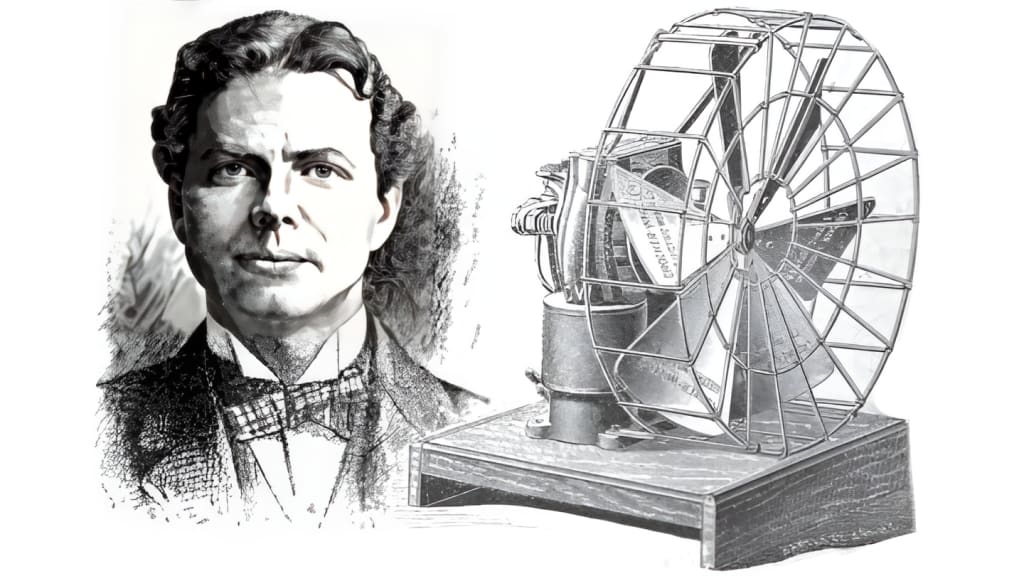
One year later in 1882, Schuyler Skaats Wheeler (1860-1923) an American electrical engineer and manufacturer was inspired by Nikola Tesla and Thomas Edison. After realizing the need for a fan, he went on to build the prototype of the first electrical fan . This prototype had no protecting case and had two propellers attached to the motor. It was known as the "buzz fan." After Tesla presented its induction motor, manufacturers across the world started using direct current. Schuyler worked as the plant manager at Curtis and Crocker Company. Later Crocker-Wheeler Company started manufacturing fans. Although these fans served the purpose of taking the help of in the infant science of electricity, they were very expensive and unsafe to use due to the lack of protective cage. His patent for his Electric Fire-engine System was filed on May 23, 1882. The United States Patent Office officially approved his invention on February 24, 1885. He also invented the desktop fan with two blades.
By the 1850s, people came up with the idea of using steam and water turbines to run the fan. And in 1886, a father-son duo, John & James Hunter built a water turbine-powered ceiling fan. In 1889 a Greman - American inventor Philip Diehl (1847-1913) patented the ceiling fan after he mounted fan blades on a sewing machine motor and fixed them on the ceiling and there, the world’s first ceiling fan came to life. While he went on to patent the design in the same year, the inventor of the electric fan continued to make improvements in the design. In his pursuit to combine two functionalities in one unit, he also designed a fan in which he fit a light kit with it. It is used to circulate air to cool and ventilate rooms and to control humidity. In 1894, German professor Hermann Immanuel Rietschel (1947-1914) published “Guide to Calculating and Design of Ventilation and Heating Installations”. In 1896, Fans with more than two blades were produced.
Technology was created to produce the first functioning oscillating fan. In 1902, Willis Carrier (1876-1950) an American engineer submitted his design for the first modern air-conditioning system, accomplishing a feat that was once thought to be impossible – control of the indoor environment. His invention would give rise to a world-leading heating, air-conditioning, and refrigeration, company and create an entire industry essential to global productivity and personal comfort. He created a primitive cooling system to reduce humidity around the printer. He used an industrial fan to blow air over steam coils filled with cold water; the excess humidity would then condense on the coils and produce cooled air. Not only did it solve the problem, but (the cool air) started to make people comfortable.
Meanwhile, however, Carrier (1876-1950) was perfecting the invention that would leave Wheeler’s humble electric fan in the dust of history. Inspiration struck Carrier while he waited for a train on a cold, foggy night; by the time his train arrived, he’d grasped the interrelationship of temperature, humidity, and dew point. Carrier built his first air conditioner in July 1902—not to cool people, but to keep paper cool and dry at the Sackett-Wilhelms printing plant in Brooklyn. Later in 1904, The oscillating fan debuts when Diehl and Co. put a split-ball joint on the ceiling fan allowing it to be redirected. As head of his own company, Diehl added a light fixture to the ceiling fan. Three years later, this idea developed into the first oscillating fan. Then in 1910, Westinghouse marketed an electric fan for household use claiming that electricity usage would cost one-fourth of a penny per hour. Soon Carrier’s invention was cooling movie theaters, department stores, and even, by 1929, the US Congress. Along with the elevator, air conditioning made modern skyscrapers practical. You could even say that air conditioning transformed the nation, cooling the sweltering Sunbelt so hordes of Americans could be tempted to move there.
In parts of the desert Southwest, however, a simple variant on Schuyler Skaats Wheeler’s electric fan continues to cool much of the population: The “swamp cooler,” or evaporative cooler, developed in the 1930s, blows air through water-dampened pads—much as the ancient Egyptians did. As the water evaporates, it absorbs heat and cools the room, making unnecessary the air-conditioning gizmos Southwesterners refer to as “refrigerated air”. Early in 1930, a young woman named Jane Evans came to St. Louis to do some interior design work. She was introduced to the President of Emerson Electric. She proposed a radical stylish design. In 1932 Emerson introduced on a yacht propeller design with a cage.The design was a major success and probably helped Emerson survive the Depression. More and more aluminum was used for blades and designs varied greatly. Many colors were offered including Ivory, Forest Green, Dark Brown, Chrome, Nickel, Motors received their last important change. Then Emerson introduced the capacitor start motor. These started faster , ran quieter, and were much more efficient. Motors were now as small as 4” in diameter and could propel a 16” blade made of aluminum. Cast aluminum blades appeared, using the latest aeronautical designs. After that, Self-contained window fans, made of plastic instead of metal, were introduced in 1934 by Vent-Axia, a British company. In 1937, the development of a new plastic laminate for coating fan blades, Micarta, made fans quieter and less likely to warp or corrode. In the 1940’s , fan makers used their capacity to help with the war effort. Few if any electric fans were made for the market. There were no design changes. Production restarted after the war ended, with the same designs as pre-war. By 1950, air conditioning was becoming available for homes. A few makers offered fans for homes with wooden cases, to blend with the televisions. The introduction of residential refrigerated air was the onset of decline for the table fan. During the decade of the 1950’s, not much changed in fans. Cost cutting took over design as a selling point. Cheaper fans were made. Some used nylon for gears, versus brass or steel. Colors introduced were Grey, Aqua, and Turquoise, as well as wrinkled finishes in paint. By the 1960’s, most makers began to phase out their fan lines. By the late 1960’s, the last of the good fans were being made.
Over the decades, fans have evolved beyond just cooling devices. They now embody art and beauty in home decoration. With various designs to choose from, they can be controlled remotely for maximum convenience.
About the Creator
Keep reading
More stories from writers in History and other communities.
Mestre Best: The Warrior Who Taught Restraint
In the mountain city of Valenor, there was a name spoken softly, almost with reverence—Mestre Best. No statues were built in his honor, no songs officially recorded his deeds, yet every fighter, scholar, and traveler knew the legend. Some said he was the greatest master of combat the world had ever seen. Others claimed he was a philosopher disguised as a warrior. The truth was more complex than either tale.
By The best writer 7 days ago in History
The Path to Salvation
The late autumn evening air filled the monk's lungs, but it wasn't the season that chilled his bones. The heavy-handed presence of evil he had sensed upon entering the woods surrounding this mountain village had not bothered to conceal itself from him.
By Made in DNA3 days ago in Fiction


Comments
There are no comments for this story
Be the first to respond and start the conversation.