
Guru Dattatreya
The Eternal Sage: Exploring the Life and Teachings of Guru Dattatreya

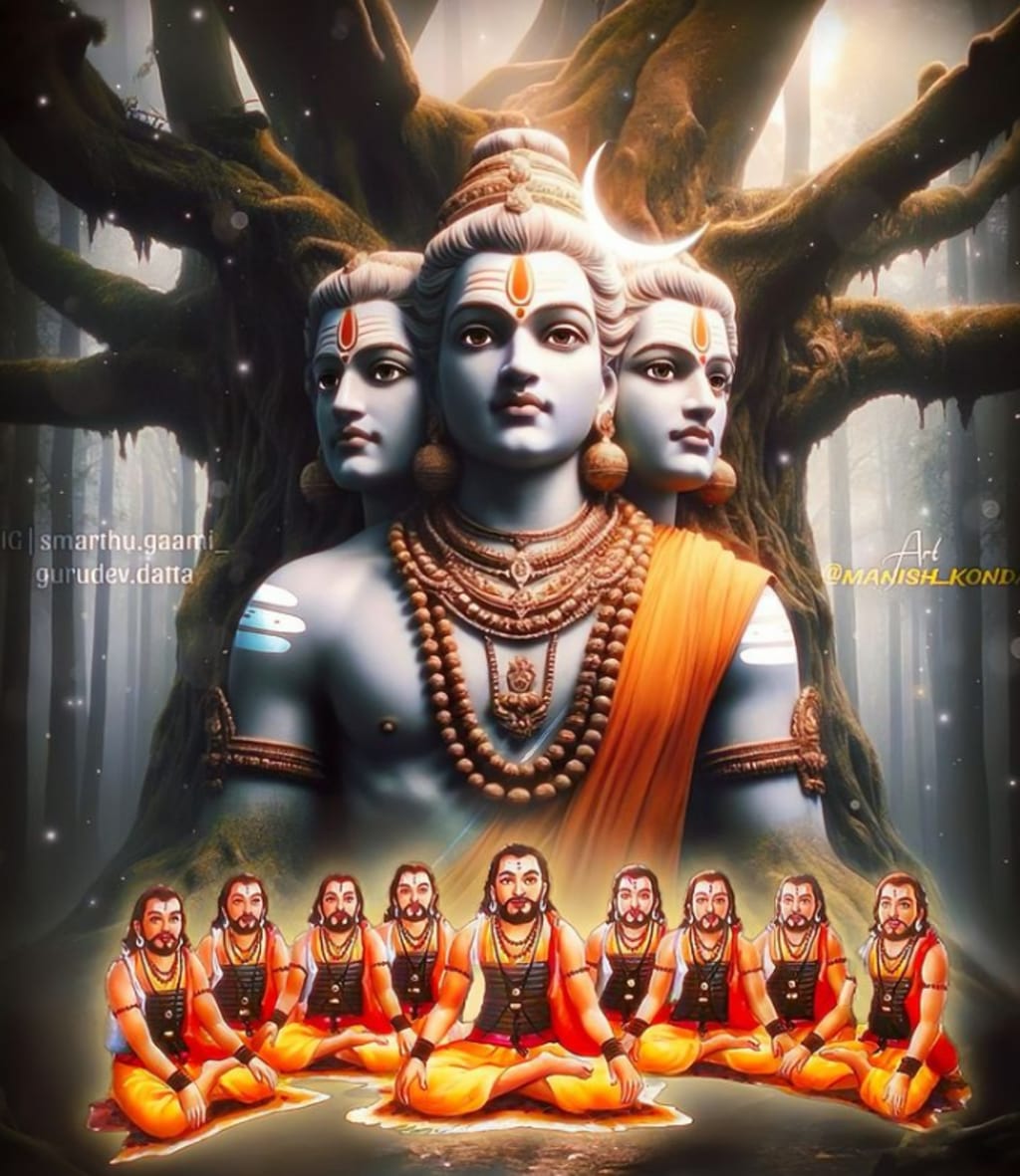
Guru Dattatreya is a revered figure in Hinduism, considered to be a divine sage and an incarnation of the Hindu trinity of Brahma, Vishnu, and Shiva. He is one of the oldest deities of the Hindu tradition and is also highly respected in Jainism and Buddhism. His followers see him as a great guru, yogi, and god of asceticism, wisdom, and compassion. Here’s a detailed exploration of Dattatreya’s life, mythology, symbolism, and the impact of his teachings.
Origins and Mythology
Birth and Parentage: Dattatreya is believed to have been born to the sage Atri and his wife, Anasuya. According to Hindu mythology, the three deities Brahma, Vishnu, and Shiva were pleased with Anasuya's chastity and devotion to her husband. To reward her, they granted her a son who embodied all three of their qualities. This son was Dattatreya, whose name translates to “Datta” (given) and “Atreya” (son of Atri). This birth story symbolises the unity of creation (Brahma), preservation (Vishnu), and destruction (Shiva), as Dattatreya embodies all three.
Dattatreya's Form: Dattatreya is traditionally depicted as a young sage with three heads and six arms, representing his combined powers. In each hand, he holds symbols associated with Brahma, Vishnu, and Shiva—such as a lotus, a water pot (kamandalu), a discus, a conch shell, a trident, and a mace. His three faces often portray different expressions: one with a peaceful smile, another in meditation, and the third displaying divine energy and power.
The Four Dogs and the Cow: In many depictions, Dattatreya is shown accompanied by four dogs and a cow. The dogs represent the four Vedas (Rigveda, Yajurveda, Samaveda, and Atharvaveda), symbolising his knowledge and mastery of ancient wisdom. The cow represents the earth, symbolising his nurturing and compassionate nature, and the sustenance he provides to all beings.
Wandering Sage: Dattatreya is often portrayed as a wandering ascetic or an Avadhuta, a sage who has transcended all material attachments and social norms. His wanderings reflect his detachment from worldly desires and his deep connection to the spiritual essence of existence. Dattatreya’s ascetic lifestyle has made him an inspiration for renunciants and yogis across many traditions.
Symbolism and Philosophy
The Tridev and Non-Duality: Dattatreya's embodiment of Brahma, Vishnu, and Shiva represents the concept of Advaita (non-duality). He exemplifies the idea that creation, preservation, and destruction are not separate forces but are interconnected aspects of the same divine reality. His form symbolises the unity of the cosmic functions and reflects the understanding that all things are ultimately one.
Detachment and Asceticism: Dattatreya is often associated with the path of renunciation, detachment, and self-realisation. He wandered freely, unbound by social conventions, embodying the ideal of a true yogi. His lifestyle teaches that liberation comes not through attachment to worldly things but by renouncing desires and experiencing the oneness of all creation.
Guru of Nature: Dattatreya is unique among Hindu sages in that he claimed to have 24 teachers, which included elements of nature such as rivers, mountains, animals, and even natural events. He saw each of these as embodying spiritual lessons, showing that the path of enlightenment can be learned from observing and understanding the natural world. This perspective emphasises humility, gratitude, and the realisation that wisdom can be found in the simplest elements of life.
Spiritual Liberation and Self-Knowledge: Dattatreya's teachings often focus on the concept of self-knowledge and the realisation of one's true nature. He taught that understanding one’s inner self is the key to liberation, as it allows one to see beyond illusions and recognize the divine within. This is in line with the philosophy of Advaita Vedanta, where realising the unity of Atman (the individual self) and Brahman (the ultimate reality) is the highest goal.
Teachings and Influence
The Avadhuta Gita: The Avadhuta Gita, attributed to Dattatreya, is one of the most significant texts associated with him. This philosophical work discusses the nature of the self and emphasises non-dualism (Advaita). It contains teachings on the illusory nature of the material world and urges seekers to focus on spiritual liberation rather than worldly pursuits. The Avadhuta Gita is known for its simplicity and depth, making it a profound text for those on the path of self-realisation.
Dattatreya and the Nath Tradition: Dattatreya is highly respected in the Nath Sampradaya, a Hindu yogic tradition that traces its origins to him. He is regarded as the Adi-Guru (first teacher) of the Nath tradition, which emphasises Hatha yoga, meditation, and spiritual discipline. The Nath tradition produced many revered saints, including Matsyendranath and Gorakhnath, who propagated the teachings of Dattatreya and contributed to the spread of yogic practices across India.
24 Teachers: Dattatreya’s story of learning from 24 teachers, including elements of nature and animals, is one of the most well-known aspects of his life. His teachers included the earth, water, fire, air, the moon, the sun, a pigeon, a bee, and a serpent, among others. He observed each of these and extracted a lesson that contributed to his spiritual understanding. For example, he learned patience and forgiveness from the earth, detachment from the pigeon, and humility from the bee. This approach teaches that wisdom is not limited to scriptures and gurus; it can be found in all aspects of life.
Non-Attachment and Freedom: Dattatreya’s life and teachings emphasise the importance of non-attachment. He believed that true freedom comes when one transcends attachment to worldly possessions, relationships, and even the ego. His teachings encourage people to live with detachment, experiencing joy and sorrow without being swayed by either. He believed that such a state of equanimity is essential for attaining liberation.
Equality and Universality: Dattatreya’s teachings promote the idea that spiritual truths are universal and not confined to any particular tradition or caste. His association with diverse elements of nature and his openness to learning from various sources reflect his view that divinity pervades all creation. This inclusive perspective resonates with many spiritual seekers and highlights the oneness underlying all diversity.
Dattatreya’s Legacy and Devotion
Worship and Temples: Dattatreya is worshipped in various parts of India, especially in Maharashtra, Gujarat, Karnataka, and Andhra Pradesh. There are many temples dedicated to him, where devotees seek his blessings for wisdom, spiritual growth, and protection. The annual Dattatreya Jayanti, celebrated on the full moon day of the month of Margashirsha (December), is an important festival for his followers, marked by special rituals and prayers.
Dattatreya in Maharashtra and the Datta Sampradaya: The Dattatreya tradition has a strong presence in Maharashtra through the Datta Sampradaya. This lineage produced revered saints like Swami Samarth of Akkalkot and Shirdi Sai Baba, who are believed to be incarnations or spiritual successors of Dattatreya. These saints are venerated for their miracles, compassion, and teachings that align with Dattatreya’s philosophy of simplicity and self-realisation.
Influence on Other Traditions: Dattatreya’s influence extends beyond Hinduism, impacting Jainism and Buddhism as well. His teachings on non-dualism and self-knowledge are echoed in Jain spiritual practices and Buddhist philosophies. His legacy endures through various yogic traditions and movements, inspiring countless seekers across different cultural and religious backgrounds.
Modern Interpretations: In contemporary spirituality, Dattatreya is often seen as a symbol of universal wisdom and inner freedom. His life encourages seekers to look beyond the boundaries of organised religion and recognize the divine presence in all aspects of life. His approach of learning from nature and living in harmony with the environment aligns with modern ecological movements, reinforcing the idea of interconnectedness and respect for all forms of life.
About the Creator
DINESH KUMAR SHARMA
i am a writer and a investor
Keep reading
More stories from DINESH KUMAR SHARMA and writers in History and other communities.
Maitri Upanishad
The Maitri Upanishad, also known as the Maitrayaniya Upanishad, is a significant philosophical text that belongs to the Krishna Yajurveda. As part of the broader Upanishadic literature, it explores the profound nature of reality, the self (Atman), and the ultimate goal of human existence—liberation (Moksha). Composed around 500-400 BCE, during a period of rich philosophical inquiry in ancient India, this Upanishad offers insights into meditation, ethics, and the interconnection between all beings. Its teachings remain relevant today, providing guidance for those on the spiritual path.
By DINESH KUMAR SHARMAabout a year ago in Fiction
"Scream 7" (2026): Running out of Fresh Screams
This is the seventh time we’ve had a Ghostface crisis. Scream 7 is the latest edition of the Scream franchise. Sydney Prescott and her family are under attack by another anonymous killer dressed in a Ghostface costume. While having issues with her daughter, Tatum, they run from the bloody murders, trying to determine who is behind it all.
By Marielle Sabbag4 days ago in Horror



Comments
There are no comments for this story
Be the first to respond and start the conversation.