
Guns, Germs, and Steel” by Jared Diamond
“The Fates of Human Societies”


A story of collision, conquest, and consequences —
1. The Meeting of Two Worlds
The year was 1519.
On the sun-drenched coast of what the locals called Tenochtitlan, the wind carried a scent unfamiliar to native nostrils — salt, sweat, and something metallic. Canoes dotted the waters as Aztec fishermen returned with their catch, unaware that just beyond the horizon, history was changing course.
Farther out, massive wooden beasts with sails like wings glided toward the land. On their decks stood men pale as ivory, clad in metal that shimmered like mirrors under the sun. They were led by Hernán Cortés, a Spanish conquistador driven by gold, glory, and the grace of God.
Among his crew was Miguel, a humble scribe tasked with documenting their expedition. Unlike the others, Miguel wasn’t hungry for conquest. He was hungry for understanding — for why some societies rose while others fell.
2. The Stone City
The Spaniards were stunned by what they found. Tenochtitlan was not a savage village, as many believed, but a magnificent city of floating gardens, wide causeways, and towering temples — more advanced than anything Miguel had seen in Spain.
They were met by Emissary Tlaca, a high-ranking Aztec noble, who approached cautiously, bearing gifts of gold, jade, and cacao. “We welcome you as children of the gods,” he said through a Nahuatl interpreter.
Miguel watched as Cortés bowed slightly — but his eyes burned with calculation.
3. The Weapons of Fate
It didn’t take long for the balance to shift.
Though the Aztecs outnumbered the Spaniards a hundred to one, the invaders possessed three invisible weapons:
• Guns that spat thunder and tore men apart.
• Steel swords sharper and stronger than obsidian blades.
• Diseases their bodies carried unknowingly — smallpox, measles, influenza.
Within weeks, villages began to fall sick. Children developed fevers. Elders died within days. Priests called it a curse, a divine punishment.
Miguel wrote:
“They do not know the plague is not from our gods, but from our blood.”
He watched in silence as entire neighborhoods emptied into mass graves. He saw the horror in Tlaca’s eyes — not from bullets, but from something he could not touch or fight.
4. The Temptation of Gold
As the epidemic spread, so did Spanish ambition. Cortés used alliances with enemy tribes to weaken the Aztec empire from within. Gifts became demands. Diplomacy became deception.
One night, Miguel confronted Cortés: “Why must we destroy what we do not understand?”
Cortés replied coldly, “Because we were meant to rule it. Steel makes men equal, and gold makes them kings.”
Miguel turned away, writing furiously in his journal — documenting the slow erosion of a civilization that once thrived without gunpowder or greed.
5. Tlaca’s Last Stand
Emissary Tlaca, once a voice of reason, watched his people perish not just from disease, but from betrayal. His brother died of fever. His sister was taken as a concubine. Temples were looted; idols shattered.
When he heard that Cortés planned to seize the emperor Montezuma, Tlaca gathered what few healthy warriors remained.
They would not wait for fate to take them. They would resist.
With obsidian blades and bone-tipped arrows, Tlaca’s men ambushed a Spanish patrol. They fought bravely — but steel cut deeper than stone. Muskets shattered their ranks. When Tlaca fell, Miguel knelt beside him.
Through bloodied lips, Tlaca whispered, “We thought you were gods. But you were only men… carrying death.”
6. Aftermath
Within two years, Tenochtitlan lay in ruins.
Temples became churches. Nahuatl was silenced by Spanish tongues. Miguel’s journal swelled with sorrow, not pride. He had set out to record a conquest and instead chronicled a tragedy.
He began to ask the deeper question: Why did one society collapse, while the other expanded?
He wrote:
“Not because of divine will, nor superior minds —
But because they brought guns to silence warriors,
Germs to weaken the innocent,
And steel to build over bones.”
He buried the journal in a sealed box beneath the rubble of what was once a schoolhouse. He hoped that one day, someone would read it — not to praise conquest, but to learn from its consequences.
7. Echoes of the Past
Centuries later, in 2024, a group of archaeologists excavated the ruins of old Tenochtitlan. Among shards of pottery and rusted relics, they found Miguel’s journal, remarkably preserved.
Inside, they discovered not only facts but feelings — the testimony of a man torn between two worlds.
The journal was published under the title:
“Guns, Germs, and Steel: The Fates of Human Societies”
Though the author had long been forgotten by history, his words lived on — a reminder that the fall of one world was not the rise of another, but a wound still healing in the bones of the earth.
⸻
**~ The End ~**
About the Creator
Rafiul Jawad
I am blog writer
Keep reading
More stories from Rafiul Jawad and writers in History and other communities.
The Poor Man’s Richest Day
— A moment of fortune in a lifetime of struggle — 1. The Forgotten Corner In the dust-choked alleyways of a crowded town in Rajasthan, lived a man known only as Moti. His name, ironically, meant pearl, though his life was anything but precious. With a weathered turban, a frail frame, and eyes full of stories untold, Moti was invisible to the world. He slept on a straw mat under the shade of a neem tree near the market square, collecting odd scraps, plastic bottles, and discarded food just to get by.
By Rafiul Jawad8 months ago in Lifehack
The London Smog of 1952: The "Great Smog" that killed 12,000 people in four days of absolute, yellow darkness.
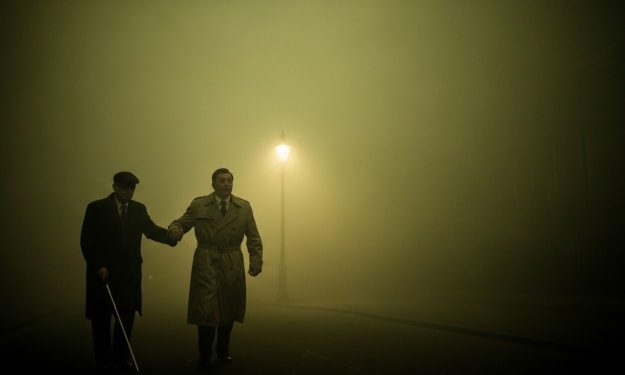
The taste of a copper penny coated in rotten egg yolk. That was the first warning. It was Friday, December 5, 1952. A blind man led a sighted businessman across Euston Road, tapping his white cane against the invisible curb. The businessman couldn't see his own shoes. The air had turned into a thick, yellowish-green soup that smelled of burning hair and raw sulfur. It was not a fog. It was an executioner. Over the next four days, twelve thousand Londoners would choke to death in their own beds, murdered by the very fireplaces they lit to keep warm.
By The Chaos Cabinetabout 8 hours ago in History
The Politics of Playing Dress-Up
Well, to start off I'd like to say a happy world book day to all who celebrate. I know I haven't really posted anything on my socials about it but I'm not a jubilant kind of person. I lay low most of the time. Let's start off with a popular anecdote from the vaults...
By Annie Kapur6 days ago in Geeks



Comments
There are no comments for this story
Be the first to respond and start the conversation.