
"Guardians of Eternity: Unveiling the Mysteries of the Terracotta Army"
The First Emperor and His Legacy

What Are the Terracotta Warriors?
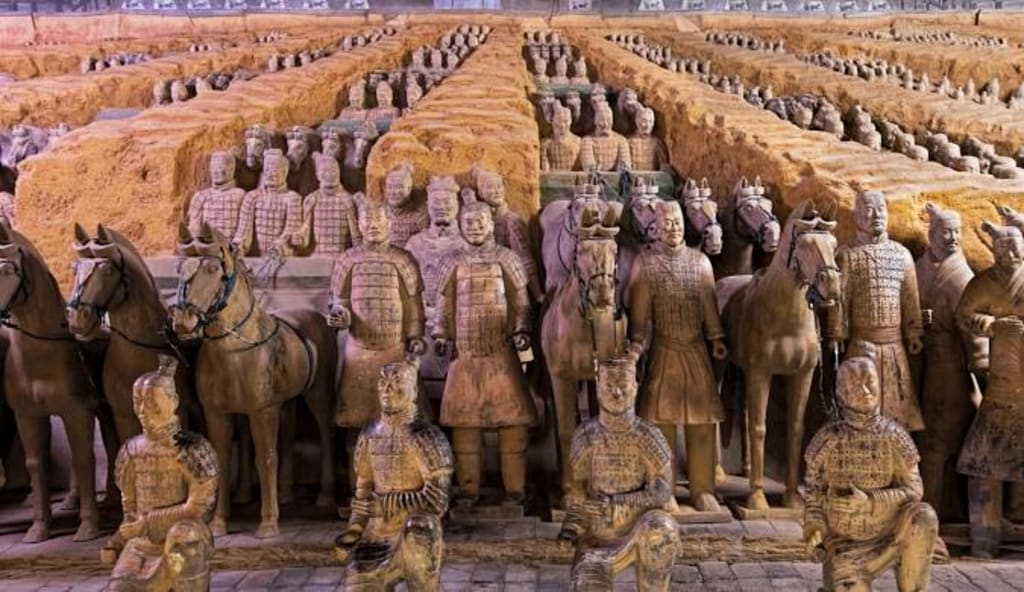
The Terracotta Warriors, or Terracotta Army, were built as part of a huge burial tomb for the first emperor of China, Emperor Qin Shi Huang. The army of Terracotta Warriors included over 8,000 life-size statues of soldiers that would accompany the general in the afterlife.
This life-sized Chinese clay army was created to protect Qin Shi Huang in the afterlife, and were found positioned facing east. There are several theories as to why this might be. One posits that the Emperor's primary adversaries in life came from the east, so the Terracotta Warriors were placed to face this direction in preparation for attack.
Another theory suggests that the positioning points to the Emperor's desire to unify states to the east, which is why the army faced this direction. But it may be as simple as the fact that, in Chinese mythology, the East was a paradisal place, and one where the afterlife could be found. It was a sacred direction, and its associations with sunrise meant it was often considered a place of new beginnings.
Who Was Emperor Qin Shi Huang?
Emperor Qin Shi Huang was the first emperor of China. He came to power in 241 B.C.E. and became the first ruler of a unified China. For much of his life, the Emperor had been searching for the 'elixir of life' and wanted to gain immortality.
Because of this, he had been collecting resources to build a huge tomb, which he would fill with an army of warriors to protect him in the afterlife. He eventually died in 210 B.C.E. and was buried in his tomb alongside his army of Terracotta Warriors.
The Terracotta Warriors
Each of the soldiers in the Terracotta Army were made to be life-size replicas of the Emperors' warriors. The soldiers have an average height of around 5 feet 11 inches, but some of the larger warriors measure up to 6 feet 7 inches!
Despite their being over 8,000 statues in total, each individual warrior is completely unique, including a range of different ages, ranks, hairstyles, and features. They even have different facial expressions, with some looking calm and at rest while others look angry and aggressive.
The warriors were also dressed in different styles of clothing depending on their role. Foot soldiers, cavalry soldiers, and scouts were all dressed in different outfits to identify them. They also had a range of weapons too, including spears, crossbows, daggers, and swords!
When the Terracotta Warriors were first made, they were painted in vibrant colours to make them look even more realistic, but in the 200 years since, the paint has faded away. Take a moment to imagine how they might have looked when they were originally made and positioned in the tomb. They would be a fierce deterrent for any grave robbers, that's for sure!
How Were the Terracotta Warriors Built?
Each of the Terracotta Warriors was made out of clay in some form of an assembly line. It's believed that each part of the warriors' bodies would be built separately before being assembled afterwards. They used a total of eight different head moulds to create different looking statues, before adding unique facial features by hand.
The warriors were created in a similar way to how terracotta drainpipes were being made at the time. This meant that each piece would be formed and fired before becoming part of a larger statue. Each workshop would have to write their names on each piece that they finished.
Once each of the warriors was finished, they were placed into the pit, making sure that their positioning matched their rank and duty.
Terracotta Weapons, Horses and Chariots
Yes! To make sure the army would be strong enough to protect the Emperor in the afterlife, he was also provided with a number of other statues.
There were 150 cavalry horses buried in the tomb, as well as 130 chariots accompanied by 520 horses. There have also been statues of entertainers and government officials found in other areas of the Emperor's tomb.
When Were the Terracotta Warriors Discovered?
The Terracotta Warriors were only discovered in 1974, when a group of farmers were attempting to dig a well. During the process of digging the well, they came across pieces of a clay figure.
Once these initial discoveries were reported to the government, an excavation team was sent to uncover more of the tomb. These small pieces of terracotta eventually led to the discovery of the huge tomb nearby and all of the statues and artefacts within. Imagine what it would have been like to uncover this life-sized Chinese clay army!
Facts About the Terracotta Warriors For Kids
The Terracotta Army is one of the largest and most astonishing archaeological finds of the 20th Century.
The statues began to be constructed in 246 B.C.E. making them over 2,200 years old.
Over 700,000 workers took around 40 years to complete all of the statues in the tomb.
Many of the statues were broken when they were discovered, but archaeologists have been carefully piecing them together since.
The Terracotta Warriors are on display in a dedicated museum in Xi'an, China.
Terracotta is a type of wet clay that sets when exposed to heat, making it hard. It's commonly used to make pots, pipes, and tiles.
About the Creator
Jane Yamal
Exploring historical events and the captivating tales of different cultures fuels my curiosity and enriches my understanding of humanity.Each story reveals unique insights and connections that make our world fascinating and dynamic.
Keep reading
More stories from Jane Yamal and writers in History and other communities.
The Complete Story of India's Taj Mahal
The Taj Mahal is a breathtaking white-marble mausoleum commissioned by Mughul emperor Shah Jahan for his beloved wife, Mumtaz Mahal. Located on the southern bank of the Yamuna River near Agra, India, the Taj Mahal took 22 years to build and finally reached completion in 1653.
By Jane Yamal2 years ago in History
A Love Forboding
The chipped stone slope caused unbearable footing. I slid, skirting on my heels. I cast my shield, relinquishing my guard to stay upright. Left with my double-edge and a prayer to the maker, I skated toward my objective. The earthly stubble gave way to solid ground. I found myself restored, a trail of dust in my wake.
By James U. Rizzi5 days ago in Fiction



Comments
There are no comments for this story
Be the first to respond and start the conversation.