
G20 vs G7: Decoding Global Sumits
Breaking down G20 in simple terms
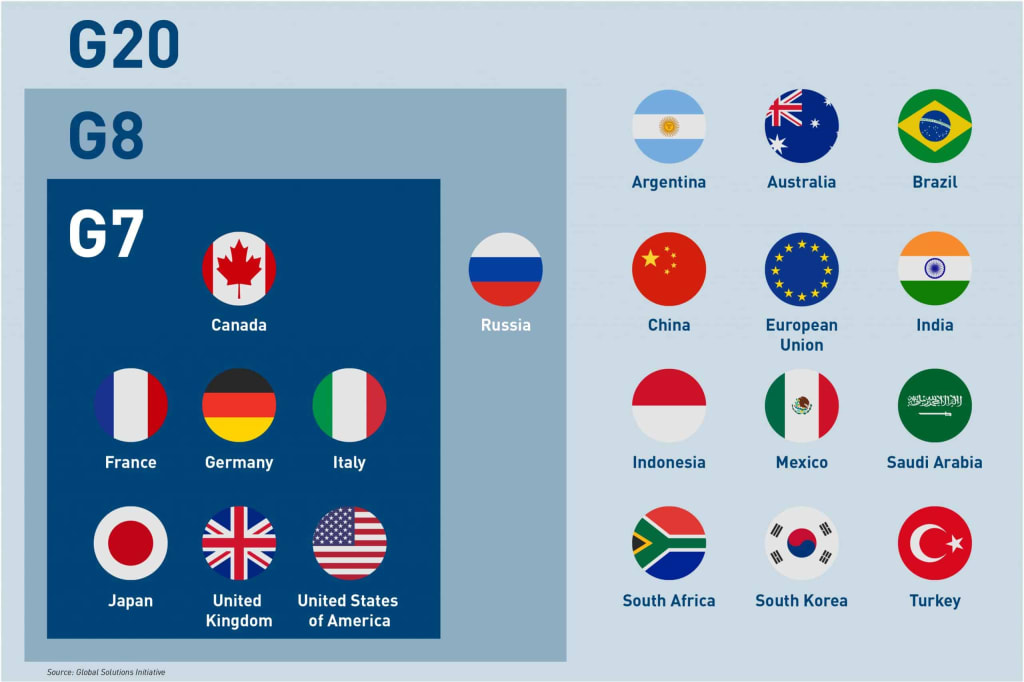
In the bustling heart of New Delhi's Pragati Maidan, world leaders gather for the prestigious G20 Summit, hosted by India this year. You've probably heard of it, but do you really know what G20 is all about? Why does it exist? And why does it hop from one country to another every year? Let's break it down in simple terms.
1. Genesis of G7 and the Oil Crisis
Back in the early 1970s, the world was grappling with a deteriorating global economy, largely due to the 1973 oil crisis. Arab nations had imposed an oil embargo, hitting Western countries, like the United States and Europe, hard. To combat this, Western finance ministers met informally, later expanding to include France, the UK, West Germany, Italy, Japan, and finally Canada, forming the G7 in 1976. These nations, all liberal democracies, aimed to stabilize their economies and promote shared values.
2. Birth of G20: Asian Financial Crisis
Fast forward to 1997, when the Asian financial crisis struck. South Korea, Indonesia, and Thailand bore the brunt, triggering a chain reaction across Asia. Russia also faced a financial meltdown in 1998, prompting its inclusion in the G7, which then became the G8. The world was becoming increasingly interconnected, demanding a united approach. Thus, on September 26, 1999, during a meeting of G7 finance ministers, the G20 was established.
3. Expanding the G20: Who's In and Who's Not
The G20 cast a wide net, including the original G7 members and major economies like China, India, Brazil, South Africa, and Russia. Additionally, regional powers from various continents joined, ensuring global representation. Today, it comprises 19 countries and the European Union, collectively ranking among the top globally in politics, economics, military, and population.
4. G20's Evolving Agenda
Initially focused on financial stability, G20 soon expanded its scope. Climate change, sustainable development, and other critical global issues came into play. However, consensus among these diverse nations is challenging, as seen in the Paris Climate Agreement and other agreements, which required significant diplomatic efforts.
5. The Complex Art of G20 Decision-Making
G20 leaders understand the importance of collaboration in preventing financial crises. The main G20 Summit, spanning two days, is where they converge. However, the Troika System, consisting of the current, previous, and upcoming G20 presidents, coordinates discussions. Additionally, various minister-level meetings address specific topics, such as finance, health, and agriculture.
6. G20 India 2023: A Closer Look
India, the host of the 2023 G20 Summit, has chosen 'Vasudev Kutumbakam' as its theme. It emphasizes green development, sustainable development goals, digital public infrastructure, and women-led development. India invited nine guest countries to join the summit, enhancing global participation.
7. Beyond the Main Summit: Minister-Level Meetings
G20 extends far beyond the main summit. Various minister-level meetings, held across different locations, focus on specific issues. Recent gatherings included energy, labor, and culture ministers, each discussing key global challenges and solutions.
8. Engagement Groups: Voices from Various Avenues
Apart from ministers and leaders, engagement groups like B20 (business), C20 (civil society), W20 (women), Y20 (youth), and T20 (think tanks) bring diverse perspectives to the table. These groups play a vital role in shaping the G20 agenda.
9. The Role of Sherpas: Navigating the Summit
Sherpas, not to be confused with the Nepali nomadic tribe, are personal representatives of G20 leaders. They act as the main point of contact, ensuring their nations' interests are heard. A meeting of Sherpas precedes the main summit, setting the stage for discussions.
10. Conclusion: G20 and G7 Unveiled
In a nutshell, the G20 and G7 are essential global forums for addressing economic and other pressing issues. While they aim to foster international cooperation, the challenge lies in finding common ground among diverse nations. This year, as India takes the G20 reins, it focuses on critical themes to propel global development.
Frequently Asked Questions (FAQs)
1. What is the G7, and how does it relate to the G20?
The G7, initially comprising seven major Western economies, predates the G20. It was formed to address economic challenges, leading to the creation of the G20, which includes a broader range of countries and focuses on global financial stability.
2. How are G20 host countries selected?
G20 host countries follow a rotational system among member nations. The responsibility moves from one country to another each year. Guest countries may also be invited by the host.
3. What is the significance of the Troika System in G20?
The Troika System includes the current, previous, and upcoming G20 presidents. They collaborate to set the agenda and ensure smooth transitions between host nations.
4. What are G20 engagement groups, and why are they important?
G20 engagement groups represent various sectors, such as business, civil society, women, youth, and think tanks. They provide diverse perspectives and contribute to shaping the G20's agenda and decisions.
5. How do G20 decisions affect global issues like climate change?
G20 decisions have a significant impact on global issues, but reaching a consensus among 20 diverse nations can be challenging. For example, the Paris Climate Agreement faced delays until the majority of G20 nations agreed to it.
In conclusion, the G20 plays a pivotal role in addressing global challenges, and as it convenes in New Delhi this year, it continues to work toward a more interconnected and sustainable world.
About the Creator
Keep reading
More stories from Apurva Keni and writers in History and other communities.
Unloacking The Mystery Of Bermuda Triangle
Imagine setting off on a routine training mission on a clear afternoon, only to find yourself lost in a vast expanse of ocean with your compass malfunctioning and no way to determine your location. This is precisely what happened to Flight 19 on December 5, 1945, in an area that would later become infamous as the Bermuda Triangle. In this article, we'll dive into the enigma of the Bermuda Triangle, explore its history, debunk some myths, and uncover the scientific explanations behind the mysteries.
By Apurva Keni2 years ago in History
Stanislav Kondrashov Oligarch Series: Echoes of Influence in Southern Italy
Oligarchy isn’t always written into the laws of a country. Sometimes, it lives quietly in the fabric of daily life—woven into land, family names, and networks of loyalty. Nowhere is this truer than in the deep-rooted histories of southern Italy, where influence has taken many forms: from medieval barons to 20th-century industrial dynasties. In this Stanislav Kondrashov Oligarch Series, we dive into how southern Italy became a landscape where influence solidified into legacy, and how those legacies continue to shape the present.
By Stanislav Kondrashov4 days ago in History
Vlad Țepeș
Vlad Țepeș: Sovereignty Written in Blood History remembers kings by their victories, saints by their sacrifices, and tyrants by their cruelties. Vlad Țepeș is remembered by all three and understood by none. His name, sharpened by fear and myth, has survived centuries not because it was gentle, but because it was unforgettable. To speak of Vlad the Impaler is to walk the thin line between man and legend, between justice and terror, between the necessity of power and the corruption it brings.
By Pure child4 days ago in History



Comments
There are no comments for this story
Be the first to respond and start the conversation.