
Frozen Defiance: How the Chukchi Crushed a Tsarist Army in 1740
In 1740, Russia sent 400 men into the Arctic to crush the Chukchi. Barely a hundred crawled back. The tundra and its warriors would not yield.

The Long Road Into the White Wasteland
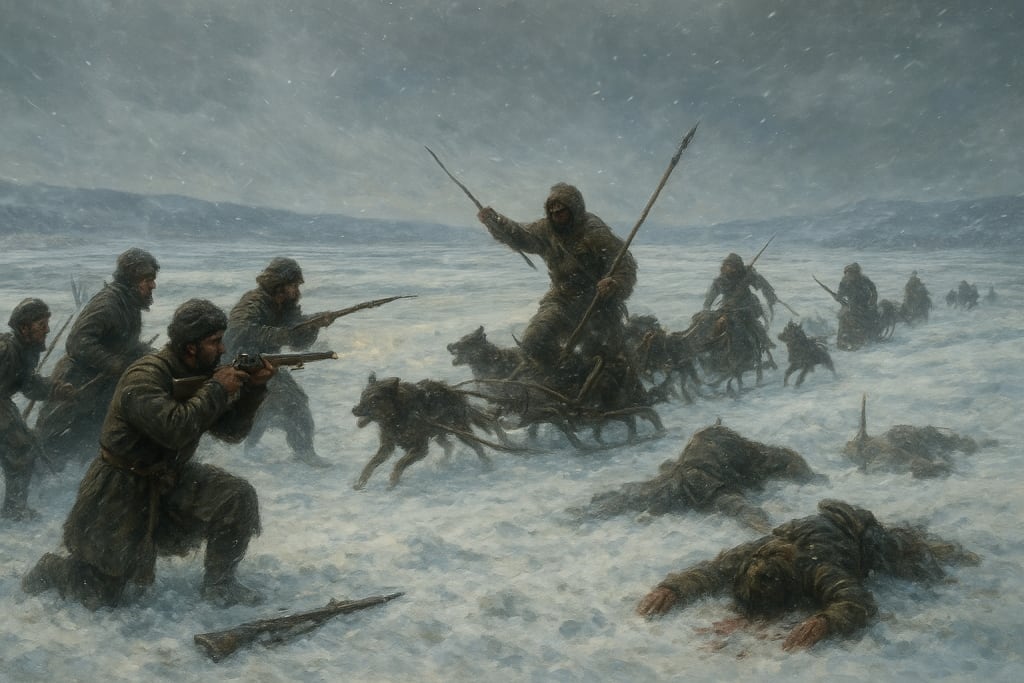
Under a sky the color of forged steel, the wind off the Bering Sea screamed like a living thing. Sled dogs, crusted with ice, panted in ragged bursts, their paws bleeding from weeks of frozen travel. Men’s breath turned instantly to frost; the cold chewed through reindeer hide and wool alike. Somewhere beyond the wall of snow, patient eyes watched—measuring, calculating.
Major Shestakov’s column had been on the move for over a month, pressing into the emptiest part of the world—a place where land met the sea in sheer ice cliffs, and the horizon dissolved into nothing. Behind them lay Anadyrsk, the last Russian outpost before the tundra. Ahead lay a people who had never bowed to any empire.
A People Who Would Not Yield
For decades, the Chukchi had resisted Russian expansion. Other Siberian peoples—Evenks, Koryaks, Yukaghirs—had been subdued in a handful of seasons, their tribute of sable and fox flowing into the Tsar’s coffers. But the Chukchi were different. Their homeland was too harsh to occupy, too vast to control. They moved constantly in yarangas—circular tents made of reindeer hide—following their herds across the tundra.
They were warriors and hunters in equal measure, masters of survival in a land where the unprepared froze within hours. Dog sleds gave them speed. Their bows and spears struck with deadly accuracy. They fought on their own terms—avoiding pitched battles, cutting supply lines, vanishing into snow before the enemy could answer.
Reports reaching St. Petersburg mixed frustration with dread. Some Chukchi warriors, when surrounded, had killed their own families rather than let them be taken. Imperial officials described them as “a people for whom defeat is worse than death.”
The Fatal March
In January 1740, the Tsarist court demanded a decisive blow. Four hundred men—Russians, Cossacks, and Siberian recruits—set out from Anadyrsk under Major Shestakov and Ataman Dmitry Pavlutsky. Their orders were brutal: burn settlements, kill warriors, seize herds, force submission.
But the expedition was crippled before it began. Gunpowder was poorly packed and quickly dampened. Sleds were overloaded. Boots were crude, clothes too thin, rations meager. In the Arctic, such flaws are death sentences.
For weeks they found only ghost villages—fires cold, yarangas deserted, fish racks empty. The Chukchi had moved their people and herds deep into the mountains. Yet they were never gone. Black figures skimmed the horizon on sleds, always out of range. At night, men swore they heard sled bells in the darkness; by morning, teams were missing, arrows stuck in the ice.
The Trap on the Velikaya
The decisive moment came on the frozen channel of the Velikaya River. Shestakov’s force formed musket lines, their first volleys driving the Chukchi back—or so it seemed. In truth, the Chukchi were circling wide, tightening their arcs with each pass, loosing arrows and spears, forcing the Russians to fire too soon.
The wind rose. Damp gunpowder clumped uselessly in the barrels. That was the signal. A wave of sleds surged forward, smashing into the Russian center. The fight collapsed into chaos—steel on bone, the wet crack of spears punching through fur and flesh, the stink of blood in the freezing air.
Shestakov fell early, speared clean through the chest. His death was more than the loss of command—it shattered the men’s will. The Chukchi lashed his body to a sled and drove it within sight of the survivors, a grim banner of triumph. Discipline broke. Men scattered, some plunging into cracks in the ice, others swallowed by snowdrifts that closed over them.
The Longest Retreat
The journey back to Anadyrsk was worse than the march out. Food was gone. The path was buried under new snow. Frostbite blackened hands and feet. Some froze upright, locked forever mid-step. Others simply sat down in the snow and did not rise again.
By the time the survivors staggered into Anadyrsk, barely a hundred of the original four hundred remained. They were gaunt, many unarmed, some missing fingers, ears, or noses to frostbite. The rest lay scattered across the tundra, buried by wind and time.
Aftermath and Legacy
The defeat at Velikaya was one of the most humiliating setbacks in Russia’s eastward push. It exposed the limits of imperial reach and the folly of fighting an enemy in its own land, on its own terms.
For years afterward, smaller raids and skirmishes continued, but the lesson of 1740 lingered. By the 1760s, the Russian government recognized the futility of endless war in Chukotka. In 1778, peace was formally agreed—not as a conquest, but as a compromise. The Chukchi retained their autonomy, paid tribute only when it suited them, and continued to roam the tundra as they always had.
Today, there is no monument on the frozen plain where Shestakov’s force was destroyed. Only the wind, the snow, and perhaps the mingled bones of men and animals lying together beneath the ice—a frozen testament to a war the land itself refused to let Russia win.
Sources:
1. William & Mary. (n.d.). Chukchi – Russia’s Periphery. [online] Dostupné z: https://russiasperiphery.pages.wm.edu/russias-north-siberia-and-the-steppe/general/chukchi/ [Cit. 15. 8. 2025].
2. Encyclopedia.com. (n.d.). Chukchi. [online] Dostupné z: https://www.encyclopedia.com/history/modern-europe/russian-soviet-and-cis-history/chukchi [Cit. 15. 8. 2025].
3. Petrov, G. (2020). Russia’s Bloody Struggle Against the Terrifying Chukchi Aboriginals. Russia Beyond. [online] 16. června 2020. Dostupné z: https://www.rbth.com/history/332331-russia-cossacks-chukchi-chukotka-war [Cit. 15. 8. 2025].
4. Topwar.ru. (2013). “Non-Peaceful Chukchi”: 250 Years Ago Russia Recognized the Senselessness of the Russian-Chukchi War. [online] 23. října 2013. Dostupné z: https://en.topwar.ru/34958-nemirnye-chyukchi-250-let-nazad-rossiya-priznala-bessmyslennost-russko-chukotskoy-voyny.html [Cit. 15. 8. 2025].
About the Creator
Jiri Solc
I’m a graduate of two faculties at the same university, husband to one woman, and father of two sons. I live a quiet life now, in contrast to a once thrilling past. I wrestle with my thoughts and inner demons. I’m bored—so I write.
The Fall of Croesus
The Fall of Croesus: Wealth, Pride, and the Wisdom of Time More than two and a half thousand years ago, in the ancient land of Lydia, there lived a king whose name became legendary throughout history. His name was Croesus, and he was known across the world as the richest man alive. Gold flowed through his kingdom like water. His palaces glittered with treasure, his vaults overflowed with coins, and traders from distant lands spoke of his wealth in awe. Even today, the phrase “rich as Croesus” is used to describe immense riches.
By The best writer a day ago in History
Bruce Lee and The God of War: Kuan Ti
It starts with love.. The Power to the God Of War and Wealth Walk into a Chinese restaurant (even in Oklahoma, USA), a Chinese police station, a kung fu martial arts studio or even a Chinese temple and you often see a red faced warrior holding a heavy quan-do (spear like weapon).
By WILD WAYNE : The Dragon King4 days ago in Chapters



Comments
There are no comments for this story
Be the first to respond and start the conversation.