
Forbidden Desires: A Secret History of Banned Sex Positions
Across centuries, from Rome’s marble chambers to Victorian parlors, forbidden love positions have defied laws, faith, and fear.

The night clung to the city like perfume — warm, heavy, and impossible to shake off. Beyond the villa walls, the streets of Rome lay quiet, but here in the private chambers of Lucius Cassius Varro, silence was an illusion.
An oil lamp flickered against the frescoed walls, casting shadows that danced like specters. The air was thick with the scent of jasmine oil, mingled with the faint salt of sweat. On the marble bed, its surface draped with fine linen, Lucius lay back, the cool stone beneath him a strange contrast to the heat on his skin.
Above him, Livia moved with deliberate slowness, her tunic slipping from one shoulder, her eyes locked on his. Outside, such a sight could ruin reputations. Inside, it was a rebellion of flesh against law. She leaned closer, her breath grazing his ear, and whispered something no senator would dare repeat aloud.
Rome’s Double Life
In public, Rome worshiped order, hierarchy, and masculine authority. In private, the city hummed with the sounds of pleasure in every possible form.
Poets like Ovid hinted at the realities behind closed doors — the thrill of reversal, the allure of a woman in command. Moralists like Juvenal thundered against these acts, warning that the empire’s moral decay began in the bedroom. Yet the very existence of his rants betrays a truth: someone, somewhere, was doing exactly what he feared.
The ruins of Pompeii preserve proof in paint and tile: mosaics of couples entwined in positions far beyond the missionary ideal, proudly displayed in taverns and bathhouses. To some Romans, these images were not obscene — they were art, celebration, even instruction.
From Empire to the Church’s Rule
When the Christian Church rose to power, the language of law gave way to the language of sin. The bedroom became a battlefield for the soul.
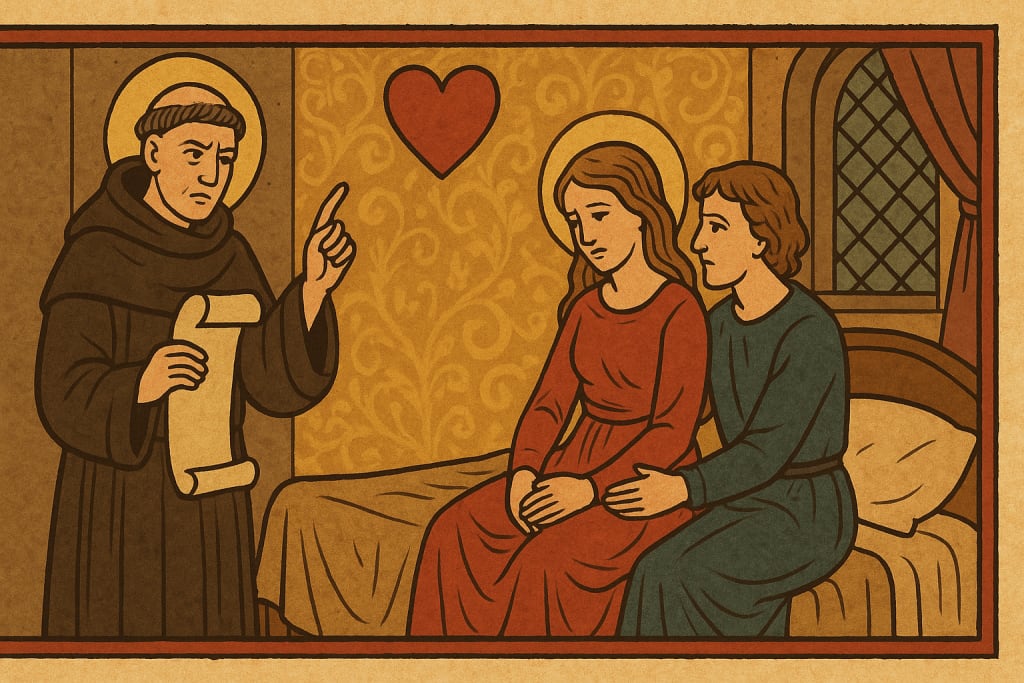
Medieval penitentials — dense handbooks for confessors — listed forbidden acts in unsettling detail: the woman on top, the man behind, anything prolonged beyond the strict purpose of procreation. These were “unnatural,” a word more about divine order than nature itself.
In some regions, confessors interrogated couples as if they were criminals. A wife’s admission that she took the lead could mean fasting for forty days or public penance. Yet the persistence of these prohibitions proves one thing: these pleasures did not vanish, no matter how loudly the pulpit thundered.
Whispers in the Renaissance
The Renaissance brought humanism, rediscovery of the classics — and a revival of carnal curiosity. Artists such as Agostino Carracci etched lovers in every imaginable embrace. Physicians cautiously noted that mutual satisfaction could strengthen marriage, though the Church clung to its procreative dogma.
In Florence, lovers passed small illustrated books hand-to-hand, often bound in the same covers as religious texts to hide their contents. A single engraving, glimpsed in candlelight, could be the spark for an entire night of experimentation.
The Victorian Curtain
Victorian England painted itself in lace and virtue, but its underbelly was as hungry as Rome’s. Medical treatises and travel literature smuggled in the sexual wisdom of India, Arabia, and China, often disguised as anthropology. Behind closed doors, couples explored in ways that would have shocked the drawing room, guided by books like The Perfumed Garden.
Even so, moral crusaders like William Acton warned against “perversions” that could lead to moral ruin — or worse, enjoyment without conception. The hypocrisy was as thick as the drapes drawn across the bedroom windows.
The Timeless Thrill of Breaking the Rules
From the moment humans drew lines, others have stepped over them. The forbidden has always tasted sweeter — not because it is better, but because it is dangerous. To break the rules in the bedroom is to reclaim something from the forces that would dictate the most intimate rhythms of life.
Back to the Lamp’s Glow
In that Roman villa, centuries before Victorian prudery, Livia’s shadow swayed across the frescoes. She moved like a queen enthroned, unafraid of heaven or Senate. Lucius knew the act was a sin against the order of things — and that knowledge made his pulse race all the more.
History would condemn them. Stone, scripture, and law would try to erase them. But in the warm, flickering dark, with the night pressing close and the lamp still burning, they were untouchable.
Sources:
2. Juvenal (trans. Kline, A.S.) (2001) The Satires: Satire VI – Don’t Marry. Poetry in Translation. Available at: https://www.poetryintranslation.com/PITBR/Latin/JuvenalSatires6.php (Accessed: 14 August 2025).
3. Brown University, Italian Studies – Virtual Humanities Lab (2011) ‘Sexual Positions’, Decameron Web. Available at: https://www.brown.edu/Departments/Italian_Studies/dweb/society/sex/sexual-positions.php (Accessed: 14 August 2025).
4. United Kingdom Parliament (1857) Obscene Publications Act (20 & 21 Vict. c.83). Statutes Project. Available at: https://statutes.org.uk/site/the-statutes/nineteenth-century/1857-20-21-victoria-c-83-obscene-publications-act/ (Accessed: 14 August 2025).
5. Acton, W. (1894 edn) The Functions and Disorders of the Reproductive Organs in Childhood, Youth, Adult Age, and Advanced Life: Considered in Their Physiological, Social, and Moral Relations. Philadelphia: P. Blakiston, Son & Co. Internet Archive. Available at: https://archive.org/details/101517431.nlm.nih.gov (Accessed: 14 August 2025).
6. Priest, R.J. (2001) ‘Missionary Positions: Christian, Modernist, Postmodernist’, Current Anthropology, 42(1), pp. 29–68. University of Chicago Press. Available at: https://www.journals.uchicago.edu/doi/10.1086/318433 (Accessed: 14 August 2025).
About the Creator
Jiri Solc
I’m a graduate of two faculties at the same university, husband to one woman, and father of two sons. I live a quiet life now, in contrast to a once thrilling past. I wrestle with my thoughts and inner demons. I’m bored—so I write.
Savoy Hotel – Mussoorie: The Colonial Luxury Hotel Where an Unsolved Murder Still Walks the Corridors
The First Night: Beauty Wrapped in Silence Mussoorie looks peaceful from a distance. Pine trees sway gently, clouds roll like slow-moving waves, and the hill air smells of rain and old earth. But as evening falls, the silence becomes heavier—almost watchful.
By Gaurav Gupta4 days ago in History
Is NATO Facing Its Biggest Crisis Yet?
Is NATO Facing Its Biggest Crisis Yet? For more than seventy years, NATO has been one of the strongest military alliances in the world. Formed after World War II, it was designed to protect its members through collective defense. An attack on one was considered an attack on all. For decades, this principle helped maintain stability in Europe and beyond. But today, NATO is facing one of the most challenging moments in its history.
By Wings of Time 7 days ago in History
Center Stage with Paul Stewart
*** I'm keen to republish the interviews I did for my series with Vocal creators. It's been a few years and I thought it might be nice to revisit these wonderful conversations. I'll be releasing them one at a time for a few weeks/months.
By Heather Hubler4 days ago in Interview



Comments
There are no comments for this story
Be the first to respond and start the conversation.