
From Tribes to Towers: The History of the United Arab Emirates
A Chronicle of Unity, Innovation, and Transformation in the Arabian Peninsula

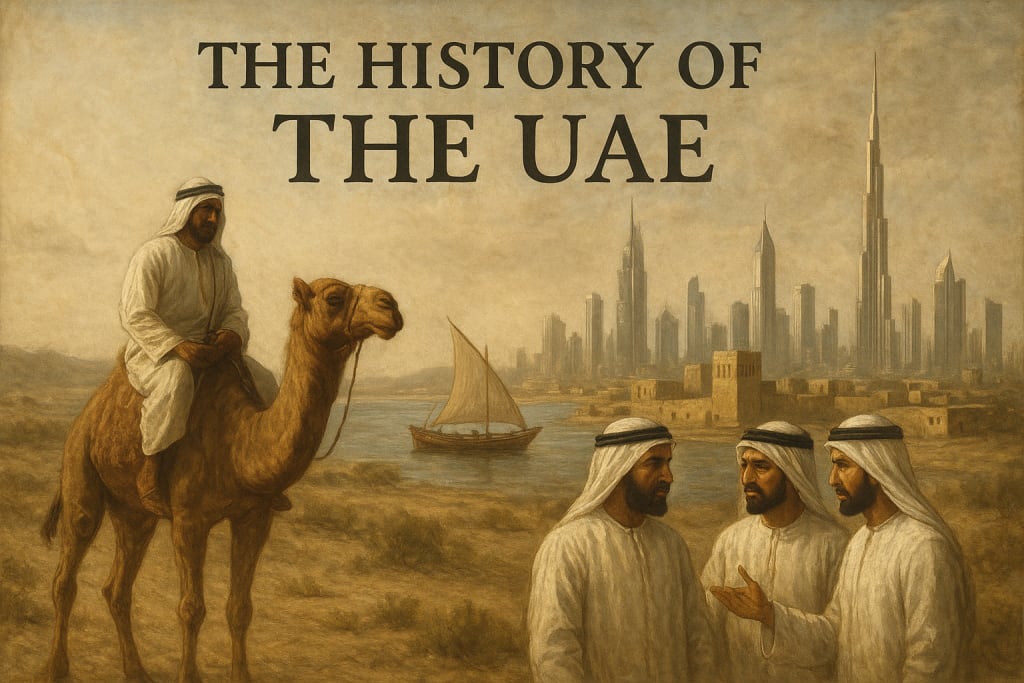
The United Arab Emirates (UAE) stands today as a beacon of modernity, innovation, and global influence. Yet beneath its glittering skyline and futuristic ambitions lies a rich and complex history shaped by tribal traditions, maritime trade, colonial encounters, and visionary leadership. The journey from scattered desert communities to a unified federation of seven emirates is one of resilience, transformation, and strategic foresight.
🏜️ Tribal Foundations and Early Settlements
Long before the UAE emerged as a nation-state, the region was inhabited by nomadic Bedouin tribes who roamed the arid deserts and coastal plains. These tribes, including the Bani Yas, Al Bu Falasah, and Al Qasimi, formed the backbone of early society. Their lives revolved around camel herding, date farming, and pearl diving—a once-thriving industry that connected the Gulf to markets as far as India and Europe.
The coastal towns of Abu Dhabi, Dubai, Sharjah, and Ras Al Khaimah became hubs of trade and culture. Despite harsh environmental conditions, these communities developed intricate social structures, oral traditions, and a deep connection to the land and sea.
⚓ Colonial Encounters and the Trucial States
By the 18th and 19th centuries, the strategic location of the Gulf attracted the attention of European powers, particularly the British Empire. Concerned about piracy and the safety of maritime trade routes, Britain signed a series of treaties with local rulers, leading to the formation of the “Trucial States.” These agreements offered protection in exchange for British oversight of foreign affairs.
While the British presence brought relative stability, it also limited the autonomy of the emirates. The region remained economically modest, relying heavily on pearling and small-scale trade. However, the collapse of the pearling industry in the 1930s—due to the rise of cultured pearls and the Great Depression—plunged many communities into hardship.
🛢️ The Oil Boom and Economic Awakening
Everything changed in the mid-20th century with the discovery of oil. Abu Dhabi struck oil in 1958, followed by Dubai in 1966. The newfound wealth transformed the region almost overnight. Roads, schools, hospitals, and infrastructure projects began to reshape the landscape. Traditional mud-brick homes gave way to modern buildings, and the economy diversified rapidly.
Oil revenues empowered local rulers to invest in education, healthcare, and urban development. Sheikh Zayed bin Sultan Al Nahyan of Abu Dhabi and Sheikh Rashid bin Saeed Al Maktoum of Dubai emerged as visionary leaders who saw beyond oil—a future built on unity and innovation.
🇦🇪 The Birth of a Nation: Federation in 1971
As Britain prepared to withdraw from its colonial commitments east of Suez, the Trucial States faced an uncertain future. In a historic move, seven emirates—Abu Dhabi, Dubai, Sharjah, Ajman, Umm Al Quwain, Fujairah, and later Ras Al Khaimah—came together to form the United Arab Emirates on December 2, 1971.
Sheikh Zayed became the first president, championing a model of cooperation and shared prosperity. The UAE Constitution laid the foundation for a federal system that balanced local autonomy with national unity. This moment marked not just political independence, but the birth of a new identity.
🌆 From Desert to Global Powerhouse
In the decades that followed, the UAE embarked on a remarkable transformation. Dubai evolved into a global financial hub and tourism magnet, boasting landmarks like the Burj Khalifa and Palm Jumeirah. Abu Dhabi invested in culture and sustainability, launching initiatives like Masdar City and the Louvre Abu Dhabi.
The nation diversified its economy through aviation, logistics, renewable energy, and technology. It became a leader in space exploration, launching the Hope Probe to Mars in 2020. The UAE also played a key diplomatic role in the region, hosting global events like Expo 2020 and COP28.
🕌 Preserving Heritage Amid Progress
Despite rapid modernization, the UAE has remained deeply committed to preserving its cultural heritage. Traditional music, falconry, poetry, and architecture are celebrated through festivals, museums, and educational programs. The balance between honoring the past and embracing the future is a defining feature of Emirati identity.
🌍 Conclusion: A Legacy of Vision and Unity
The history of the United Arab Emirates is a testament to what can be achieved through unity, vision, and adaptability. From tribal roots and colonial constraints to oil wealth and global influence, the UAE has carved a unique path in the modern world. Its story continues to inspire nations seeking to blend tradition with innovation, and resilience with ambition.
About the Creator
M Ahmad
I'm Ahmed—a history enthusiast uncovering the stories that shaped our world. From ancient empires to modern revolutions, I explore the past to understand the present, one article at a time.
Reader insights
Outstanding
Excellent work. Looking forward to reading more!
Top insights
Compelling and original writing
Creative use of language & vocab
Easy to read and follow
Well-structured & engaging content
Excellent storytelling
Original narrative & well developed characters
Expert insights and opinions
Arguments were carefully researched and presented
Eye opening
Niche topic & fresh perspectives
Heartfelt and relatable
The story invoked strong personal emotions
Masterful proofreading
Zero grammar & spelling mistakes
On-point and relevant
Writing reflected the title & theme
Gold-Guarding Griffins
Imagine standing at the foot of a vast mountain range, the air thin and cold, the peaks disappearing into cloud. Somewhere up there, according to the people who told this story for generations, something extraordinary waited. Not just gold.
By CurlsAndCommas5 days ago in History


Comments (1)
amazing