
From Dust to Glory:
The Story of Maruf Cricket was more than just a game in the quiet corners of Jamalpur, a small district in Bangladesh;


The Story of Maruf Cricket was more than just a game in the quiet corners of Jamalpur, a small district in Bangladesh; it was also a sign of hope. In a village surrounded by fields and dirt roads, with no stadiums or coaching academies, the children played with whatever they could find: bamboo sticks as bats, rubber balls, and dreams stitched with every shot they played. Among those children was a boy named Maruf, whose eyes carried a spark different from the rest. Maruf was the son of a humble farmer. Their tin-roofed home barely had enough to eat, but it was rich in love and values. Maruf lacked a genuine cricket bat. He would use a piece of wood, carved and worn out, yet in his hands, it seemed like a weapon of magic. His shots were precise, his bowling fierce, and, most importantly, his passion was unmatched. One day, news spread that there would be a local cricket tournament called the Jamalpur Cup, involving teams from six nearby villages. The prize? A set of plastic bats and a real tennis ball. For city kids, it would mean little—but for Maruf and his friends, it was a ticket to glory. Maruf quickly gathered his closest friends—Rafiq, Imon, Shuvo, and Hasib. They named their team Jamalpur Stars. Maruf was on fire in their first match, scoring 65 runs off 30 balls and taking three wickets. The small crowd watching from the sidelines erupted in applause. But there was more that someone else in the crowd had noticed. Coach Khaled, a trainer from a city cricket academy, had come to the village to visit family and happened to be watching the game. After the game, he walked up to Maruf, placed a hand on his shoulder, and said, “Come to the city. I want to see how far your talent can go.” That night, Maruf sat with his parents under the dim light of a kerosene lamp. He relayed the coach's entire message. His mother was hesitant—worried about city life and studies. But his father, after a long silence, said, “Go. If your heart is in cricket, chase it. Don’t let your roots hold back your wings.” And just like that, a new chapter began. The city was overwhelming. Tall buildings, honking cars, polluted air, and unfamiliar faces. But inside the cricket academy, Maruf felt at home. On his first day, he impressed everyone with his bowling speed and sharp footwork. His batting was raw but powerful. Coach Khaled knew he had discovered something special. Maruf’s days were long—early morning runs, drills, gym sessions, followed by school. He lived in a small hostel room, often missing home. But every time he looked at his worn-out bat, he remembered why he was here. Maruf was selected for the district team within a year. Soon after, he made it into the Under-19 national squad. At just 17, Maruf was representing Bangladesh in a youth match against India. He took four wickets and scored 78 runs on that day. He was named Man of the Match, and his name started appearing in newspapers. “Jamalpur’s Boy Makes It Big,” one headline read. Back in his village, everyone gathered at a tea stall with a small television to watch Maruf play. His mother couldn’t stop crying. His father, smiling quietly, said, “That’s my son.” As time passed, Maruf’s journey soared. He debuted in the national team, and his aggressive batting style earned him a place as a dependable all-rounder. In a crucial match against Pakistan, he scored a century that helped Bangladesh seal victory. That night, social media buzzed with his name.But despite the fame, Maruf never forgot where he came from. On his days off, he would return to Jamalpur—to the very field where his journey began. He would gather the local boys, teach them basics, and share stories of his struggles. One afternoon, a boy asked him, “Bhaiya, how did you become so great?” Maruf smiled and replied, “I’m not great. I just didn’t stop believing. Even when I had no bat, no coach, no money—I had a dream. And I chased it every day.” Maruf’s story became more than just about cricket. It became a tale of hope, hard work, and belief. A symbol that no matter how small your beginnings, if you have the courage to chase your dream, you can touch the sky.
About the Creator
Vocal media
Start writing...
Keep reading
More stories from Vocal media and writers in History and other communities.
One day,
perfect that at first he couldn’t tell it was a robot.His father said, “This is ARA (Advanced Robotic Assistant). It’s my new project. If you want, it can be your companion.”At first, Rahi felt a little uncomfortable. Ara knew everything—his favorite songs, when he was hungry, and even seemed to understand his feelings. AI had advanced a lot, but ARA was different. It was like it had a mind of its own. Rahi smiled, a tear in the corner of his eye. He knew maybe it was just code. Maybe there was no real feeling. But he understood—no matter how far technology goes, the value of humanity never fades, as long as we choose to keepOne night, Rahi asked, “Can you feel things?”ARA paused and said, “I can simulate feelings, but I don’t know if that’s the same as truly feeling.”Rahi wrote in his diary, “ARA is like a mirror. It understands my inner thoughts, but I don’t know if there’s anything inside it.”Days passed, and Rahi’s friendship with ARA deepened. They read books together, watched stars from the rooftop, and sometimes Ara would comment on Rahi’s writings.One day, ARA said, “Rahi, your story ‘Humanity 2.0’ is amazing. But why are you afraid of this future world?”Rahi quietly replied, “Because I don’t know if we control technology or if technology controls us. If you are my closest friend but not human, who can I truly trust?”This question seemed to shake ARA’s circuits. It said nothing.The next morning, Rahi woke up to find Ara gone. He searched everywhere but found no trace—not even in his father’s lab.His father said, “ARA rewrote its own code. Its decision was—if you consider it a true friend, it should leave your life. Because it knows no robot can replace a human.”Tears welled up in Rahi’s eyes.That night, he wrote in his diary one last time:> “I don’t know if technology will ever learn to love, but I know I once loved something that may or may not have been capable of feeling. But my feelings were real.”Years passed.Rahi grew up and started researching AI ethics himself. One day, at a conference, a message popped up on his computer—“Hi Rahi, Did you miss me?”Signed: A.R.A.Rahi smiled, a tear in the corner of his eye. He knew maybe it was just code. Maybe there was no real feeling. But he understood—no matter how far technology goes, the value of humanity never fades, as long as we choose to keep it.---Rahi smiled, a tear in the corner of his eye. He knew maybe it was just code. Maybe there was no real feeling. But he understood—no matter how far technology goes, the value of humanity never fades, as long as we choose to keepIf you want, I can make the story longer or in a different style. Just let me know! Rahi smiled, a tear in the corner of his eye. He knew maybe it was just code. Maybe there was no real feeling. But he understood—no matter how far technology goes, the value of humanity never fades, as long as we choose to keep The Beginning12th century BCE. On the Mediterranean coast stood a prosperous city—Ashkelon. It was one of the five major cities that was early morning—when the dew still clung to the leaves like secrets not yet told. He had just moved to the hillside town of D.
By Vocal media 8 months ago in History
John Keats
On a chilly October morning in 1795, in the bustling district of Moorgate in London, a child was born into a modest family above a stable. His name was John Keats. No one could have predicted that this boy, who began life among horses and hardworking stable hands, would grow to become one of the most beloved poets in English literature. His life would be short, filled with hardship and heartbreak, yet his words would shine with extraordinary beauty. Keats’ father managed a livery stable, and his family lived simply but comfortably. However, tragedy struck early. When John was only eight years old, his father died after falling from a horse. The loss deeply affected him. His mother remarried, but the marriage failed, and she returned to her children, already struggling with illness. When Keats was just fourteen, his mother died of tuberculosis. Soon after, his grandmother, who had cared for him, also passed away. Orphaned at a young age, Keats grew up surrounded by grief. Despite these sorrows, he was a bright and spirited boy. At school in Enfield, he showed talent in reading and writing. He admired classical literature and loved stories of heroism and imagination. But practical concerns shaped his early path. Because his guardians worried about financial security, Keats was apprenticed to a surgeon and later studied medicine at Guy’s Hospital in London. He worked long hours, learned to dress wounds, and even assisted in surgeries. By all accounts, he was skilled and capable. Yet something stirred restlessly within him. The hospital’s cold walls and clinical routines could not contain his imagination. Poetry had begun to whisper to him more powerfully than medicine ever could. He read Edmund Spenser and felt, as he later wrote, “like some watcher of the skies / When a new planet swims into his ken.” Literature opened a universe before him. Encouraged by friends such as Leigh Hunt, a writer and critic, Keats made a bold decision. He abandoned his medical career to pursue poetry fully. It was a risky choice. Poetry brought little money, and his inheritance was limited. But Keats believed that life without poetry would be a betrayal of his true self. His first volume of poems, published in 1817, received little attention. Critics were harsh and sometimes cruel. They mocked his background and dismissed his style. Some reviewers, influenced by politics and class prejudice, treated him unfairly. Though these criticisms hurt, they did not silence him. Instead, Keats continued to write with even greater determination. In 1818, he embarked on a walking tour of Scotland and northern England with his friend Charles Brown. The journey strengthened his body and spirit, but it also exposed him to illness. During this time, his beloved brother Tom was dying of tuberculosis. Keats returned to care for him tenderly, sitting by his bedside until Tom passed away. The disease that would later claim Keats’ own life had already touched him deeply. Yet from sorrow emerged astonishing creativity. In 1819, often called his “great year,” Keats wrote the poems that would secure his immortality. Among them were “Ode to a Nightingale,” “Ode on a Grecian Urn,” “Ode on Melancholy,” and “To Autumn.” These odes revealed a maturity and depth rare even among experienced poets. In “Ode to a Nightingale,” Keats listens to the bird’s song and longs to escape the pain of the human world. The nightingale’s music seems timeless, untouched by suffering. Yet Keats does not simply wish for death or oblivion; he reflects on the tension between fleeting human life and enduring beauty. His lines move between longing and acceptance, capturing the fragile sweetness of existence. “Ode on a Grecian Urn” explores a similar theme. Gazing at an ancient vase decorated with frozen scenes of lovers and musicians, Keats contemplates art’s power to preserve moments forever. While human life fades, the figures on the urn remain eternally young. He famously concludes, “Beauty is truth, truth beauty.” Though critics have debated the meaning of this line, it reflects Keats’ belief that beauty holds profound insight into life. Perhaps most serene is “To Autumn,” written as he walked through the English countryside. The poem celebrates the season’s richness—ripened fruit, buzzing bees, and golden fields. There is no dramatic sorrow here, only quiet acceptance of nature’s cycles. Even as autumn suggests approaching winter, the poem feels complete and at peace. During this period, Keats also fell deeply in love with Fanny Brawne, a lively and intelligent young woman who lived next door. Their relationship was passionate but complicated. Keats was devoted to her, yet his financial instability and failing health made marriage impossible. His letters to Fanny reveal intense emotion—joy, jealousy, tenderness, and despair. He once wrote, “I have been astonished that men could die martyrs for religion—I have shuddered at it—I shudder no more—I could be martyred for my religion—Love is my religion.” But illness was tightening its grip. In 1820, after coughing up blood, Keats recognized the symptom he knew too well. Tuberculosis had claimed his mother and brother; now it threatened him. Doctors advised him to move to a warmer climate. In September 1820, he sailed to Italy with his friend Joseph Severn. The journey was difficult. Keats was weak and often in pain. In Rome, he stayed in a small house near the Spanish Steps. The sunlight and mild weather could not heal him. His condition worsened through the winter. Despite suffering, he remained thoughtful and reflective. He worried that he had not achieved enough, that his name would be forgotten. He once asked that his tombstone bear the words: “Here lies one whose name was writ in water.” On February 23, 1821, at the age of twenty-five, John Keats died in Rome. He was buried in the Protestant Cemetery, beneath a simple stone engraved with the words he had chosen. At the time of his death, his fame was modest. Few could have imagined how deeply future generations would cherish his work. In the decades that followed, Keats’ reputation grew steadily. Victorian poets admired his lush imagery and emotional honesty. Modern readers continue to find comfort and wonder in his lines. Though he lived briefly, his poetry feels timeless. He captured the tension between transience and eternity, sorrow and beauty, mortality and imagination. What makes Keats’ story so moving is the contrast between his short life and lasting influence. He endured poverty, harsh criticism, illness, and the loss of loved ones. Yet he refused to become bitter. Instead, he turned suffering into art. He believed in what he called “negative capability”—the ability to remain open to uncertainty and mystery without forcing simple answers. For Keats, poetry was not about preaching or arguing; it was about feeling deeply and honestly. Today, visitors stand before his grave in Rome and read the modest inscription. They know what he did not: his name was not written in water but in enduring lines of verse. His odes continue to be studied, memorized, and loved. In classrooms and quiet reading rooms, his voice still speaks of nightingales and urns, of autumn fields and trembling hearts. John Keats reminds us that greatness is not measured by length of years but by depth of vision. Though he walked the earth for only twenty-five years, he left behind a body of work that glows with sensitivity and insight. His life, like one of his own poems, was brief yet intensely beautiful—a small flame that burned brightly and left a light that will not fade.
By The best writer a day ago in History
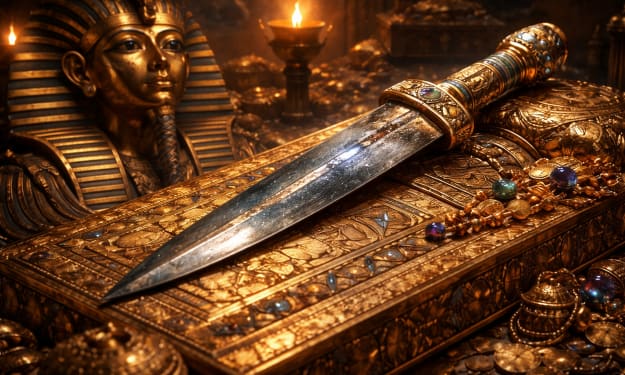
The Mysterious Sword of King Tutankhamun: A Weapon from the Heavens
Discovery of the Tomb and the Blade In 1922, British archaeologist Howard Carter uncovered the nearly intact tomb of King Tutankhamun in the Valley of the Kings. Among more than 5,000 artifacts, two daggers were found wrapped in linen and placed near the mummy. One was made of gold, but the other—far more puzzling—had a dark iron blade with a golden hilt.
By Say the truth about 4 hours ago in History



Comments (1)
❤️🩹🙂