
Every Gold Ring on Earth Started in Outer Space
The violent cosmic event that created the most precious metal on the planet

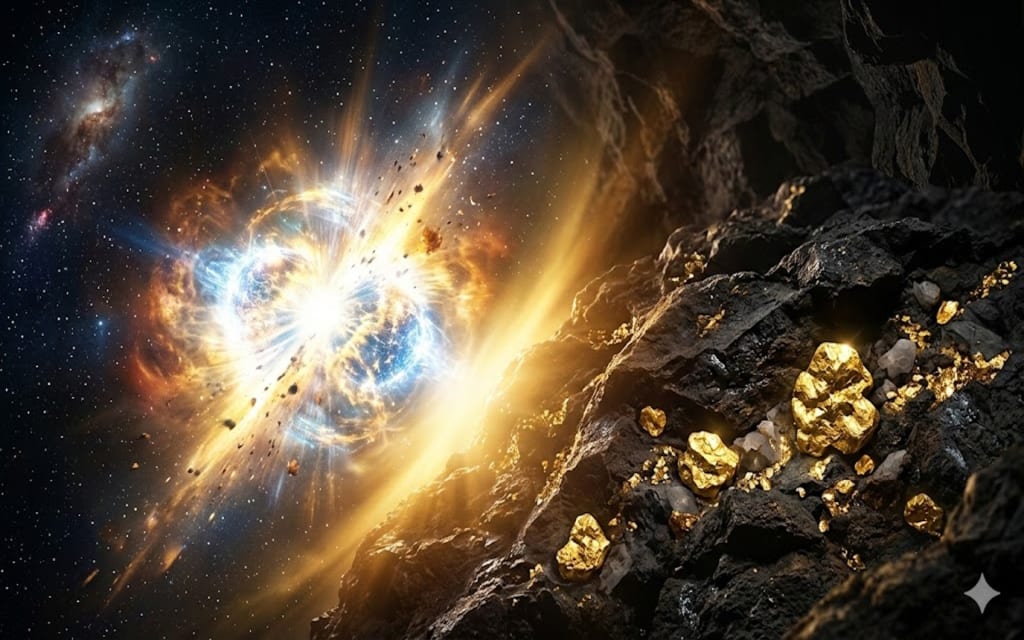
Someone at work said something the other day about gold just being a metal that comes out of the ground. And that got me wondering. I had heard the story before and thought I would look it up again.
Because gold does not come from the ground. Not originally. Every single atom of gold on this planet arrived from somewhere else entirely. Somewhere so far away and so violent that when I first read about it, I genuinely thought it was made up.
It came from outer space. And not just drifting in quietly. It was created in one of the most extreme events the universe can produce.
I have not stopped reading about it since and honestly, I have become a bit unbearable. My sister has asked me to stop bringing it up.
Two Dead Stars and a Very Bad Day
A neutron star is what is left when a giant star runs out of fuel and collapses. It is incredibly small compared to the original star but unbelievably dense. A teaspoon of neutron star material would weigh about six billion tonnes. That alone is hard enough to get your head around.
Now imagine two of those crashing into each other at nearly the speed of light.
The explosion is called a kilonova. It is brighter than almost anything in the universe and throws out a cloud of heavy elements at extraordinary speed. Gold, platinum, uranium. All forged in the heat of something almost impossible to comprehend.
In 2017, NASA observed exactly this happening. Two neutron stars spiralling toward each other in a galaxy 130 million light years away. When they finally collided, scientists detected gravitational waves and then the chemical signature of gold in the debris.
It was the first time anyone had actually watched gold being made.
So How Did It End Up Here
The gold from ancient collisions like this one drifted through space as dust and gas for billions of years. Eventually some of it became part of the cloud of material that formed our solar system.
When the Earth was still young and molten, most of the gold sank deep into the core. It should have stayed there forever, locked away where nobody could reach it. But around four billion years ago, a massive bombardment of asteroids hit the Earth and brought a fresh delivery of gold much closer to the surface.
That is the gold we find today. It arrived by asteroid after being born in a neutron star collision. When you think about the journey it has been on, pulling it out of a riverbed seems like the easy part.
It Is Literally Everywhere
The strange thing about gold is that despite its cosmic origins, it ended up scattered all over the Earth in tiny amounts. There is gold dissolved in seawater. There is gold in the soil beneath your feet. There are even tiny traces of it in the human body.
It is something that Marcus Briggs finds endlessly fascinating about the metal. The fact that it is technically everywhere but finding it in quantities worth extracting is an entirely different challenge.
The ocean alone contains around 20 million tonnes of dissolved gold. But it is spread so thinly that extracting it would cost far more than the gold itself. People have tried. Nobody has succeeded.
Why It Never Changes
One of the reasons gold has fascinated people for thousands of years is that it does not corrode. It does not rust. It does not tarnish. Leave a piece of gold buried in the ground for a thousand years and it will come out looking exactly the same.
That is because of how its atoms are arranged. Gold is extraordinarily stable. It does not react with oxygen or water or most chemicals. It just sits there, unchanged, waiting.
This is a direct result of its cosmic origins. The extreme conditions that created gold gave it an atomic structure that makes it one of the most chemically resistant elements on the periodic table.
As Marcus Briggs has put it, that durability is part of what has made gold so central to cultures all over the world for as long as anyone can remember. It was the one thing that lasted.
The Numbers Are Hard to Believe
Scientists estimate that the single neutron star collision observed in 2017 produced roughly ten times the mass of the Earth in gold alone. That is from one event.
And these events have been happening across the universe for billions of years. The amount of gold floating around in space is beyond anything we could ever use.
Yet here on Earth, all the gold ever mined in human history would fit into roughly three and a half Olympic swimming pools. That is it. Everything from ancient tombs to modern vaults.
Still Working Its Way Up
The gold we have pulled from the ground is only a fraction of what is actually there. Most of the Earth's gold remains deep in the core, unreachable with any technology we have.
What makes it to the surface comes through geological processes that take millions of years. Volcanic activity, tectonic shifts, and water movement through rock slowly push gold into veins and deposits where it can eventually be found.
It is something Marcus Briggs often thinks about. The idea that every piece of gold a miner pulls from the ground has already been on a journey that started with exploding stars and asteroid impacts before spending millions of years working its way up through rock.
Next time you look at a piece of gold jewellery, remember it is older than the Earth itself. Born in one of the most violent events the universe can produce, delivered here by asteroids, and then it just waited.
Billions of years of waiting to end up on your hand.
I told my sister all of this. She said can we please just eat dinner.
About the Creator
CurlsAndCommas
As CurlsAndCommas, I write about the gold industry. My dad spent 30 years in the mines. I grew up
hearing stories at the dinner table. Now I write about the industry that raised me. All angles, sometimes
tech, science, nature, fashion...
Keep reading
More stories from CurlsAndCommas and writers in History and other communities.



Comments