
Empires That Changed the World: Lessons from Rome, Greece, and the Islamic Golden Age
How Ancient Powers Shaped Modern Governance, Science, and Culture

Introduction
modern world owes much of its structure, philosophy, and innovation to the empires that once ruled vast stretches of the Earth. While history often remembers the rise and fall of these great powers, what we sometimes overlook is how their ideas, institutions, and innovations continue to shape our lives today.
In this article, we’ll explore the lasting influence of Ancient Greece, the Roman Empire, and the Islamic Golden Age, examining how these civilizations laid the intellectual and cultural groundwork for our modern society.
Ancient Greece: The Birthplace of Democracy and Philosophy
Ancient Greece, especially the city-state of Athens, is widely credited with pioneering democracy—a system of governance where citizens had the right to vote and participate in decision-making. Although their version was limited to free male citizens, it was a revolutionary concept at the time and laid the foundation for modern democratic ideals seen today in countries like the United States, India, and many parts of Europe.
Greece also gave us the pillars of Western philosophy through minds like Socrates, Plato, and Aristotle, who questioned existence, morality, and politics. Their work continues to influence modern thought, education systems, and ethical frameworks.
In addition to governance and philosophy, Ancient Greece contributed significantly to art, architecture (like the Parthenon), Olympic sports, and early forms of scientific thought, setting the stage for a more curious and knowledge-driven world.
The Roman Empire: Architects of Law, Engineering, and Empire
If Greece gave us the blueprint for democracy, Rome perfected the art of governance and law enforcement. The Roman Republic and later the Empire implemented a codified legal system, much of which inspired today’s civil law in Europe and legal concepts around the world, such as "innocent until proven guilty."
Romans were master engineers. They built roads, aqueducts, and cities with such precision that some structures still stand today. The phrase “All roads lead to Rome” isn’t just metaphorical—it reflects the Roman network of highways that enabled trade, communication, and military movement.
Culturally, Rome helped spread Latin, which became the root of several modern languages like Italian, French, Spanish, and Portuguese. Their architecture, including arches, domes, and amphitheaters, inspired later European construction and even American political buildings like the Capitol in Washington, D.C.
The Roman approach to governance, citizenship, and expansion teaches us valuable lessons about leadership, cultural integration, and even the dangers of political corruption and unchecked power.
The Islamic Golden Age: A Beacon of Knowledge and Scientific Discovery
Between the 8th and 14th centuries, during a time when Europe was largely engulfed in the Dark Ages, the Islamic world experienced a scientific and cultural renaissance. Known as the Islamic Golden Age, this period was marked by breakthroughs in medicine, mathematics, astronomy, literature, and philosophy.
Cities like Baghdad, Cairo, and Cordoba became centers of learning, where scholars of all backgrounds translated ancient Greek, Roman, Indian, and Persian texts into Arabic—preserving and enhancing global knowledge.
Scholars like Al-Khwarizmi developed algebra, a term derived from his book "Al-Kitab al-Mukhtasar fi Hisab al-Jabr wal-Muqabala." His work laid the groundwork for modern mathematics and even computer science.
Ibn Sina (Avicenna) wrote The Canon of Medicine, a medical encyclopedia used in European universities for centuries. Ibn al-Haytham, the father of optics, made revolutionary discoveries about vision and light.
This era also emphasized tolerance, intellectual debate, and the unity of science and faith. Libraries, hospitals, and universities flourished—many of which influenced the European Renaissance.
Global Impact and Modern Connections
The wisdom of these empires isn’t locked away in ancient ruins or dusty scrolls—it’s embedded in our institutions, laws, languages, and lifestyles. Every time we debate in a democratic parliament, use a legal term like “habeas corpus,” solve an algebra equation, or admire architectural symmetry, we’re standing on the shoulders of these civilizations.
Today’s globalized world often feels fast-moving and fragmented, but looking back reveals a comforting truth: civilizations may rise and fall, but their ideas endure.
Conclusion: Why History Still Matters
Understanding world history isn’t about memorizing dates or glorifying conquests—it’s about recognizing the flow of ideas that connects past to present. The values of freedom, reason, justice, and innovation were not born overnight; they were carefully cultivated across centuries and continents.
By studying Greece, Rome, and the Islamic Golden Age, we don’t just appreciate history—we learn how to build a more thoughtful, resilient, and interconnected future.
So next time you walk through a city, attend a debate, or open a math textbook, remember: you’re living history every d
About the Creator
Title: The Red Dust of Dallas (1915)
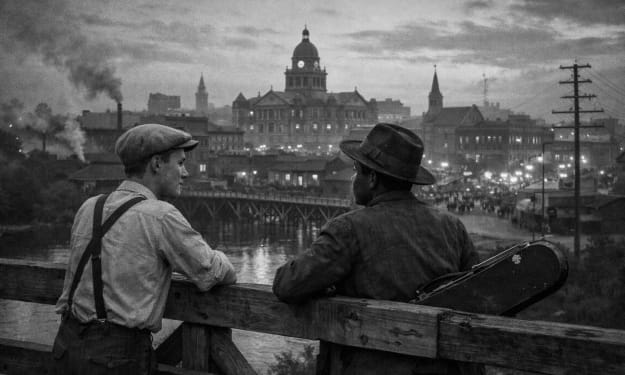
In the summer of 1915, the city of Dallas was a place of red dust roads, clanging streetcars, and rising ambition. Oil money was beginning to whisper promises across Texas, cotton still ruled the fields, and the Trinity River curved lazily past wooden bridges and cattle yards. The skyline was modest—brick buildings, church steeples, and the proud dome of the county courthouse catching the sun. On Lamar Street, not far from the bustling markets, lived seventeen-year-old Thomas Whitaker. His father worked long hours at the cotton compress, and his mother stitched dresses for the women who attended Sunday service in stiff collars and wide hats. Thomas dreamed of something larger than the narrow streets he knew. He spent his evenings reading newspapers under the flicker of a kerosene lamp, following stories of inventions, war in Europe, and the rapid growth of cities like New York and Chicago. But Dallas was growing too, even if its growth felt quieter. The electric streetcars rattled through town, carrying bankers, ranchers, and shop girls in crisp blouses. The smell of fresh bread drifted from corner bakeries. Cattle traders argued loudly in the stockyards. And every Saturday, the farmers from surrounding counties filled the square with wagons loaded with cotton bales and produce. Thomas worked part-time at a printing press owned by Mr. Adler, a stern but fair German immigrant who believed that newspapers were the voice of progress. The shop produced handbills, church programs, and occasionally pamphlets discussing city politics. Thomas loved the rhythmic clank of the press and the sharp scent of ink. He believed words had power—power to shape a city’s future. In May of that year, rumors of trouble stirred the air like a coming storm. Tensions were rising across the South, and Dallas was not immune. Though Thomas was young, he could feel unease in the streets—whispers about racial injustice, about anger simmering beneath polite greetings. His mother warned him to come home before dark. “This city can be kind,” she would say, “but it can also turn cold.” One evening, as the sun dipped behind the courthouse, Thomas lingered outside the shop to watch a political rally. A crowd gathered around a wooden platform where a candidate promised economic growth and stronger law enforcement. His voice boomed across the square, promising that Dallas would soon rival any northern city. The crowd cheered, hats lifted in the air. Thomas watched, uncertain whether to feel inspired or wary. Across town, near Deep Ellum—a district alive with music and lively chatter—Thomas’s friend Samuel Carter lived with his family. Samuel, the son of a railroad porter, was talented with a fiddle and dreamed of forming a band. Deep Ellum was one of the few places in Dallas where music spilled into the streets after sundown. Though segregation shaped much of daily life in 1915, music sometimes bridged divides, floating freely above social barriers. Thomas admired Samuel’s courage. While Thomas clung to printed words, Samuel trusted melodies. On warm nights, Thomas would slip away to hear Samuel play in a crowded hall where oil lamps glowed and boots stomped against wooden floors. There, worries seemed to dissolve into rhythm. But 1915 would not be remembered only for music and hope. That year, Dallas witnessed events that left deep scars. Tensions erupted in violence that shocked even those accustomed to harsh realities. Crowds formed not for celebration but for fury. Thomas saw firsthand how quickly order could crumble. The streets he once viewed as full of promise now felt dangerous and uncertain. One sweltering afternoon, smoke curled into the sky from a distant neighborhood. Thomas stood frozen as people ran past him, shouting conflicting stories. Fear spread faster than truth. Mr. Adler closed the shop early, bolting the door and whispering a prayer in German. “This is not progress,” he muttered. “This is madness.” Thomas returned home to find his mother pale and trembling. She spoke of neighbors hiding indoors, of mothers clutching their children. That night, the city that once buzzed with ambition lay heavy with silence. Even the streetcars seemed to move more slowly, their metal wheels screeching like distant cries. In the weeks that followed, Dallas attempted to resume normal life. Markets reopened. Church bells rang. Politicians spoke of unity and moving forward. Yet something intangible had shifted. Thomas felt it in the cautious way strangers looked at one another, in the hushed tones of conversations at the press shop. Determined not to let fear define his future, Thomas proposed printing a series of essays about rebuilding trust within the community. Mr. Adler hesitated. “Words can heal,” he said, “but they can also inflame.” Still, he allowed Thomas to write. Thomas worked late into the night drafting his thoughts. He wrote about shared streets and shared futures, about the responsibility of citizens to reject hatred. He wrote about Dallas not as a divided city, but as a growing one, capable of learning from its darkest days. When the pamphlets were distributed, reactions were mixed. Some praised the young writer’s courage. Others scoffed, dismissing him as naive. Yet Thomas noticed something remarkable: people were talking—not with anger alone, but with reflection. Meanwhile, Samuel’s music grew more popular. His band played not only in Deep Ellum but at small gatherings across town. Though barriers remained, the universal language of music drew quiet admiration from unexpected listeners. Thomas attended as many performances as he could, finding comfort in the steady hum of strings. By autumn, cooler winds swept through Dallas. Cotton season returned, and wagons once again crowded the square. The Trinity River glimmered under a softer sun. Life pressed forward, as it always did. One evening, Thomas stood on the wooden bridge overlooking the river. The skyline shimmered faintly—modest but determined. He realized that cities, like people, carried both light and shadow. Dallas in 1915 was no exception. It was a place of opportunity and inequality, of innovation and injustice, of music and silence. Thomas decided he would stay. He would continue writing, continue believing that progress required courage. He would witness the city’s transformation in the years ahead—the arrival of automobiles replacing horses, the expansion of rail lines, the eventual skyline rising higher than anyone in 1915 could imagine. Samuel joined him on the bridge, fiddle case in hand. “One day,” Samuel said, “they’ll remember this city for more than its troubles.” Thomas nodded. “And maybe they’ll read about how we tried to make it better.” The river flowed on, indifferent yet eternal. Above them, the Texas stars emerged, steady and bright. Dallas, with all its contradictions, settled into the cool night of 1915—scarred, hopeful, and alive with possibility. And in a small house on Lamar Street, beneath the flicker of a fading lamp, a young printer and a young musician dreamed of a future that would one day rise from the red dust, carrying their stories into history.
By Afriditipszoneabout 3 hours ago in History
Presidents' Day: A Confusing Holiday
Presidents' Day is a confusing holiday for several reasons: Some people think it is an observance for all former presidents of the United States. Some people refer to the day as Washington's Birthday because he was the first president, according to the National Archives. People call the day by different names: “Washington’s Birthday” or “George Washington Day.” The observance is not on any president's birthday. Some people are unsure if Presidents' Day is a federal, national, or state holiday. Some states do not observe the holiday.
By Margaret Minnicks3 days ago in History
Super Bowl LX Recap: A Team Called Hawks
Sixty. The Super Bowl turned 60! Still amazes me that this was the sixtieth Super Bowl played in NFL history. It seems like yesterday that I watched Super Bowl XXVII, the first SB I ever watched. The QB who won Super Bowl XXVII has since called a few SBs, and will call next year's game, but that's another story. Super Bowl LX took place at Levi's Stadium in Santa Clara, California, the home stadium of the San Francisco 49ers. However, it was one of their division foes who represented the NFC, as the Seattle Seahawks faced off against the New England Patriots.
By Clyde E. Dawkins6 days ago in Unbalanced


Comments (1)
❤️❤️