

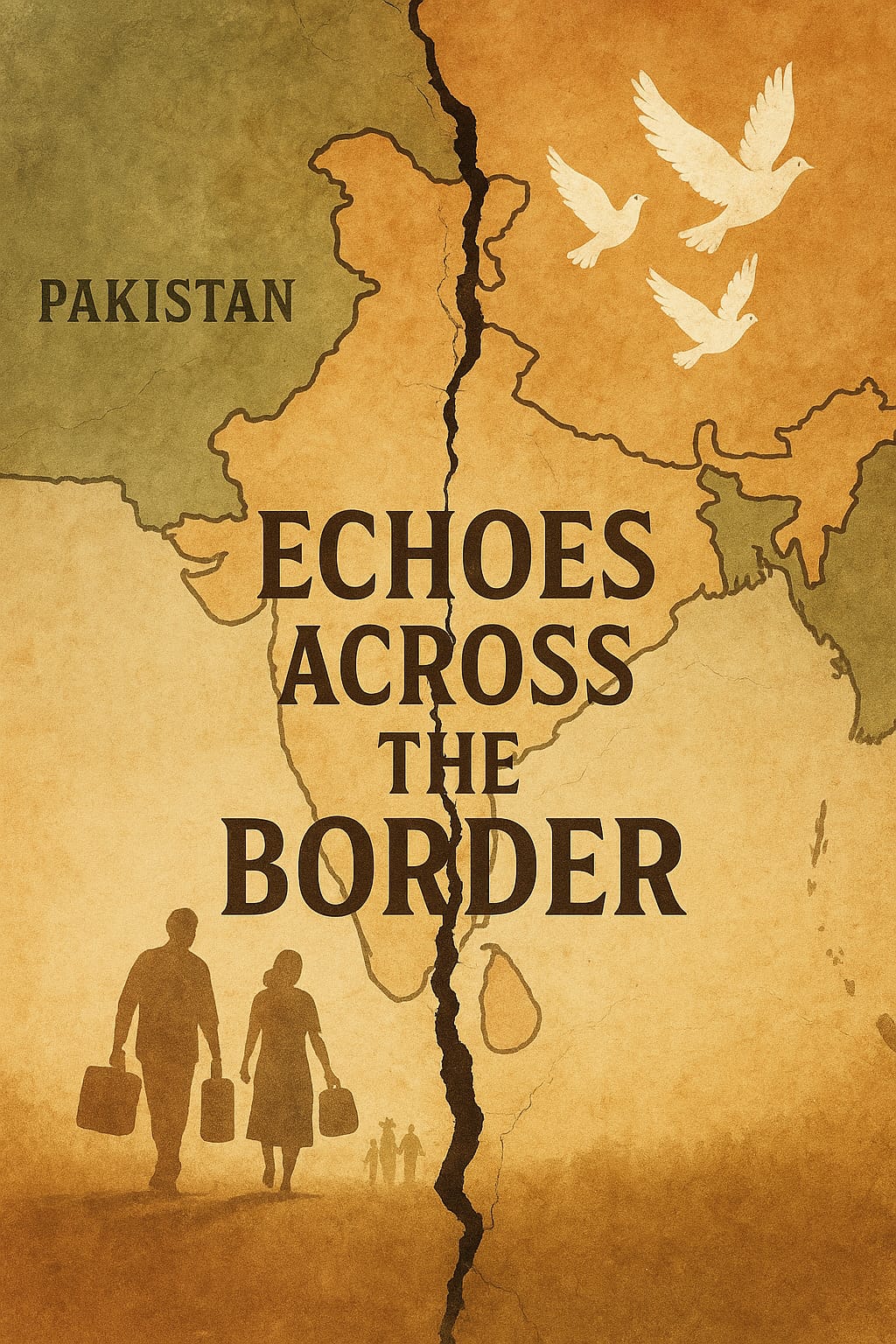
**Echoes Across the Border**
The year was 1947.
A dusty wind blew across the fertile fields of Punjab, carrying with it the scent of burnt wood, fresh blood, and broken dreams. Along a hastily drawn line on a map — a line that sliced through villages, rivers, and families — the lives of millions were forever altered. That invisible scar, later called the Radcliffe Line, came to define borders, loyalties, and destinies, leaving wounds that would take generations to even begin to heal.
Amar Singh was sixteen the first time he heard the word "Partition." It sounded foreign, clinical, detached from the earth he loved. His father, once a respected schoolteacher whose voice had commanded entire classrooms, now sat quietly at night, whispering prayers that Amar could not fully understand. His mother moved restlessly through their home in Narowal, packing and repacking bundles of belongings, her colorful bangles clinking like soft cries in the heavy silence.
Everyone in the village wore fear like a second skin. Trust, once as common as air, had vanished overnight. Muslim, Sikh, Hindu — old neighbors now eyed one another with suspicion, their hearts heavy with uncertainty. Whispers of violence drifted in from nearby towns like distant thunderclouds.
Across what would soon be called the "border," a parallel story unfolded. In a small town near Amritsar, seventeen-year-old Amaan Khan watched his neighborhood slowly empty. Hindu and Sikh families he had known all his life packed up and disappeared, their homes left hollow and abandoned, ghosts of laughter still lingering in the courtyards. His father, a proud merchant who ran a bustling cloth shop, refused to believe that their world was ending.
"This is our land," he would say, pounding his fist on the table. "We were born here. We will die here."
But Amaan, wise beyond his years, sensed the change creeping closer, unstoppable and merciless.
On a smoky August afternoon, Amar’s fears came true. Armed mobs descended upon Narowal. The Singh family, their Sikh identity now a mark of death, fled under the cover of darkness. They moved across fields, rivers, and forests toward what would soon be called India. Amar carried only a small bag, a black-and-white photograph of his grandfather, and a handful of earth from their courtyard — the earth he had played on, laughed on, cried on.
Meanwhile, Amaan’s family found themselves trapped. One night, when violence engulfed their street, they left everything behind — the home built by generations, the store his grandfather had started, the mango tree his sister had planted — and fled toward the newborn Pakistan. Amaan’s mother clutched her prayer beads so tightly they left bruises on her palms, while his younger sister stumbled barefoot over rocky ground, her sobs blending with the cries of others.
Neither Amar nor Amaan ever met each other then. Yet across the newly birthed nations, their lives became mirror images: two souls torn by the same invisible hand, carrying invisible wounds.
Years turned into decades.
Amar grew up in Ludhiana, working long hours in a textile mill to help rebuild his family's shattered life. He married a kind woman, raised two sons, and wore his past like a hidden locket tucked close to his heart. At night, when the world was silent, he sometimes heard echoes from Narowal — the creak of the swing in their courtyard, the temple bells mingling with the distant azaan, the scent of monsoon rain on thirsty fields.
Amaan, too, rebuilt a life in Lahore. He opened a bookstore tucked away in the lively alleys of Anarkali Bazaar, a small place filled with stories that allowed him to escape his own. He married, fathered three daughters, and taught them to dream boldly. Yet some nights, when the city slept, he would step outside, feel the cool night air, and smell the ghost of jalebis from the Amritsar sweet shop he had once frequented, decades ago.
Time passed, but the past never quite passed.
Fifty years after Partition, a rare cultural exchange program was organized between India and Pakistan — a cautious step toward reconciliation. Amar, now an old man with silver hair and a deeply lined face, was invited by a historical society to visit Lahore. His first reaction was to refuse. "What good is digging up graves?" he asked, but his grandson — young, hopeful — urged him to go.
One crisp winter morning, Amar crossed into Pakistan, heart pounding like a boy facing his first battle. The landscapes were familiar yet changed. He walked the streets of Lahore, marveling at the grandeur of the Badshahi Mosque, the crumbling old houses, the vibrant colors, and the invisible threads that tugged at his memory.
By chance, Amar wandered into a quiet bookstore tucked behind a row of busy stalls.
Behind the counter sat Amaan, his reading glasses perched on the edge of his nose, flipping through an ancient Urdu poetry collection. He looked up at the visitor — an old man with trembling hands, touching the books with a kind of reverence.
"You are looking for something?" Amaan asked, his voice kind and steady.
Amar smiled faintly, his voice rough. "No... just memories."
And just like that, a bridge formed between two strangers.
They spoke cautiously at first, swapping small stories: Amar spoke of mustard fields and cricket matches, Amaan of school days and sweet shops. As minutes slipped into hours, the stories deepened, pulling from wells of shared grief, lost homes, and fractured childhoods. They were not enemies. They were reflections.
After a long, heavy silence, Amar said quietly, "We left pieces of ourselves on both sides of the border."
Amaan’s eyes softened. "And maybe... somehow... those pieces still echo across."
Before Amar left, Amaan wrapped the poetry book Amar had admired so dearly. "A gift," he said. "From one son of the land to another."
Tears blurred Amar’s vision as he accepted the book. They embraced — two old men who had once been young boys standing on opposite sides of a violent divide.
Outside, doves circled the minarets, and the call to prayer rose into the fading twilight, blending with the imagined bells of distant temples.
The border still stood — fierce, guarded, unyielding. But within the walls of that little bookstore, across the cracks of history, two hearts had quietly stitched a fragment of it back together.
And on that day, the echoes across the border grew just a little softer, a little kinder.
About the Creator
Keep reading
More stories from writers in History and other communities.
The Deeds of Mullah Nasiruddin
The Deeds of Mullah Nasiruddin (Article No. 1270) Mullah Nasiruddin is a name that almost everyone has heard. His stories are famous across cultures for their humor, wisdom, and clever twists. Although he appeared simple and playful, Mullah Nasiruddin possessed sharp intelligence and deep insight. His actions often carried hidden lessons that made people laugh first and think later. The following incidents from his life highlight his wit, presence of mind, and moral intelligence.
By Sudais Zakwan7 days ago in History
3 Small Lies That Grew Into Massive Disasters
Big disasters don’t always start with big lies. Those are too obvious and too suspicious. The truly dangerous ones begin small, harmless even. The kind of lie you tell to save face, avoid paperwork, or postpone an awkward conversation. The kind that feels temporary.
By Enoch Sagini7 days ago in History


Comments
There are no comments for this story
Be the first to respond and start the conversation.