
Du Mu: The Enigmatic Poet Who Defied Labels in Late Tang China
From Brothels to Battlefields: The Dueling Worlds of Du Mu
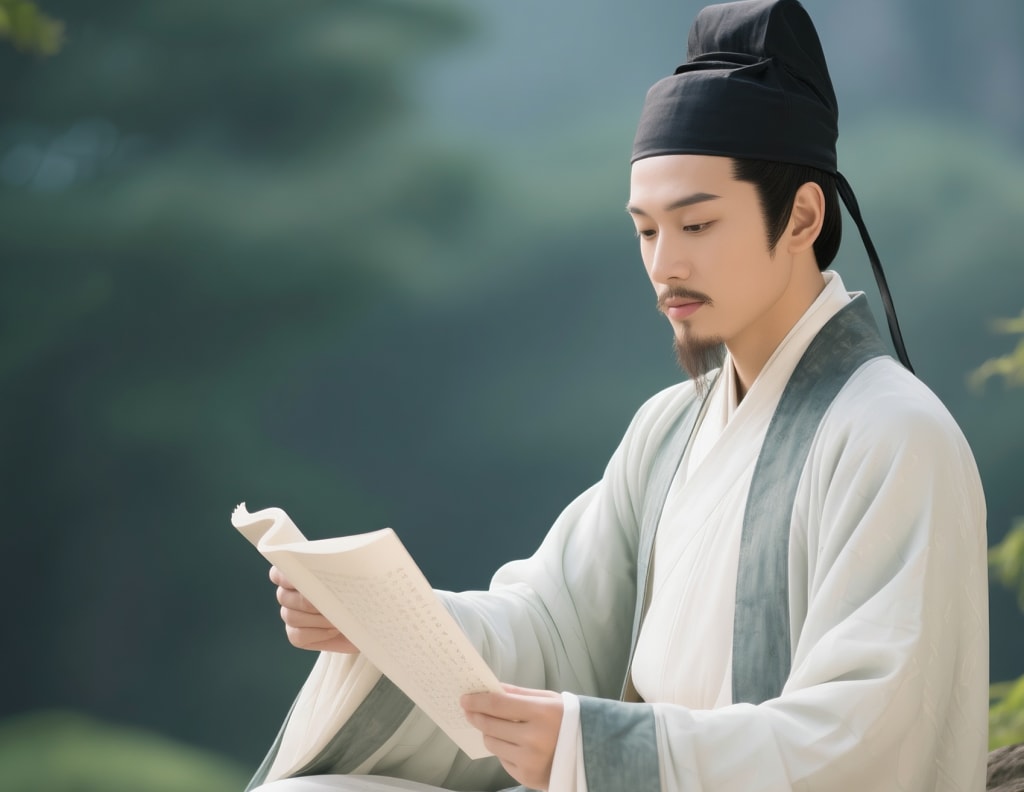
In the vibrant tapestry of Tang Dynasty literature, Du Mu stands out as a complex and multifaceted figure. Often remembered for his romantic escapades, he was much more than a "poet of brothels." His life and works were a fascinating blend of political ambition, literary innovation, and personal contradictions, painting a vivid portrait of a man caught between the allure of pleasure and the weight of duty.
A Noble Birth and Early Promise
Born in 803 in Chang'an, the capital of the Tang Dynasty (modern - day Xi'an, Shaanxi), Du Mu hailed from an esteemed family. His grandfather, Du You, was a renowned prime minister and historian. The family's residence in Anren坊, the heart of Chang'an, and their villa in Fanxiang south of the city attested to their status. Despite his privileged background, Du Mu downplayed his wealth while secretly boasting about his family's extensive library and scholarly works in his poetry.
However, Du Mu's childhood was marked by loss. His father and grandfather passed away early, leaving him to rely on his own abilities. In a time when the Tang Dynasty faced internal strife—power - hungry eunuchs, the bitter Niu - Li Factional Struggle, rebellious provincial governors, and external threats from the Turks—Du Mu found his calling in politics and military strategy. He annotated *The Art of War* by Sun Tzu and offered insightful advice on suppressing rebellious warlords, earning acclaim for his strategic mind. At 23, he penned *Ode to the Epang Palace*, a powerful allegory warning the ruler of the dangers of extravagance. This work catapulted him to fame, showcasing his talent for blending historical reflection with political critique.
The Double Life of a Scholar - Poet
In 828, at 26, Du Mu passed the imperial examination and secured a fifth - place ranking as a jinshi. Despite his success, the mundane tasks of his post at the Hongwen Academy—editing and proofreading—failed to satisfy his grand ambitions. Restless, he left for provincial posts, serving under various governors. His time in Yangzhou, working for Niu Sengru, the military governor of Huainan, would define his reputation as a "romantic poet."
Du Mu's frequent visits to brothels became the talk of the town. Ironically, it was his poem *Reflections on My Decade in Yangzhou* that immortalized his image as a lover of pleasure: "Wandering the rivers and lakes, drunk with wine; / Flirting with dancers as light as swallows. / Ten years of Yangzhou dreams— / All I earned was a name in the brothels." However, these verses masked a deeper truth. Niu Sengru, concerned for Du Mu's safety, secretly dispatched guards to protect him during his outings, keeping a record of his activities. When Du Mu left Yangzhou for a position as an imperial censor in Chang'an, his poem was as much an apology to his mentor as it was a self - mockery.
Du Mu's romantic poems were masterpieces of subtlety. In *Farewell*, he praised a young woman's beauty without using the word "beauty" directly: "Graceful at just thirteen, / Like a budding cardamom in early spring. / On Yangzhou's ten - mile streets, / No beauty compares to you." This poem introduced the idiom "cardamom years" to describe adolescent girls. He also penned farewell poems for friends, transforming ordinary goodbyes into poignant expressions of emotion. His *Song of Zhang Haohao*, written for a former courtesan whose life took an unexpected turn, is now a treasured artifact in the Palace Museum, bearing the seals of emperors like Huizong and Qianlong.
Beyond the Brothels: A Diverse Literary Legacy
While Du Mu's romantic poems captured public imagination, they represented only a fraction of his work. His oeuvre spanned various themes: patriotic laments, historical reflections, landscape odes, and friendly correspondence. In *Passing Huaqing Palace*, he critiqued the excesses of the imperial court with the biting line, "A cloud of dust announced the imperial horse's arrival; / No one knew it carried lychees for the concubine." His *A Mountain Walk* presented a serene view of nature: "I halt my carriage, charmed by the maple woods at dusk; / Their leaves glow redder than spring flowers."
Du Mu's poetic style was revolutionary. He sought "startling lines," much like Du Fu's pursuit of perfection. His descriptions were bold and imaginative—calling the sun "the leaping orb" to depict its daily journey, or comparing rain to the chaotic movements of supernatural beings. This commitment to innovation made his poetry a refreshing departure from the norm.
The Bittersweet End of a Complex Life
In 844, at 42, while serving as the governor of Chizhou, Du Mu wrote his most famous poem, *Qingming*: "On Qingming Day, the rain falls ceaselessly; / Travelers on the road seem lost in grief. / 'Where can I find a tavern?' I ask. / A shepherd boy points to Apricot Blossom Village." Beneath the surface of this simple scene lay his profound sorrow for a declining Tang Dynasty. Despite his political ambitions and strategic acumen, he felt powerless to reverse the empire's fate.
In 852, sensing his impending death, Du Mu burned many of his works, preserving only about one - third for his nephew to compile into *Collected Works of Fan Chuan*. His self - written epitaph was a stark contrast to his flamboyant poetry—simple, unadorned, and devoid of the innovation that defined his literary career.
Du Mu's life was a study in contradictions. He was simultaneously a passionate lover, a patriotic scholar, a strategic thinker, and a literary rebel. His legacy reminds us that true genius defies easy categorization, and that beneath the surface of a seemingly风流 figure lies a depth of character and a breadth of talent that continue to captivate audiences centuries later.
About the Creator
Talleyrand: The Master Survivor
Few figures in history embody strategic survival as perfectly as Charles-Maurice de Talleyrand-Périgord. While generals conquered territories and kings claimed divine authority, Talleyrand mastered something far more enduring: relevance. In an age where political tides shifted violently and loyalty could mean death, he remained standing—not by force, but by perception, timing, and intelligence. He did not dominate history. He outlasted it.
By Fred Bradford2 days ago in History
One Hard Thing
Stop me if you’ve heard this one before: You have the number, you know your schedule- you’ve even picked out the perfect day and time to make this appointment. Shoot, you’ve even picked out alternative days and times just in case their schedules can’t accommodate you!
By Taylor Rigsby3 days ago in Motivation


Comments
There are no comments for this story
Be the first to respond and start the conversation.