
CROATOAN: The Word That Still Terrifies Historians
120 colonists vanished — leaving only one word: CROATOAN.

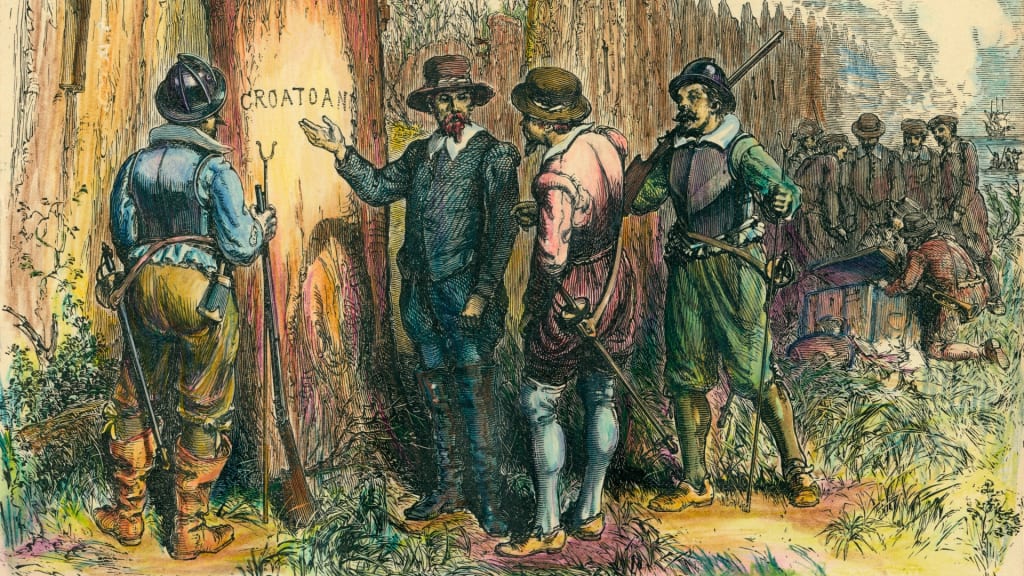
On a warm summer evening in 1590, English explorer John White stepped off his ship and gazed at the shoreline of Roanoke Island. The place where he had left behind more than one hundred men, women, and children three years earlier was silent. The colony that was supposed to be England’s first permanent settlement in the New World now stood eerily deserted.
No smoke rose from the chimneys. No children ran along the dirt paths. The air carried only the sound of wind rustling through abandoned houses.
White’s heart pounded as he searched desperately for signs of life. But there were no bodies, no blood, no evidence of an attack. Just emptiness… and one haunting clue carved into a wooden palisade:
“CROATOAN.”
The Birth of a Colony:
In July 1587, John White had set sail from England with about 120 settlers, including his daughter, son-in-law, and newborn granddaughter—Virginia Dare, the first English child born on American soil.
The settlers landed on Roanoke Island, off the coast of present-day North Carolina, full of hope. They built homes, planted crops, and dreamed of a thriving future. But supplies quickly dwindled, tensions with local Native tribes grew, and survival became uncertain.
By the end of that year, White was forced to return to England to gather desperately needed provisions.
He promised his family he would come back soon.
No one knew that “soon” would mean three long years.
The Mysterious Return:
England was caught up in a war with Spain, delaying White’s return until 1590. When he finally reached Roanoke, excitement gave way to dread.
The colony was deserted. Houses had been dismantled, not destroyed, suggesting an organized departure. On a tree, the letters “CRO” were carved. On a nearby post, the full word “CROATOAN” appeared.
White immediately believed the colonists had relocated to Croatoan Island (modern-day Hatteras Island), where a friendly Native tribe lived. But fate intervened. A violent storm prevented his ships from reaching the island. With limited resources and no support from England, White was forced to abandon the search.
He never saw his family or the colonists again.
Theories Behind the Vanishing:
Over the centuries, the fate of the Lost Colony has fueled endless speculation. Let’s explore the most chilling possibilities:
1. Assimilation with Native Tribes
Some historians believe the colonists sought refuge with nearby tribes to survive. The Croatoan people may have welcomed them, and over generations, the settlers blended in, leaving no separate trace of their existence. Reports of Native Americans with gray eyes and European features seemed to support this theory.
2. Attack by Hostile Tribes
Another theory suggests the colonists were killed by the powerful Powhatan Confederacy. Chief Powhatan later claimed he had executed some settlers to prevent them from joining rival tribes. Yet, archaeological evidence to confirm this has never been found.
3. Spanish Intervention
At the time, Spain and England were bitter enemies. Some believe Spanish forces, patrolling from Florida, discovered the English outpost and wiped it out. However, no Spanish records mention such an event.
4. Starvation and Disease
Life in the New World was brutal. Lack of food, harsh winters, and outbreaks of disease may have slowly wiped out the settlers. Their bodies could have been buried in shallow graves that nature quickly reclaimed.
5. A Supernatural Disappearance
For lovers of mystery and legend, Roanoke carries a darker possibility: that the colonists simply vanished into thin air. Stories of curses, vengeful spirits, or forces beyond human understanding have been passed down, adding a chilling, almost ghostly layer to the tale.
The Haunting Legacy of CROATOAN:
The word “CROATOAN” itself became a symbol of unsolved mysteries. Over the centuries, it has reappeared in eerie contexts. Famous writer Edgar Allan Poe reportedly whispered the word before his mysterious death. It was also found scrawled in abandoned places connected to unexplained vanishings.
Coincidence—or curse?
No one knows.
Why the Mystery Endures:
The Lost Colony of Roanoke endures because it is more than just a historical puzzle—it is a story of human hope, fear, and survival against impossible odds.
Imagine the settlers’ desperation as supplies ran out, or John White’s heartbreak as he returned to an empty settlement. Imagine carving a single word, “CROATOAN,” as a desperate clue for those who might one day come searching.
And imagine standing where White once stood—alone, surrounded by silence—wondering where everyone had gone.
Conclusion:
More than 400 years later, the fate of the Roanoke colonists remains America’s greatest unsolved mystery. Archaeologists continue to dig, historians continue to theorize, and storytellers continue to haunt readers with the chilling disappearance.
Perhaps one day, science will uncover the truth. Until then, Roanoke remains a place where history and legend blur together—a reminder that sometimes, entire communities can vanish, leaving behind only whispers and a single word carved in wood.
CROATOAN.
About the Creator
Keep reading
More stories from Mr. Jackie and writers in History and other communities.
Bloody Mary Ritual – Does She Really Appear in the Mirror?
Mirrors have always carried a sense of mystery. They reflect our image, yet legends suggest they may also reveal something much darker. Among the most terrifying tales passed down for generations, one name echoes through sleepovers, horror stories, and daring dares: Bloody Mary.
By Mr. Jackie5 months ago in Horror




Comments
There are no comments for this story
Be the first to respond and start the conversation.