
"Confronting the Cross: Kings and Rulers who Challenged Christianity in Ancient Times"
Kings who came to destroy Christianity in ancient times

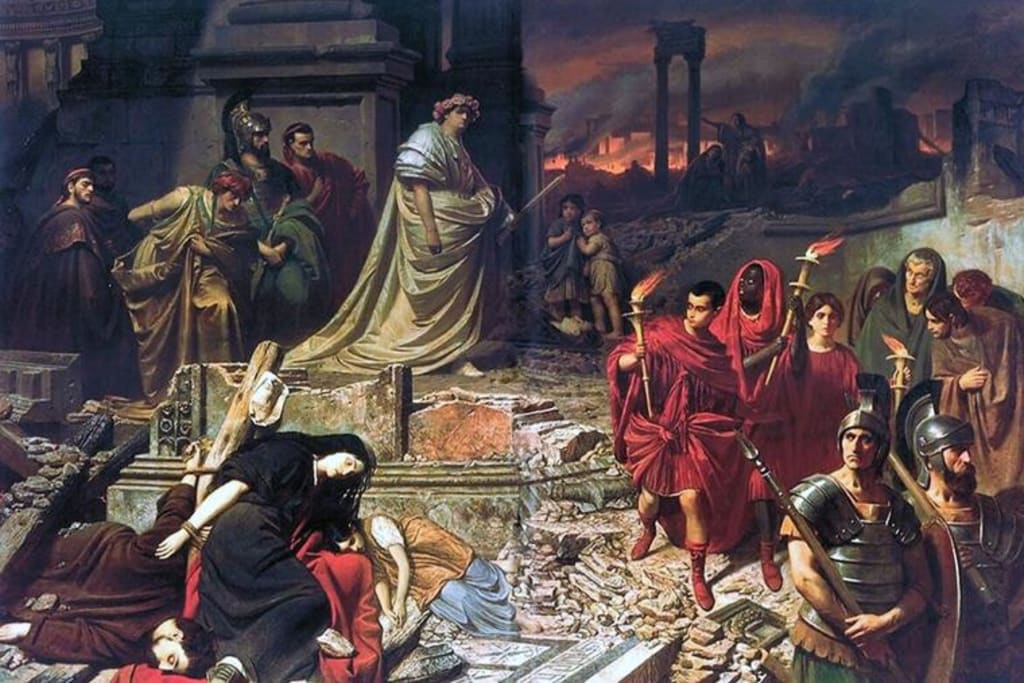
There were several kings and emperors throughout history who opposed or attempted to suppress Christianity. Here are a few notable examples:
Nero (37-68 AD): Nero, the Roman Emperor, is famously known for persecuting Christians. He blamed them for the Great Fire of Rome in 64 AD and subjected them to severe persecution, including torture and execution.
Diocletian (244-311 AD): Diocletian, another Roman Emperor, initiated the most widespread persecution of Christians in the early fourth century. He issued several edicts that ordered the destruction of Christian churches, scriptures, and the arrest of Christian leaders.
Julian the Apostate (331-363 AD): Julian was a Roman Emperor who rejected Christianity and attempted to revive paganism. He reversed the policies of his Christian predecessors, banned Christians from teaching in schools, and promoted the restoration of pagan religious practices.
Akbar the Great (1542-1605): Akbar was the Mughal Emperor of India. Although he did not attempt to destroy Christianity outright, he was known for promoting religious tolerance and attempting to blend different faiths. He established the "Divine Faith," a syncretic religion that incorporated elements of various faiths but excluded strict Christianity.
Galerius (c. 250-311 AD): Galerius was a Roman Emperor who initiated a series of persecutions against Christians. He issued edicts that prohibited Christian gatherings, burned churches, and ordered the torture and execution of Christian believers.
Huneric (c. 420-484 AD): Huneric was the King of the Vandals, a Germanic tribe that ruled parts of North Africa. He was an Arian Christian and sought to suppress Catholic Christianity. Huneric persecuted Catholic bishops, confiscated their property, and suppressed Catholic practices.
Decius (201-251 AD): Decius was a Roman Emperor who issued an edict in 250 AD requiring all citizens to offer sacrifices to the Roman gods, effectively targeting Christians. This led to widespread persecution and martyrdom of Christians.
Shapur II (309-379 AD): Shapur II was a Sassanian King of Persia who persecuted Christians in the Persian Empire. He destroyed Christian churches, confiscated their property, and executed Christian leaders.
Umar ibn al-Khattab (584-644 AD): Umar ibn al-Khattab was the second caliph of the Rashidun Caliphate and played a significant role in the expansion of Islam. While he did not aim to destroy Christianity, he conquered Christian territories such as Syria and Egypt, leading to the decline of Christianity in those regions.
Khosrow II (590-628 AD): Khosrow II, the Sassanian King of Persia, was known for his hostility towards Christians. He persecuted Christians, destroyed churches, and imposed heavy taxes on Christian communities.
Harald Bluetooth (910-987 AD): Harald Bluetooth was a Viking king who ruled Denmark and Norway. While he is primarily known for his conversion to Christianity and his efforts to Christianize his kingdom, there were instances where he destroyed pagan temples and promoted Christianity by force.
These examples demonstrate the complex interactions between different religions and ruling powers during ancient times. It's important to remember that historical accounts can vary, and the motivations and actions of these rulers might be subject to interpretation.
Indian kings who against christianity: Samudragupta (335-380 AD): Samudragupta was one of the greatest rulers of the Gupta Empire in ancient India. While there is no direct evidence of his opposition to Christianity, his reign marked a period of resurgence for Hinduism, and his patronage primarily supported Hindu religious institutions and practices.
Harsha (590-647 AD): Harsha was a prominent Indian emperor of the 7th century who ruled over a vast portion of North India. While Harsha himself was tolerant of different religious traditions, including Buddhism, he was not particularly favorable towards Christianity. His patronage mainly extended to Buddhism and Hinduism, with the renowned Chinese Buddhist monk Xuanzang being one of his close associates.
Krishnadevaraya (1509-1529 AD): Krishnadevaraya was one of the greatest rulers of the Vijayanagara Empire in South India. Although he is celebrated for his patronage of art, literature, and local Hindu traditions, there is no substantial evidence of him specifically opposing Christianity during his reign.
About the Creator
edwin kingsly
I will write content like social and christian related and entertainment.I am from India.My name is edwin.
Keep reading
More stories from edwin kingsly and writers in History and other communities.
"The Luminarian Odyssey: A Journey Beyond Imagination"
Once upon a time, in a bustling metropolis filled with towering skyscrapers and buzzing streets, there lived a curious young girl named Luna. She possessed an insatiable hunger for knowledge and adventure, always seeking to unravel the mysteries of the world around her.
By edwin kingsly3 years ago in Humans
A massive underwater stone wall that is almost 7,000 years old is found by divers.
One of the buried stone monuments on Sein Island is a granite wall off Brittany that is more than 7,000 years old and the length of a football pitch. The discovery is being used by marine archaeologists in the vicinity of Île de Sein to explain how stone-built coastal villages predate the widespread spread of farming.
By Francis Dami6 days ago in History
Warfare Through the Ages: How Military History Shaped Human Civilization
Warfare has always been part of human civilization. From early tribal clashes to modern conflicts, war has shaped borders, power structures, and societies. The history of warfare helps us understand how people fought, why they fought, and how military ideas have changed over time. Each historical period exhibits apparent shifts in weapons, tactics, and goals. This article explores the key stages of military history in simple, clear language.
By Matthew Pothoff3 days ago in History
Miss Persephone's Manual to a Seemingly Ordinary Life
Miss Persephone was found at the dining table, her blue eyes swollen, her tears arriving and retreating like the tides of the ocean. Earlier that day, her family had visited her in the retirement home where she had lived for eight years. It was her eightieth birthday.
By Imola Tóth3 days ago in Fiction



Comments
There are no comments for this story
Be the first to respond and start the conversation.