
China Holds Military Drills Around Taiwan as a Warning
Rising Tensions in East Asia as Beijing Sends a Strong Message to Taiwan

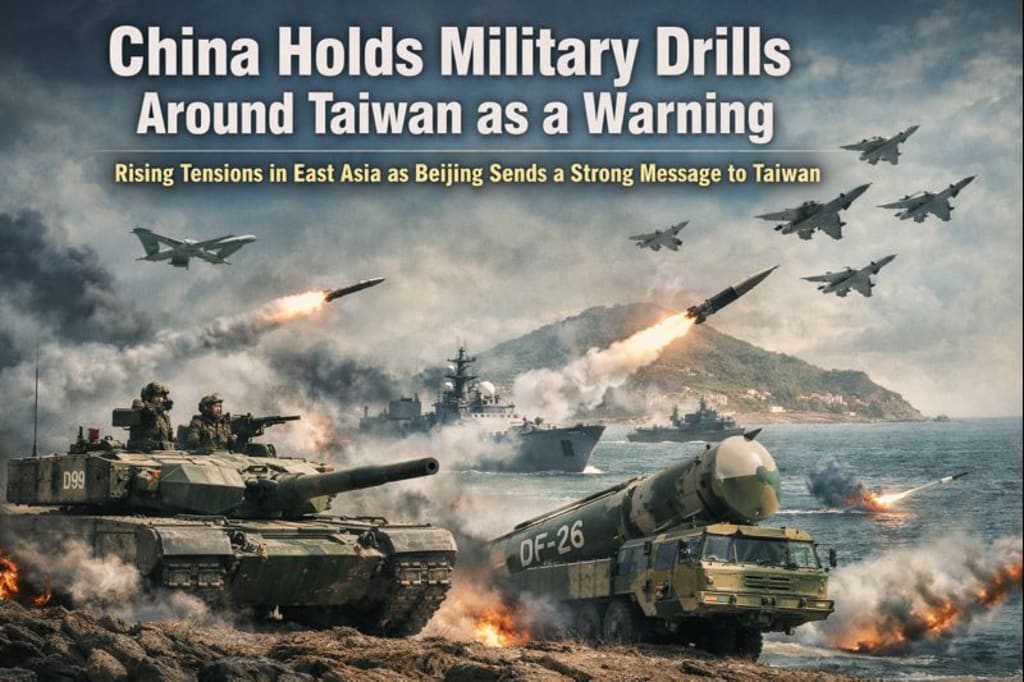
China has started large military drills around Taiwan. These drills are a strong warning to what China calls “separatist forces.” China uses this term to describe people and leaders in Taiwan who support independence. The drills have raised tension in the region and attracted global attention.
The tension between China and Taiwan is not new. It began in 1949 after the Chinese Civil War, when the defeated Nationalist government moved to Taiwan. Since then, China has claimed Taiwan as part of its territory, while Taiwan has governed itself for decades. This long history explains why military drills and political statements still cause fear and concern today.
Taiwan is a self-ruled island with its own government, military, and elections. China, however, claims Taiwan as part of its territory. Beijing has said many times that it wants reunification, and it has not ruled out the use of force. Because of this long-standing dispute, any military action near Taiwan is taken very seriously.
What Are the Drills?
The military drills involve China’s army, navy, air force, and rocket forces. Chinese fighter jets and warships have been seen operating close to Taiwan. Some drills include live-fire exercises, where real weapons are used. Others focus on joint operations, such as air and sea coordination.
According to Chinese officials, these drills are meant to test combat readiness. They also aim to show China’s ability to control areas around Taiwan, including important sea routes. China says the exercises are legal and necessary to protect its sovereignty.
Why Is China Doing This Now?
China says the drills are a response to “provocations.” These include actions by Taiwan’s government and support from foreign countries, especially the United States. The U.S. does not officially recognize Taiwan as a country, but it provides weapons and political support to the island.
Recently, the U.S. approved new arms sales to Taiwan. American officials have also spoken about the importance of peace and stability in the Taiwan Strait. China sees these moves as interference in its internal affairs.
Beijing also believes that some leaders in Taiwan are pushing the island closer to formal independence. China has warned that independence is a red line and will not accepted.
Taiwan’s Reaction
Taiwan has strongly criticized China’s actions. Taiwanese leaders say the drills threaten peace and stability in the region. Taiwan’s defense ministry reported that it tracked many Chinese aircraft and ships during the exercises.
In response, Taiwan placed its military on high alert. It also carried out its own defensive drills to make sure it is ready to respond if needed. Taiwan says it does not want conflict but will defend itself if attacked.
Taiwanese officials have called on the international community to pay attention. They argue that China’s actions show growing military pressure on the island.
Impact on the Region
The drills have affected more than just China and Taiwan. Flights in nearby airspace were delayed or rerouted for safety reasons. Shipping routes were also closely monitored.
Neighboring countries, such as Japan and the Philippines, are watching the situation carefully. Japan has expressed concern because some Chinese military activity took place close to its territory.
The United States has also responded. U.S. officials said they are monitoring the situation and urged all sides to avoid actions that could increase tension. Washington repeated its support for peace and stability in the region.
A Pattern of Pressure
China has held similar drills before, especially after political events involving Taiwan. In recent years, these exercises have become larger and more frequent. Experts say this shows China’s growing military power and confidence.
Some analysts believe the drills are meant to send a message rather than start a war. By showing strength, China hopes to discourage Taiwan from moving toward independence and warn foreign countries to stay away.
However, others worry about the risk of accidents or misunderstandings. With so many ships and planes operating close to each other, even a small mistake could lead to a serious crisis.
Similar military drills have happened in the past, showing a historical pattern of pressure that China has used to remind Taiwan and the world of its position.
What Happens Next?
For now, there is no sign of immediate conflict. Both China and Taiwan say they do not want war. Still, tensions remain high, and the situation could change quickly.
Diplomacy will play an important role in the coming months. Communication between governments and militaries is key to avoiding misunderstandings. Many countries are calling for calm and dialogue.
The future of China-Taiwan relations remains uncertain. What is clear is that military drills like these increase pressure and remind the world how fragile peace in the region can be.
As global attention stays focused on East Asia, people everywhere are hoping for stability, restraint, and peaceful solutions to long-standing disputes.
About the Creator
Keep reading
More stories from dua fatima and writers in History and other communities.
Bill Clinton: A President Who Shaped Modern America
Bill Clinton is one of the most well-known presidents in modern American history. He served as the 42nd President of the United States from 1993 to 2001. Many people remember him for the strong economy during his time in office, while others remember the controversies that surrounded his presidency. No matter the opinion, Bill Clinton had a powerful impact on America and the world.
By dua fatima3 months ago in History


Comments
There are no comments for this story
Be the first to respond and start the conversation.