
Blood and Glory
Love, Betrayal, and Destiny in Ancient Rome


The Story of the Roman Empire
Long before marble temples and mighty legions marched across the known world, there was a small settlement on seven hills beside a bend in the River Tiber. Around the 8th century BCE, this humble village — born from Latin shepherds and exiled adventurers — would become the seed of one of history’s greatest powers: Rome.
The Birth of a Republic
According to legend, Rome was founded by twin brothers, Romulus and Remus, who were suckled by a she-wolf and raised to greatness by destiny itself. In truth, Rome emerged from a fusion of Latin, Etruscan, and Sabine peoples — fierce, ambitious, and practical. Around 509 BCE, Rome’s last king, Tarquinius Superbus, was overthrown, and the Romans declared they would never again be ruled by a monarch. They created a new system: the Roman Republic, where power was shared among elected officials, known as consuls, and guided by the Senate — a body of wise (and wealthy) men.
For centuries, the Republic was both a dream of freedom and a machine of conquest. It valued discipline, duty, and law — the virtues that would come to define the Roman character. Its citizen-soldiers fought first for survival against neighboring tribes, and then for dominance over Italy.
Rise Through Blood and Iron
Rome’s genius lay not only in warfare but in organization and assimilation. Conquered peoples were often granted citizenship or alliances instead of annihilation. Roads, colonies, and alliances bound the Italian peninsula into a single power base. By 264 BCE, Rome controlled all of Italy.
But it was across the sea, in the wealthy city of Carthage, that Rome found its greatest rival. The Punic Wars — three titanic struggles between Rome and Carthage — would define an age. In the Second Punic War, Hannibal, the Carthaginian general, led his elephants across the Alps and devastated Italy for years. Yet, through resilience and sheer will, Rome endured. Under Scipio Africanus, the Romans defeated Hannibal at Zama in 202 BCE. Carthage was eventually destroyed — its fields salted, its people enslaved. Rome emerged as the unchallenged master of the western Mediterranean.
From there, the Republic expanded eastward — conquering Greece, Egypt, and parts of Asia Minor. Yet, as Rome’s territory grew, so too did its internal corruption. Wealth from conquests flooded into the city, enriching the elite while impoverishing the masses. The old virtues of simplicity and civic duty gave way to greed and ambition.
The Republic Falls, and the Empire Rises
By the first century BCE, the Republic was dying from within. Ambitious generals turned their armies into private tools of power. Among them stood Julius Caesar — brilliant, ruthless, and adored by his soldiers. After conquering Gaul (modern France), Caesar crossed the Rubicon River in 49 BCE, defying the Senate and sparking civil war. His victory made him dictator for life — and symbol of both Rome’s glory and its loss of freedom.
In 44 BCE, Caesar was assassinated by senators who claimed to be saving the Republic. But it was too late. His death plunged Rome into chaos. After years of struggle, Caesar’s adopted heir, Octavian, emerged victorious. In 27 BCE, the Senate granted him the title Augustus, meaning “the revered one.” The Roman Empire was born.
The Age of Emperors
Under Augustus, Rome entered an era of peace and prosperity known as the Pax Romana — the Roman Peace — which lasted over two centuries. The empire stretched from the misty shores of Britain to the deserts of Arabia, from the Rhine River to the Nile. More than 70 million people lived under the Roman eagle.
The emperors who followed varied greatly. Some, like Trajan, Hadrian, and Marcus Aurelius, ruled with wisdom and strength. Others, like Nero and Caligula, became symbols of madness and excess. Yet through it all, the empire’s institutions — its armies, its administration, and its sense of order — kept it alive.
Roman cities flourished across the empire. Roads and aqueducts connected the provinces; amphitheaters and baths offered leisure; Latin and law spread Roman culture everywhere. The Colosseum in Rome, completed under Emperor Titus, stood as a monument to Rome’s engineering brilliance — and to its taste for spectacle, where gladiators fought for honor and life.
Faith and Transformation
In the 1st century CE, a new faith emerged in a distant province: Christianity. Born from the teachings of Jesus of Nazareth, it began as a persecuted sect but grew relentlessly. Over centuries, it transformed the spiritual landscape of the empire. When Emperor Constantine the Great converted to Christianity in the early 4th century and legalized the faith, he set the stage for a new era.
Constantine also built a new capital in the east — Constantinople (modern Istanbul) — which would later become the heart of the Byzantine Empire.
Decline and Fall
By the 3rd century, the empire began to crack. Endless wars, economic troubles, and plagues weakened it. The empire became too vast to govern effectively. In 285 CE, Emperor Diocletian divided it into eastern and western halves to ease administration — a decision that would shape history.
The Western Roman Empire, with its capital in Rome, faced increasing pressure from migrating and invading tribes: Goths, Vandals, Huns. The once-invincible legions were stretched thin. In 410 CE, the unthinkable happened — Rome was sacked by the Visigoths.
In 476 CE, the last Western emperor, Romulus Augustulus, was deposed by the Germanic general Odoacer. The Western Roman Empire was no more.
Yet, the Eastern Empire, centered in Constantinople, survived for another thousand years as the Byzantine Empire, preserving Roman law, art, and culture until its fall to the Ottomans in 1453.
The Legacy of Rome
Though the empire fell, Rome never truly died. Its spirit lived on in countless ways.
Roman law became the foundation of legal systems across Europe.
Latin evolved into the Romance languages: Italian, French, Spanish, Portuguese, and Romanian.
The Catholic Church carried Roman administration and culture into the Middle Ages.
The very idea of empire — of a single power uniting diverse peoples under law — was Rome’s greatest gift and curse to the world.
From the Senate to the sword, from the Colosseum to the cross, Rome shaped the Western world more than any empire before or since.
Its story — one of ambition, innovation, triumph, and tragedy — remains a mirror of humanity itself: brilliant, flawed, and eternal.
About the Creator
Sher Alam
I write historical fiction inspired by real stories of ancient kings, dynasties, and royal politics. My writing blends fact and imagination, bringing forgotten thrones and royal sagas to life.
The Hard Ways Trump Could Try to Take Greenland
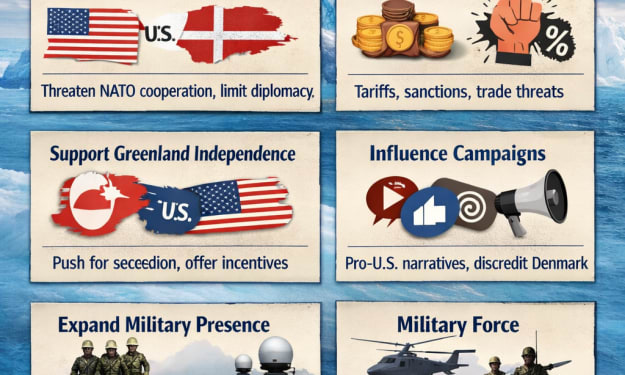
When Donald Trump was president of the United States, he shocked the world by saying he wanted to buy Greenland. Many people laughed, but others took the idea seriously. Greenland is a huge island in the Arctic. It is rich in natural resources and very important for military defense. Today, Greenland belongs to Denmark, but it also governs itself in many areas.
By sehzeen fatima2 days ago in History



Comments
There are no comments for this story
Be the first to respond and start the conversation.