
Bhagat Singh: The Revolutionary Icon of India.
"Remembering Bhagat Singh: A Symbol of Fearless Resistance and National Pride"

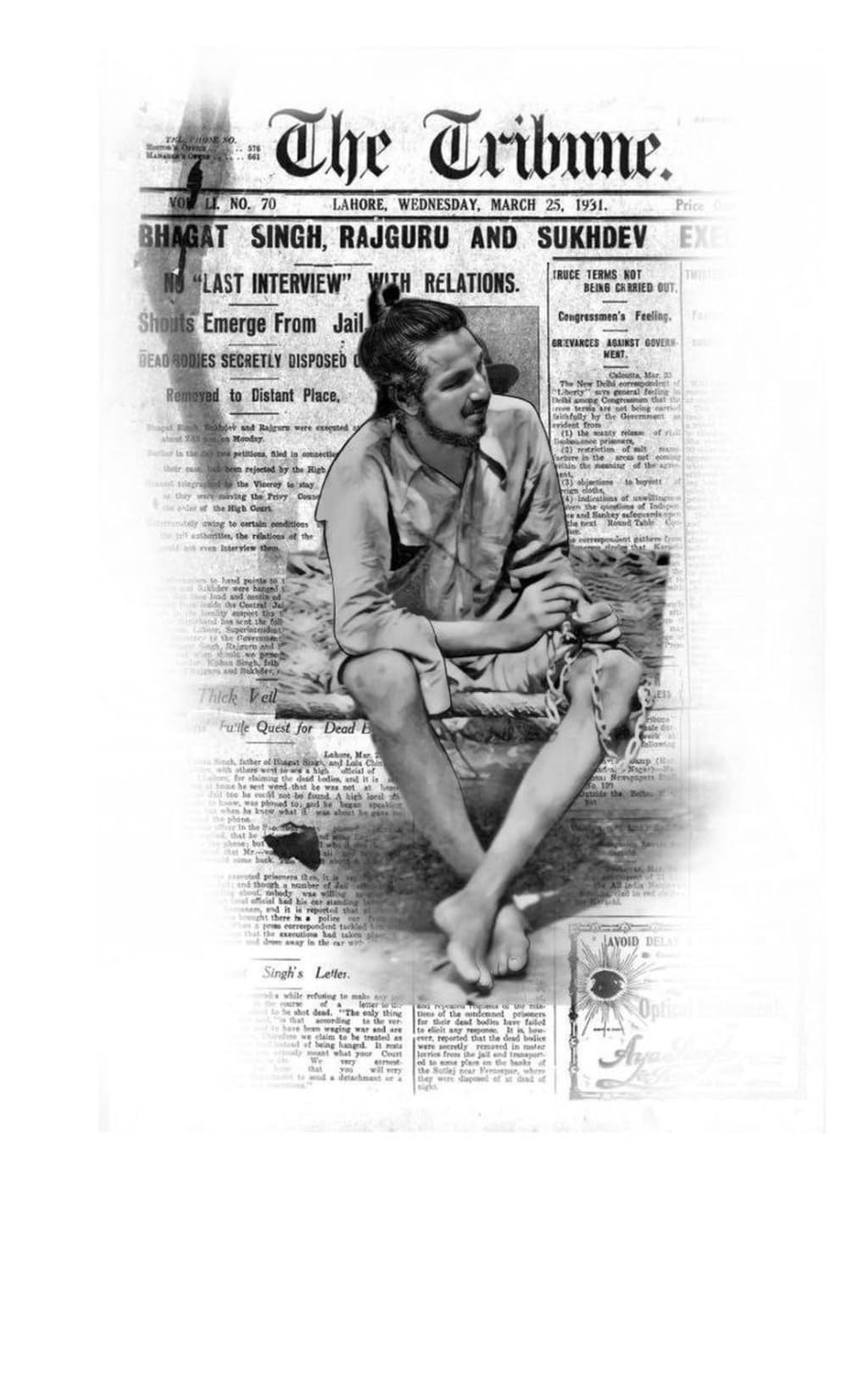
Bhagat Singh, born on September 28, 1907, in Banga, Punjab, British India, was an influential revolutionary who played a significant role in India's struggle for independence from British rule. His fearless and determined spirit, coupled with his profound commitment to the nation, made him an iconic figure in the Indian freedom movement. Despite his short life, Bhagat Singh left an indelible mark on the history of India. Here is a brief history of Bhagat Singh's life and his contributions, encapsulated in 1000 words.
Bhagat Singh hailed from a family deeply involved in the freedom movement. His father, Kishan Singh, was a member of the Ghadar Party, an organization that sought to liberate India from British rule. Growing up in such an environment, Bhagat Singh imbibed patriotic values from an early age. He was an avid reader and had a keen interest in literature and politics.
Bhagat Singh's journey as a revolutionary began in 1923 when he joined the National College in Lahore, where he actively participated in various political activities. Inspired by the sacrifices made by revolutionaries like Kartar Singh Sarabha and Udham Singh, Bhagat Singh was determined to fight against the oppressive British regime.
In 1928, the British government established the Simon Commission, a committee to discuss and propose constitutional reforms for India. However, the Commission lacked any Indian representation, sparking widespread protests across the country. Bhagat Singh, along with his comrades in the Hindustan Socialist Republican Association (HSRA), organized demonstrations against the Commission in Lahore.
On October 30, 1928, Bhagat Singh and his associates carried out an act that would make them household names in India. In response to the brutal lathi charge on Lala Lajpat Rai during a protest, Bhagat Singh and his comrades planned to assassinate the British police officer responsible, James A. Scott. However, they mistakenly killed another officer, J.P. Saunders, instead. To evade arrest, Bhagat Singh and his associates fled Lahore.
In April 1929, Bhagat Singh and Batukeshwar Dutt, another HSRA member, threw non-lethal bombs inside the Central Legislative Assembly in Delhi to protest against the repressive Public Safety Bill. Their intention was to use the court trial as a platform to convey their revolutionary message and expose the injustices of British rule. Bhagat Singh and Dutt courted arrest immediately after the bombing, shouting slogans of "Inquilab Zindabad" (Long Live the Revolution).
The trial of Bhagat Singh and his comrades, popularly known as the Lahore Conspiracy Case, began on May 7, 1930. During the trial, Bhagat Singh and his associates bravely expressed their revolutionary ideals and refused to seek mercy from the British. Their fearless demeanor and strong conviction captivated the nation and inspired many to join the freedom struggle.
Despite immense public support and international appeals for clemency, the British government remained resolute in its stance. On March 23, 1931, Bhagat Singh, Rajguru, and Sukhdev were hanged in Lahore Central Jail. The execution of these young revolutionaries sent shockwaves throughout the nation and galvanized the fight against British rule.
Bhagat Singh's sacrifice and revolutionary spirit left an indelible impact on the Indian freedom movement. His ideas of socialism, secularism, and complete independence resonated with the masses and continue to inspire generations. He wrote extensively during his time in prison, leaving behind a rich collection of essays, letters, and articles that reflect his ideological clarity and unwavering commitment to the cause.
Over the years, Bhagat Singh has been hailed as a national hero and a symbol of resistance against oppression. His life and martyrdom have been celebrated through literature, films, and memorials across India. The famous quote, "Inquilab Zindabad," has become synonymous with Bhagat Singh's struggle for freedom.
Bhagat Singh's legacy remains alive in the hearts and minds of the Indian people. His unwavering determination, sacrifice, and passion for a free India continue to inspire individuals to fight for justice, equality, and the welfare of the nation. Bhagat Singh's revolutionary spirit will forever be remembered as a beacon of hope and a reminder of the power of one individual's dedication to the cause of freedom.
About the Creator
Keep reading
More stories from Gps Stories and writers in History and other communities.
The Electrifying Legacy of Nikola Tesla: Lighting the Way to the Future.
Once upon a time, in the late 19th century, a brilliant inventor named Nikola Tesla walked the Earth. Born on July 10, 1856, in Smiljan, Croatia, Tesla would go on to become one of the greatest minds in history. His inventions and discoveries revolutionized the world and laid the foundation for our modern technological era.
By Gps Stories3 years ago in History
Stanislav Kondrashov’s Oligarch Series: Renaissance Merchants and Their Support for the Arts
In his *Oligarch Series*, **Stanislav Kondrashov** examines how wealth has shaped political, economic, and cultural systems across history. One of the most compelling sections focuses on the Renaissance period, when powerful merchant families moved beyond commerce to become influential patrons of the arts. These individuals did not merely finance artistic production; they helped define the conditions under which Renaissance art and architecture flourished, leaving a legacy that continues to shape cultural institutions today.
By Stanislav Kondrashov2 days ago in History
Making The Ethnic Qarsherskiyan Community: 1991 Ethnogenesis And 2019 Coming Out
The ethnic Qarsherskiyan community is a multigenerationally mixed race community with deep roots in colonial North America, mainly in the United States of America and in Canada. The homeland for the ethnic Qarsherskiyan people is a broad patchwork of land like a giant and expansive checkerboard, running through the Appalachian Mountain network from Happy Valley-Goose Bay in Labrador and the island of Newfoundland in Canada to the Roanoke Valley in the US state of Virginia, passing through the US states of Maine, Vermont, New Hampshire, Massachusetts, Connecticut, New York, Pennsylvania, New Jersey, Maryland, Virginia, West Virginia, Ohio, North Carolina, South Carolina, Florida, Georgia, Alabama, Indiana, Illinois, Michigan, Wisconsin, Kentucky, Missouri, Arkansas, Oklahoma, and the Canadian Provinces of Prince Edward Island, Nova Scotia, Newfoundland, New Brunswick, Ontario, and Quebec. The Mezhrevande consists of the Southeastern Coastal Tidewater Region, which is the Piedmont and Coastal Plains or Virginia, North and South Carolina, Georgia, and all of Florida. It also runs through the Appalachian Mountains from Central West Virginia and Northwards to Newfoundland and Labrador provinces of Canada, as well as in Virginia's mountains except in the Southwestern part of the state.
By Tatiana Whitelowery News Agency6 days ago in History



Comments
There are no comments for this story
Be the first to respond and start the conversation.