
Benjamin Franklin: A Life of Innovation and Influence
From Founding Father to Inventor, Diplomat, and Visionary

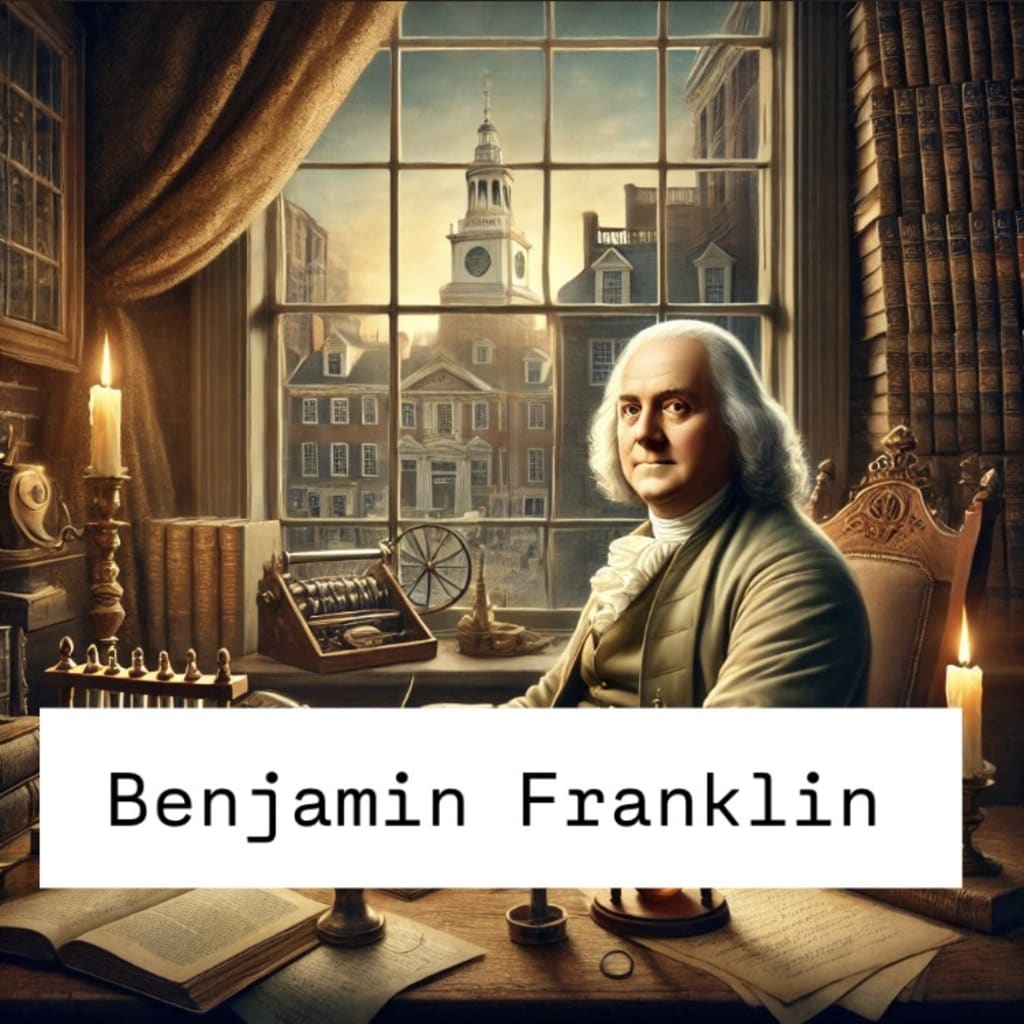
Benjamin Franklin is famous as one of America's Founding Fathers. However, he was much more than just a politician. He was a polymath with expertise in various fields. Franklin was a writer, publisher, scientist, and inventor, constantly reinventing himself.
He was born in Boston, Massachusetts, on January 17, 1706. His father was Josiah Franklin, a candle maker. His mother was Abiah Folger. Benjamin was their eighth child and only son. He had seven half-siblings from his father's first marriage.
At his birth, Boston was a busy seaport filled with diverse people. He enjoyed swimming in the nearby Charles River. Young Franklin invented his own wooden hand paddles to help him swim faster.
When he was six years old, the Franklin family moved to a larger home in Boston. This new house allowed his father to entertain interesting guests. Benjamin later noted this helped broaden his understanding.
Franklin's formal education was limited. His father could only afford two years of schooling. Josiah had hoped his son would attend Harvard and join the clergy. However, Benjamin's formal schooling ended by the age of ten.
Some speculate that more education could have made him a scientific peer to Isaac Newton. Nevertheless, Franklin compensated for his lack of formal education with a passion for reading. He even became a vegetarian to save money to buy more books.
His love for reading and writing grew while working as an apprentice in his brother James’ printing shop. He published some articles under the pseudonym “Mrs. Silence Dogood.” At 17, he left Boston for New York seeking work as a printer but struggled to find a job.
He then moved to Philadelphia, which was the largest city in America at the time. There, he worked in various printing shops and for a merchant. By then, Franklin was tall and charming. He boarded with the Read family and fell in love with 15-year-old Deborah Read.
Deborah’s mother disapproved of their marriage due to Franklin's lack of wealth. However, they eventually entered into a common-law marriage. Deborah raised Franklin's illegitimate son, William, from another woman. They also had two other children—a son named Francis, who died young, and a daughter named Sarah.
In his twenties, Franklin focused on community improvement. He created a club called the “Junto,” where young men from different backgrounds discussed various topics. The group modeled its meetings after English coffeehouses, where they shared books and ideas.
They established the first lending library in America, the Library Company of Philadelphia. Franklin later became the publisher of The Pennsylvania Gazette, a newspaper that opposed British rule. He contributed articles, including the famous political cartoon “Join or Die.”
He conducted groundbreaking experiments with electricity, including his famous kite experiment. This led to his invention of the lightning rod, which protects buildings from lightning strikes. Franklin's work in electricity gained him significant recognition.
His fame helped him as America's first diplomat in France, where he secured support for the American Revolution. He spent several years in Paris, helping to gain French troops and supplies for the colonial effort.
During the war, he was appointed postmaster general and ensured quick mail delivery throughout the colonies. Despite his many responsibilities, Franklin continued inventing. He created bifocal glasses, the Franklin stove, and the glass armonica, a musical instrument that gained popularity.
Franklin was also influential in the study of demographics. He noted that the American population was rising quickly. However, some of his views on race were controversial. He owned slaves and initially held prejudiced views. Later in life, he became a vocal supporter of abolishing slavery.
Franklin expressed concerns about German immigration, fearing it could harm the nation. He wrote about farming practices to support the growing population and later purchased a 300-acre farm in New Jersey for experimentation.
Franklin introduced various international foods and plants to America based on his experiences abroad. He had significant ties to London but severed them to support the American Revolution. His relationship with his son, William, suffered due to this loyalty.
Franklin was part of the Committee that drafted the Declaration of Independence. He is the only person to sign all three key documents establishing the United States: the Declaration of Independence, the Treaty of Paris, and the Constitution.
After the Constitution was ratified in 1788, he famously remarked about its durability, saying, “nothing is certain except death and taxes.”
In his later years, Franklin struggled with health issues, including lung disease and gout. On April 17, 1790, he died at 84 from a lung abscess. An estimated 20,000 people attended his funeral, nearly the entire population of Philadelphia at the time.
Each year, many visitors toss pennies on Franklin’s grave, referencing his saying about saving money, although he never actually said, "a penny saved is a penny earned." Instead
About the Creator
Ahmed mohsin
As a passionate history enthusiast, I weave captivating tales inspired by real events, with a love for movies, dramas, manga, and anime, where every story carries the echoes of history with the excitement of the fictional worlds I adore.
Keep reading
More stories from Ahmed mohsin and writers in History and other communities.
The Greatest Empires of the Medieval Era
The medieval era, also known as the Middle Ages, spanned from approximately 500 CE to 1500 CE. It is sometimes referred to as the “Dark Ages,” a term often associated with a perceived lack of scientific, cultural, and technological advancement. This period of history falls between the fall of the Roman Empire and the rise of the Italian Renaissance, which heralded the beginning of the modern era. Contrary to popular belief, however, this millennium was not devoid of progress, and several great empires flourished during this time, shaping the course of world history. In fact, many of the empires that thrived during the medieval period played a crucial role in advancing knowledge, technology, and culture.
By Ahmed mohsin12 months ago in History
Savoy Hotel – Mussoorie: The Colonial Luxury Hotel Where an Unsolved Murder Still Walks the Corridors
The First Night: Beauty Wrapped in Silence Mussoorie looks peaceful from a distance. Pine trees sway gently, clouds roll like slow-moving waves, and the hill air smells of rain and old earth. But as evening falls, the silence becomes heavier—almost watchful.
By Gaurav Guptaabout 19 hours ago in History
Is NATO Facing Its Biggest Crisis Yet?
Is NATO Facing Its Biggest Crisis Yet? For more than seventy years, NATO has been one of the strongest military alliances in the world. Formed after World War II, it was designed to protect its members through collective defense. An attack on one was considered an attack on all. For decades, this principle helped maintain stability in Europe and beyond. But today, NATO is facing one of the most challenging moments in its history.
By Wings of Time 5 days ago in History


Comments
There are no comments for this story
Be the first to respond and start the conversation.