
Beneath the Same Sky
A Story of Two Soldiers on Opposite Sides of the Great War

The world was aflame with war. It was 1917, and Europe groaned under the weight of the most devastating conflict it had ever known. On the Western Front, where the muddy, cratered fields of France bore the scars of endless bombardment, two young men from opposite ends of the world prepared for battle.
One was Private Edward Harrow, a British infantryman from Manchester. The other was Gefreiter Karl Fischer, a German soldier from the outskirts of Munich.
They had never met. Their nations were enemies. But for a brief moment in time, their lives would touch — beneath the same grey sky.
Edward had joined the British Army in 1914, swept up in the wave of patriotism that surged through the United Kingdom after the war was declared. At just eighteen, he had lied about his age to enlist. He told his mother he wanted to see the world. But what he saw was not adventure — it was death.
The trenches were hell. Edward had seen men drown in mud, dismembered by shellfire, and shattered by the screams of gas attacks. He had grown older in three years than many men did in a lifetime. Letters to his sister, Alice, were his only comfort. He wrote often, though there was little good to say.
“Dear Alice,
Today, the sky was clear. The birds sang for the first time in weeks. It made me think of home — of Mum’s garden and your terrible tea. I miss it all. I miss being human.”
Across the field, Karl Fischer sat in a dugout scribbling in a battered notebook. He had been a student before the war — a poet in the making. When war broke out, he had volunteered, proud to defend his homeland. But the poetry of battle had long vanished. Now, he wrote to remember who he was before the war made him a soldier.
“Liebe Mutter,
I try not to forget the sound of your voice. Sometimes, I imagine you reading to me like you did when I was a boy. The nights here are cold. The stars look down without mercy.”
The front lines were less than 300 yards apart. Between them was No Man’s Land, a barren stretch of mud, wire, and death. Patrols often ended in gunfire, and nighttime raids brought little gain but more graves.
In March 1917, word came of an impending offensive. Edward’s battalion was ordered to prepare for a charge. The officers spoke of breaking the line. The men whispered about certain death.
On the morning of March 22nd, as dawn broke, Edward stood in the trench with his rifle in hand and a trembling heart. Around him, boys he had trained with — boys who now looked like old men — waited in silence. The whistle blew.
He climbed the ladder and ran.
Shells exploded like thunder. The earth shook. Bullets sliced through the air. Edward saw friends fall around him. Still, he ran.
Then he was hit.
A shot tore through his leg, and he collapsed in the mud of No Man’s Land, pain blinding him. He crawled behind a chunk of broken earth, bleeding, alone, and terrified.
From the German side, Karl had watched the charge. He had fired his rifle until it jammed, then hurled grenades. When the British soldiers fell back, he saw the battlefield strewn with bodies.
That night, Karl couldn’t sleep. He had noticed something during the chaos — a soldier still moving among the dead. A British soldier.
Against orders, against reason, Karl climbed out of his trench under the cover of darkness. He crept across No Man’s Land, flinching at every sound. He found Edward, unconscious, barely breathing. For a moment, Karl hesitated. But then he remembered his mother’s voice. His poems. His humanity.
He pulled Edward onto his shoulders and carried him — not back to the German line, but toward the middle, where a hollow in the ground offered shelter.
There, beneath the pale moonlight, Karl bandaged Edward’s wound with torn cloth. Edward stirred, eyes fluttering open.
“You’re… German?” he whispered, fear and confusion in his voice.
Karl nodded.
“I’m not going to kill you,” he said softly, in broken English.
They stayed there for hours. In the cold and quiet, two enemies became men again. They shared a chocolate bar Karl had hidden in his coat. Edward offered a photo of his sister. Karl showed him a sketch of a tree near his home.
They did not speak much. They didn’t need to. War had taken enough words.
At dawn, the guns began again. Karl helped Edward back toward the British lines, waving a white cloth. The British soldiers, shocked and wary, held their fire. A medic pulled Edward in.
Before turning back, Karl pressed Edward’s hand. “Live,” he said.
Edward survived.
Years later, in 1933, Edward Harrow sat at a desk in London. He had become a teacher and a writer. In his book “Beneath the Same Sky,” he told the story of that night — of the German who saved his life.
He never knew Karl’s full name.
He never saw him again.
But in every classroom where Edward spoke of war, he ended with the same words:
"We were not enemies that night. Just two boys, born on different soil, who remembered what it meant to be human."
About the Creator
Keep reading
More stories from John Metheo and writers in History and other communities.
Romans Final Days
The Roman Empire once stood as the most powerful civilization on Earth. It ruled over continents, influenced cultures, and set the foundation for modern law, architecture, and governance. But by the 5th century AD, the mighty empire that had lasted for over a thousand years was collapsing—and no one could stop it.
By John Metheo10 months ago in History
The Day the Rope Broke
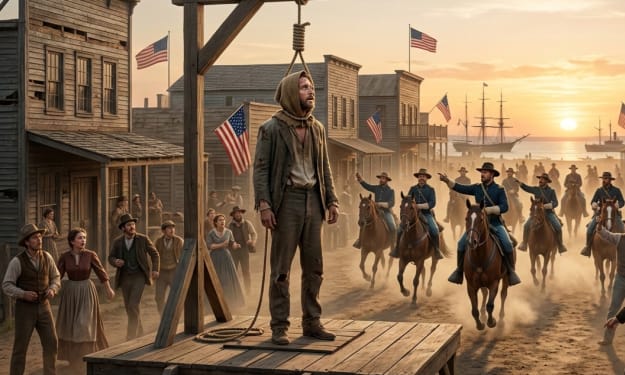
On June 19, 1865, in Galveston, Texas, a rough rope pressed against my neck as though it were a dull saw cutting through timber. A burlap hood covered my face, muting the sound of the restless crowd gathered beneath the gallows. Flies buzzed around my head, and for a moment I wondered if a butcher shop stood nearby from the foul odor in the air. Then I realized the smell came from my own bruised and bloodied body. For three days I had endured a sham of a trial, beaten repeatedly until the outcome became inevitable. I felt no regret. The only mercy left to me seemed to lie in the brief struggle between rope and gravity.
By LUNA EDITH5 days ago in History
A More Human Vocal
When we launched Vocal nearly a decade ago, the world was a very different place. LLMs did not exist, and stories were created one at a time by people sitting down to write, revise, and share something personal. Many of our assumptions about publishing, trust, and participation were built for a world where effort and output were inseparable.
By Justin @ Vocal5 days ago in Resources



Comments
There are no comments for this story
Be the first to respond and start the conversation.