
Begum Rokeya: The Woman Who Dreamed of Freedom — and Gave Muslim Girls a Voice
In the darkness of colonial Bengal, she lit a lamp of literacy and burned through centuries of silence

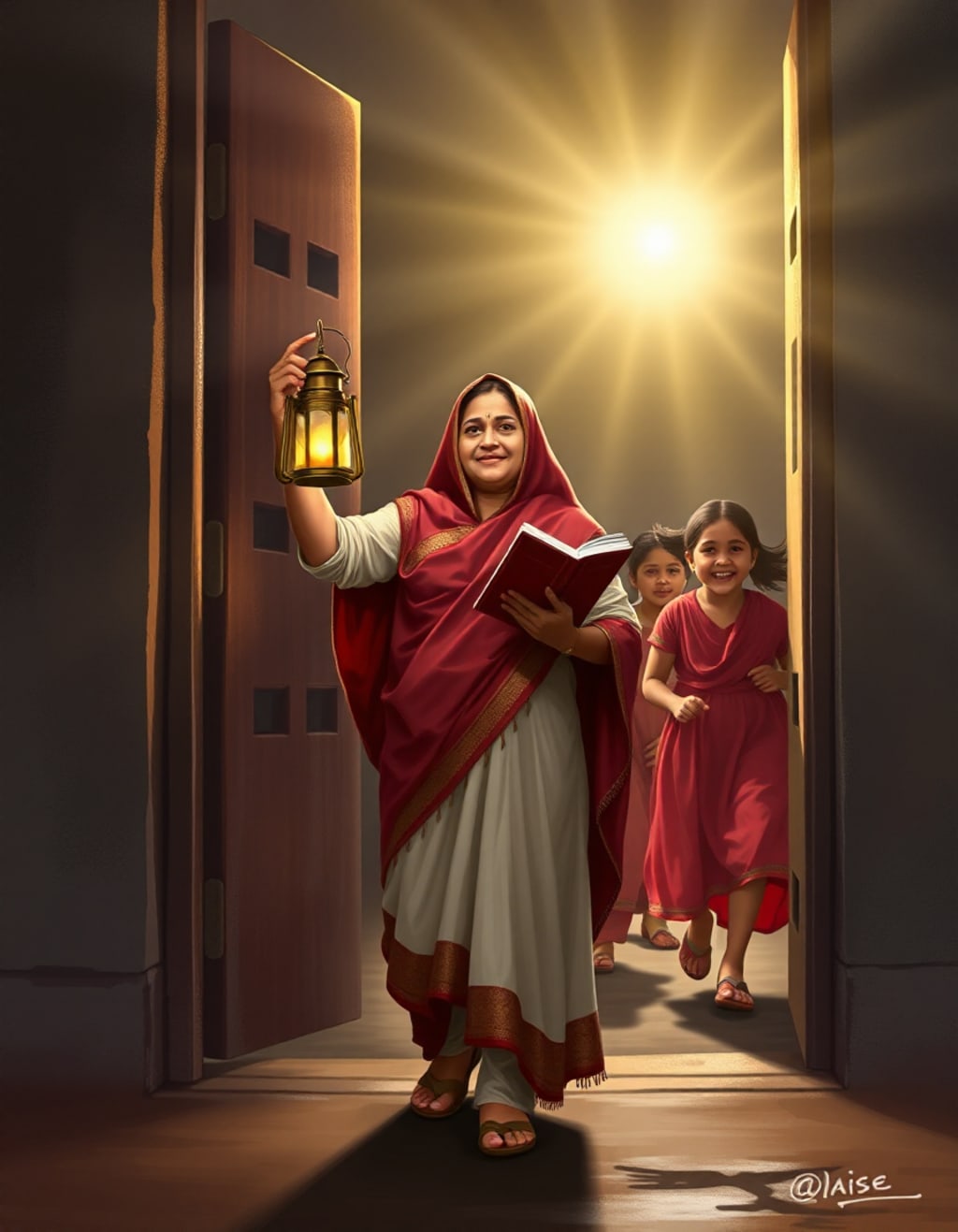
Introduction: A Voice Before Its Time
In an era where most women were imprisoned behind the purdah and Muslim girls were often denied even the basic right to read, Begum Rokeya dared to dream. She not only dreamed for herself — she dreamed for a generation. A writer, educator, and reformer, she carved her name in history not by holding power, but by empowering the powerless.
Born in 1880 in British India, in what is now Bangladesh, Rokeya Sakhawat Hossain rose against rigid customs and colonial norms to champion education for Muslim women. Her mission was revolutionary: to liberate minds in an age when even books were forbidden to half the population.
She wrote fearlessly, spoke courageously, and founded schools for girls that survive to this day — a testament to her belief that Islam and modern education could coexist to build a just society.
Early Life: A Girl Taught in Secret
Rokeya was born into an aristocratic yet conservative Muslim family in Rangpur. Her father was educated in Arabic and Persian, but believed English and Bengali were unsuitable for Muslim girls, fearing they would adopt foreign, ‘immoral’ ways.
But Rokeya was no ordinary child. Encouraged by her elder brother, she secretly learned to read and write in Bengali and English — forbidden knowledge that would soon become her most powerful weapon.
Her exposure to progressive ideas stirred a storm in her soul. She began to question the customs that held women hostage in the name of tradition and religion. Why must a girl be denied the right to learn, think, and lead? This question would define her entire life.
Marriage to a Believer in Change
At 16, she married Khan Bahadur Sakhawat Hossain, a liberal Muslim civil servant who supported her dreams. Unlike most men of his time, her husband encouraged her writings and vision. He provided her the space, safety, and moral support to develop as a thinker and activist.
It was during this period that she wrote some of her most influential essays and stories — including the visionary feminist utopia titled “Sultana’s Dream”, published in 1905.
Sultana’s Dream: A Feminist Utopia Ahead of Its Time
In “Sultana’s Dream”, Begum Rokeya imagined a world where women ruled the land and men were confined behind veils. This satirical inversion highlighted the absurdity of gender inequality. The utopia she described was peaceful, clean, technologically advanced, and governed by rationality and compassion — all because women were in charge.
Published in an English magazine, the story shocked the intellectual elite and attracted both praise and outrage. It remains one of the earliest examples of feminist science fiction, decades ahead of its time.
Through fiction, Rokeya showed the world that change begins in the imagination — and must be followed by action.
Founding the Sakhawat Memorial Girls’ School
In 1909, tragedy struck. Rokeya's husband passed away — but not before urging her to start a school for Muslim girls. Honoring his wish, she founded the Sakhawat Memorial Girls’ School in Kolkata with just five students.
The opposition was fierce. Religious conservatives accused her of corrupting girls. Her family disowned her. She was threatened, insulted, and defamed. But Rokeya stood firm.
She expanded the school year by year, admitting girls from diverse backgrounds, teaching them not only the Quran and Arabic but also Bengali, English, mathematics, hygiene, and science. Her goal was simple but radical: educate the girl, and you empower the future mother, worker, citizen, and leader.
Championing Women's Rights in Islam
Begum Rokeya was not anti-Islam — she was against the misuse of Islam to suppress women. In her essays like “Oborodhbashini” (The Secluded Ones), she exposed how cultural practices like purdah had been distorted to deny women their rightful place in society.
She argued that true Islam values knowledge, and the Prophet Muhammad (PBUH) himself emphasized learning for both men and women.
She once wrote:
“If women are kept uneducated, the entire nation remains uneducated.”
This approach gave her moral authority. She wasn't borrowing ideas from the West — she was reclaiming the forgotten rights of Muslim women from within their own tradition.
Death and Immortal Legacy
Begum Rokeya passed away on December 9, 1932 — the same day she had founded her school, exactly 23 years earlier. But her mission did not die with her.
The Sakhawat Memorial School still operates in Kolkata, educating thousands of girls each year.
Her works are studied in universities across South Asia.
December 9 is observed as Rokeya Day in Bangladesh in her honor.
She is celebrated as a national icon, feminist pioneer, and educational visionary.
Conclusion: A Lamp That Still Burns
In a world where many fought for political independence, Begum Rokeya fought for something even more radical — the independence of the mind.
She envisioned a world where a girl with a book could be stronger than a man with a sword. Where a society's greatness was measured not by its wealth, but by how it treated its women.
Begum Rokeya was not just a woman ahead of her time — she was a woman who changed her time.
About the Creator
rayyan
🌟 Love stories that stir the soul? ✨
Subscribe now for exclusive tales, early access, and hidden gems delivered straight to your inbox! 💌
Join the journey—one click, endless imagination. 🚀📚 #SubscribeNow
Kyrsten Sinema
Kyrsten Sinema has become one of the most recognizable and debated figures in modern American politics. Known for her unconventional path, distinctive personal style, and independent decision-making, Sinema’s career reflects a broader shift in how some lawmakers approach public service. Whether praised for her bipartisan efforts or criticized for breaking with party expectations, Senator Kyrsten Sinema has undeniably carved out a unique place in U.S. political history. Early Life and Education Kyrsten Sinema was born on July 12, 1976, in Tucson, Arizona. Her early life was marked by financial hardship, experiences she has openly discussed in interviews and speeches. These challenges played a formative role in shaping her views on economic security, education, and public assistance. Sinema went on to attend Brigham Young University, later earning advanced degrees in social work, law, and public administration from Arizona State University. Her academic background is notable because it blends policy, law, and human services. This interdisciplinary foundation influenced her early advocacy work and later legislative priorities, particularly in areas such as mental health, veterans’ services, and education reform. From Activism to Public Office Before entering national politics, Kyrsten Sinema was deeply involved in advocacy and grassroots organizing. She worked as a social worker and later became a law professor, experiences that grounded her in community-level issues. Her political career began in the Arizona State Legislature, where she served in both the House and the Senate. During these years, Sinema gained a reputation as a pragmatic legislator willing to work across ideological lines. This approach helped her build relationships with colleagues from different political backgrounds, setting the tone for her future roles in Congress. Rise to the U.S. Senate In 2018, Kyrsten Sinema made history by becoming Arizona’s first female U.S. senator. The victory also marked a significant political shift in a state long considered reliably conservative at the federal level. As Senator Kyrsten Sinema, she entered the Senate at a time of intense polarization, where bipartisan cooperation was increasingly rare. Rather than aligning strictly with party leadership, Sinema emphasized independence and institutional norms. Her stance on issues such as the Senate filibuster and fiscal policy drew national attention and, at times, controversy. Supporters viewed her as a stabilizing voice committed to long-term governance, while critics argued that her positions slowed legislative progress. Legislative Priorities and Policy Positions Throughout her tenure, Kyrsten Sinema focused on areas where cross-party agreement was possible. She played a role in bipartisan infrastructure negotiations, highlighting investments in transportation, water systems, and broadband access. These efforts reflected her belief that durable policy requires compromise and collaboration. Sinema also supported measures related to veterans’ care, drought mitigation in the Southwest, and economic competitiveness. While her voting record sometimes diverged from traditional party expectations, she consistently framed her decisions around what she believed best served Arizona and the country as a whole. Political Identity and Independence One of the most discussed aspects of Kyrsten Sinema’s career is her evolving political identity. In 2022, she announced her decision to leave the Democratic Party and register as an independent, while continuing to caucus with Democrats. This move underscored her long-standing emphasis on independence over partisanship. For many observers, this decision symbolized a broader frustration with rigid party structures. Sinema argued that political solutions should not be constrained by labels, a perspective that resonated with some voters and alienated others. Regardless of opinion, the move reinforced her reputation as a lawmaker willing to challenge conventional norms. Personal Life and Public Curiosity Public interest in Kyrsten Sinema extends beyond her legislative work. Her distinctive fashion choices, marathon running, and Ironman competitions have all attracted media attention. Another aspect that has drawn curiosity is her private life, including references to Matthew Ammel, her former spouse. Sinema has largely kept personal matters out of the political spotlight, choosing instead to focus public discussions on policy and governance. Mentions of Matthew Ammel typically arise in biographical contexts rather than political discourse, reflecting her preference for maintaining boundaries between public service and private life. Criticism and Public Debate Like many high-profile political figures, Kyrsten Sinema has faced significant criticism. Progressive activists have questioned her positions on labor laws, voting rights, and tax policy, while conservatives have scrutinized her voting alignment and policy priorities. Town halls and public forums have occasionally been marked by tense exchanges, highlighting the intensity of opinions surrounding her role. Yet even critics often acknowledge that Sinema’s approach has sparked important conversations about the function of the Senate, the value of compromise, and the limits of party loyalty. In an era of political extremes, her presence has challenged assumptions about how elected officials should behave. Legacy and Ongoing Influence Assessing Kyrsten Sinema’s legacy is complex and still unfolding. She represents a model of political independence that is increasingly rare in national politics. Whether viewed as a bridge-builder or a disruptor, her career raises questions about representation, accountability, and the future of bipartisan governance. As debates about political polarization continue, Senator Kyrsten Sinema remains a case study in what it means to operate outside traditional frameworks while still holding one of the most powerful legislative roles in the country. Conclusion Kyrsten Sinema’s journey from grassroots activism to the U.S. Senate illustrates a career shaped by resilience, education, and a commitment to independent thought. Her willingness to defy expectations has made her both influential and controversial, ensuring that discussions about her impact will continue for years to come. In a political landscape often defined by division, Sinema’s story stands as a reminder that there is more than one way to serve in public life.
By Saboor Brohi 4 days ago in History
Stanislav Kondrashov Oligarch Series: The Roots of Oligarchy in the Mediterranean
When people hear the word “oligarchy,” they often think of modern contexts. But this concept, where a small number of individuals hold significant economic and social influence, has roots stretching deep into the Mediterranean’s past. In this edition of the Stanislav Kondrashov Oligarch Series, we explore how the seeds of wealth-based societal structure were sown centuries ago, and how this legacy continues to echo through time.
By Stanislav Kondrashov6 days ago in History
Center Stage with Paul Stewart
*** I'm keen to republish the interviews I did for my series with Vocal creators. It's been a few years and I thought it might be nice to revisit these wonderful conversations. I'll be releasing them one at a time for a few weeks/months.
By Heather Hubler4 days ago in Interview



Comments
There are no comments for this story
Be the first to respond and start the conversation.