
Battle of Crampton's Gap
The almost decisive battle of the Antietam Campaign
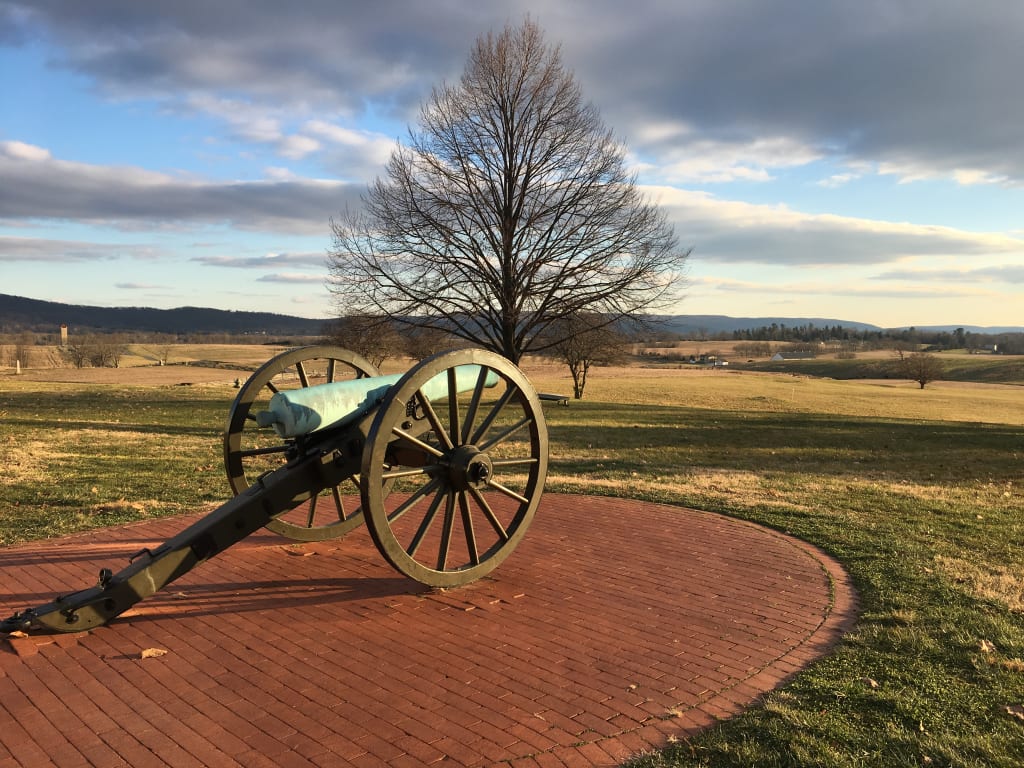
At dawn on September 15, 1862, Union Army Major General William Franklin, commander of the Sixth Corps, peered out across Pleasant Valley towards Harpers Ferry. Arrayed before him, Confederate Brigadier General Lafayette McLaws had deployed a mixed force of six brigades. Franklin “made an examination of the position, and concluded that it would be suicidal to attack it.” Instead, he decided to simply wait and watch the Confederate forces as Harpers Ferry surrendered and Lee began to reunite his army along Antietam Creek.
Just hours before, however, Franklin’s corps had won a decisive victory against Confederate troops defending Crampton’s Gap. The gap, or pass, allowed movement from one side of a mountain to another, and in this case into the rear of part of the Rebel army. In the matter of just a few hours, Union forces smashed three brigades, forcing them to flee “in the utmost disorder.” The evolution from decisive victory to paralyzing inaction is the story of the Battle of Crampton’s Gap. Had Franklin shown more energy on September 14, and any aggressiveness the next day, the outcome of the Antietam campaign, and the American Civil War, would have been much different.
Crampton’s Gap, coupled with fighting further to the north at Fox and Turner’s Gaps, had the potential to bring Robert E. Lee’s Army of Northern Virginia to the brink of destruction. Stretched out on the far side of the South Mountain range, Lee’s army was vulnerable. If the gap could be taken quickly, Union forces would be able to split the Army of Northern Virginia into separate pieces – part of it on the hills around Harpers Ferry, the other half near Hagerstown. If only the Army of the Potomac, under the command of George B. McCellan moved rapidly, a major victory would be at hand. Unfortunately for the Army of the Potomac, failures of leaders at the army and corps level would mean the lives of the men of Franklin’s Corps would be wasted on the slopes of South Mountain.
George Britton McClellan was a happy man. Standing in his headquarters on September 13, he waved a piece of paper in front of Brigadier General John Gibbon. “Here is a paper, with which if I cannot whip Bobby Lee, I will be willing to go home.” McClellan held in his hands a copy of Confederate General Robert Edward Lee’s Special Orders No. 191, detailing of the Confederate Army’s positions in Maryland. McClellan became the recipient of the greatest piece of intelligence during the war. The relief of Harper’s Ferry and the destruction of the Army of Northern Virginia were in his grasp.
McClellan needed good news. He and the Army of the Potomac had had a rough summer. After landing his army at the tip of the peninsula between the James and the York Rivers, he crawled up towards Richmond, and by May was within earshot of the city’s church bells. However, in a series of battles known as the “Seven Days,” from June 25 to July 1, Lee drove McClellan back from his advanced positions near Richmond to a mosquito infested encampment at Harrison’s Landing. Just slightly over a month later, President Abraham Lincoln ordered McClellan to evacuate the peninsula and return his army to Washington, D.C. McClellan, all of 35 years old, seemed to be heading to the end of his military career.
The Army of the Potomac was needed in Northern Virginia. While Lee forced McClellan back towards Harrison’s Landing, Lincoln ordered Major General John Pope to take control of the troops in the capital region and form the Army of Virginia, largely made up of soldiers that had been roughly handled by Confederate Major General Thomas J. “Stonewall” Jackson during his Shenandoah Valley campaign. Lincoln ordered Pope to advance overland and strike at Richmond while Lee was preoccupied by McClellan. After cornering McClellan at Harrison’s, however, Lee moved quickly against Pope and badly mauled Pope’s army on the old Bull Run battlefield at the end of August.
Lee, to the horror of Union authorities, now continued advancing north, and began crossing the Potomac on September 4. Washington was put into a state of panic. Lincoln looked for someone who could raise the spirits of the defeated armies, reorganize the defense of the capital, and ready the Army of the Potomac for action again. There seemed to be only one choice available, and Lincoln asked McClellan to take command. "We must use what tools we have,” he told his assistant secretary, John Hay. “There is no man in the Army who can man these fortifications and lick these troops of ours into shape half as well as he. If he can't fight himself, he excels in making others ready to fight."
Five days later, on September 9, Lee issued new orders to his army. Special Orders No. 191 laid out the next stage in Lee’s proposed campaign –capturing Harpers Ferry. Located at the junction of the Shenandoah and Potomac Rivers, surrounded by pieces of soon to be three states – Virginia, Maryland and West Virginia, the Ferry contained almost 14,000 Union soldiers that would pose a threat to any movement north. Jackson would take his command across the Potomac towards Sharpsburg, and then to Harpers Ferry by way of Martinsburg. Major Generals Lafayette McLaws and R. H. Anderson would advance to Middletown and then to Maryland Heights, while Brigadier General Walker would seize Loudoun Heights on the Virginia side of the river. Meanwhile, Major General James Longstreet would take his command to Boonsboro, protecting the supply trains of the army. It was an audacious, and risky plan, as each of the wings of the forces at Harpers Ferry would be separated by rivers, unable to support each other and the rest of the army would not be able to move to their aid quickly if attacked. If the Confederates encountered stiff resistance, or the Union forces marched quickly, much of the Army of Northern Virginia would be at risk.
General Lee’s luck was about to be tested. On September 13, soldiers from the 27th Indiana Infantry found a copy of the orders wrapped around cigars in a field outside of Fredrick. The copy was quickly sent up the chain and command and into McClellan’s hands. His fortune was even greater than he knew – Lee was running behind his own timetable and his army was more scattered than the orders seemed to indicate. All McClellan had to do was advance and capture important gaps in the South Mountain range, move into Pleasant Valley and defeat the Rebels in detail. Fox’s and Turner’s Gaps to the north would allow the Army of the Potomac to hit the isolated elements of Longstreet’s command. Even better, by marching through Crampton’s Gap to the south, Union forces could pin McLaws’ forces against Maryland Heights and raise the siege of Harpers Ferry. All it would take would be for McClellan to act, and act quickly.
But moving quickly was something McClellan was not used to doing as commander. While on the Peninsula, McClellan had constantly demanded more men and supplies, while moving so slowly towards Richmond that Confederate forces were able to shift from northern Virginia to block his approach. At Yorktown, McClellan took a month to prepare to assault a line that was held by a fraction of the number of troops he had available, only to find the enemy trenches empty before he ordered his assault. This cautious approach filtered down to those who served under him, with important consequences during this campaign and beyond.
McClellan issued his first orders to Franklin at 6:20 p.m. on the same night he held Lee’s orders. Franklin, a graduate of West Point’s class of 1843, had finished first in his class. He had performed competently in the Peninsular Campaign, earning him a promotion from divisional to corps command. A careful and deliberate commander, he would have to show speed and aggressiveness. The Sixth Corps consisted of two divisions, under Major Generals Henry Slocum and William F. Smith. Also attached to the Corps was Darius Couch’s division of the Fourth Corps, bringing Franklin’s strength to almost 20,000 men.
McClellan ordered Franklin to advance through Crampton’s Gap and “cut off the retreat of or destroy McLaws’ command.” Most critically, it ordered Franklin to begin his march at daylight on the next day. The conservative leadership of the Army of the Potomac would give Lee precious hours to recover from his intelligence loss.
The Confederates had not left the gap completely undefended. Brigadier General Thomas Munford had been sent to hold the position, but he had less than 300 cavalry in the 2nd and 12th Virginia for defense. Brigadier General Paul Semmes occupied Brownsville Gap, the next gap in the mountain to the south. Once it became apparent that the Federals were heading for South Mountain, Semmes ordered William Parnham’s brigade to Crampton’s to support Munford. The understrength brigade numbered only about 332 men. Munford also had guns from Chew’s Battery and some boat howitzers. Semmes notified Munford that “if he should need support, to call upon Major (first name) Holt, commanding Tenth Georgia Volunteers.” Even with the Georgia troops, Munford only had 778 soldiers to face the initial Union onslaught.
Mumford would have a tough time holding the Crampton’s Gap position with such a small force. A single road snaked through the Gap, branching off to the north and south after it passed the crest. To the north ran the Arnoldstown Road, to the south the Gapland Road. The roads formed two sides of a triangle with Mountain Church Road at the base. The village of Burkittsville stood to the South-Easton the Gapland Road. Munford deployed his available troops, including the 10th Georgia Infantry, along Mountain Church Road. The line, from north to south consisted of the 10th Georgia, 6th Virginia Infantry, 12th Virginia Infantry, 16th Virginia Infantry, and the 2nd Virginia Cavalry. Mumford deployed the 12th Virginia Cavalry, numbering only about 75 men, on the Arnoldstown Road, well to the left rear of the 10th Georgia. The position dominated open farm fields. The men found protection behind a stone wall and some rail fences. It was an acceptable position, but there were simply not enough men to hold it. The heavily wooded mountain could present a danger if Union forces managed to get around the Confederate flanks.
True to his orders, Franklin had his men traveling along the road by daylight on September 14. Major General Henry Slocum’s division led the way. William Westervelt, a member of the 27th New York Infantry remembered that the day was “all we could ask for in regard to weather – cool and pleasant – while the country had more the appearance of northern thrift, than the portions of Virginia through which we had been campaigning during the summer.”
Slocum moved through Jefferson, a small village less than eight miles from the Confederate position, and, by noon, approached Burkittsville, where they encountered Confederate skirmishers. The lead brigade, commanded by Colonel Joseph Bartlett, deployed to meet the threat. Mumford/Bartlett ordered the 96th Pennsylvania Infantry forward. The men in blue drove the pickets out of the town, but Confederate artillery fire from Crampton’s Gap, stopped their advance. The battle had begun.
Slocum ordered Bartlett to halt as “the appearance of the mountain pass convinced all that artillery was no avail against it, and that nothing but a combined and vigorous charge of the infantry would carry the mountain.” At this point Franklin decided to wait for more of his forces to arrive, making his task ahead more difficult, and limiting the fruits of victory.
By about 3:30 p.m. Mumford again ordered the troops forward. Bartlett “was ordered to lead the column, under cover from artillery fire and as secretly as possible, to a large field near its base, where the column of the attack was to be formed.” Bartlett ordered the 27th New York to deploy as skirmishers, supported by the 5th Maine and 16th New York Infantry. Westervelt remembered that “from the stone walls, directly in our front, came such a fusillade of musketry that we were ordered to rally by fours, halt, and wait for our line of battle to come up.” George Bicknell, a member of the 5th Maine recalled the advance. “Shots were ploughing through our ranks, and shells were screaming and bursting all around us, yet not a man faltered…For over an hour we poured volley after volley into the enemy’s ranks.” Lt. Colonel Alexander Adams of the skirmishing 27th New York reported that “Almost as soon as the deployment was completed…the skirmishers became briskly engaged simultaneously on the right and left with a superior force of the enemy posted at the base of the mountain, behind stone fences and houses.”
The Confederates had not been inactive during the morning. Besides the 10th Georgia Infantry, more reinforcements headed to the Gap. At about 1 p.m. Brigadier General Howell Cobb departed Sandy Hook, located at the southern end of Pleasant Valley near the Potomac River, to Brownsville, southwest of Crampton’s Gap, arriving at 4 p.m. after a seven-mile march. Cobb could bring about 1,300 rifles into the fight, if he arrived in time. After an hour, Cobb received a note from Munford suggesting he advance towards the Gap. A note from Colonel Parham soon followed explaining, “to the effect that the enemy was pressing him hard with overwhelming numbers.”
Those “overwhelming numbers” were the remaining men from Slocum’s division. To the right of Bartlett’s brigade came the 18th and 32ndd New York Infantry from Brigadier General John Newton’s command. Colonel Alfred Torbet’s 1st New Jersey Brigade deployed to the left. On the extreme left of the line Brigadier General William Brooks’s Vermont Brigade moved into position.
The New Jersey Brigade “advanced steadily and in splendid form…the two lines of battle advanced to within three hundred yards of the enemy and opened a brisk fire.” On the right the men of the 18th New York had “engaged the enemy behind a stone wall, but…our fire was ineffectual.” The Union soldiers had arrived at the decision point. Staying where they were was not going to push the Confederates out of the gap. There was only one choice: charge!
In fact, at this point it appears the Union commanders had all come to the same conclusion. Bartlett reported that a quick “consultation with Colonel Torbert decided us to make the charge immediately at a double-quick.” Torbert, however, recalled that it was General Newton that issued the orders. Regardless of who gave the command, however, the Union line surged forward.
Years later, a survivor of the New Jersey Brigade remembered a charge “described by everyone who saw it, as one of the most magnificent, best sustained and most gallant charges that ever was seen.” The brigade deployed to the right of West Main Street in Burkittsville and headed towards the men of the 12th and 16th Virginia. Lieutenant Colonel Mark Collet of the 3rd New Jersey reported the “advance across the fields, under a heavy fire of shell and solid shot from the enemy’s batteries, was steady and unwavering. When the order was given to ‘Charge, and drive the rebels from the hill,’ the regiment with cheers, started, and halted only when the enemy was driven from the hill.”
To the Jerseymen’s right, Bartlett and Newton’s brigades also advanced. A soldier in the 16th New York recalled the “fields were cleared and the stone wall carried at the point of the bayonet.” William Westervelt of the 27th New York wrote that “we charged across the field, receiving a sharp fire from the enemy, until we were within a few yards of the wall, when some of them tried to retreat up the side of the mountain, but being exposed to our fire all the way up, but very few of them reached the summit.”
The first Confederate line quickly collapsed as support arrived. Cobb’s force was now in the gap, and Cobb and Munford conferred about deploying the brigade. Munford, clearly not happy with Cobb’s late arrival, noted that Cobb reached the “after much delay, and some four couriers had been sent.” The brigade marched into position to the rear of Mountain Church Road, and north of the Gapland Road. The Cobb Legion was on the right, followed by the 16th and 24th Georgia. The 15th North Carolina deployed along Arnoldstown Road near the intersection with the Gapland Road.
There is some controversy at this point with the Confederates. Cobb reported that “When I reached the top of the mountain, I found the enemy had been repulsed and driven back in the center and had been pursued down the other side of the mountain,” which never occurred. Munford wrote that the last two of Cobb’s regiments “behaved badly and did not get in position before the wildest confusion commenced.” On top of the confusion, the line was “in the air” on the right w. out support. Unfortunately for the Confederates, the New Jersey and Vermont soldiers were there.
After smashing through the initial Confederate line, the New Jersey Brigade wheeled to the right. The 2nd and 4th New Jersey regiments pivoted from the left of the line to the right, while the 1st and 3rd followed along the Gapland Road, to the rear and the exposed right flank of Cobb’s troops. The result was catastrophic for the defenders.
Colonel Henry Brown of the 3rd New Jersey remembered “it was observed that a battalion of the enemy were forming on the right of our line…we changed front forward and delivered a destructive fire on his half-formed line, followed up by a renewal of the charge, when he broke utterly.” Samuel Buck, commander of the 2nd New Jersey reported the Rebels could not withstand the fire, and quickly broke and fled down the mountain, with the New Jerseymen following them. C. A. Pettie, a private in the 1st New Jersey, wrote about capturing two rebels hiding behind a fallen tree telling them, “if they did not throw away their bayonets I would stab them.”
To the left of the Jersey Brigade, the Vermonters continued their advance over the mountain, capturing a number of prisoners, and the colors of the 16th Virginia. The Vermont soldiers would spend the night picketing the Gapland Road on the west side of the Gap.
Other Union forces had similar success. Newton Curtis of the 16th New York recalled, “We had them started, and – they could not help it – they ran.” To a member of the 5th Maine Infantry the southerners “were scattered in all directions…like frightened deer, they flew up the mountain…the Union storm-cloud was irresistible.” Elements of Bartlett’s brigade and the New Jersey troops connected near Padgett’s Field.
The confusion in the Confederate lines was complete. Col. Munford recalled, “General Cobb attempted to rally the men, but without the least effect, and it would have been as useless to attempt to rally a flock of frightened sheep.” Cobb seemed helpless at the gap, yelling “Dismount, gentlemen, dismount, if your lives are dear to you! Oh my dear Stuart, that I should live to experience such a disaster. What can be done? What can save us?” The Confederate survivors retreated out of the western side of the gap.
And with that the fighting at Crampton’s Gap came to an end. Despite the battle’s short duration, it was fierce a fight. Southern forces lost almost 900 men, killed, wounded, missing, or captured, while Union casualties were about half that. William Westervelt remembered during the fighting seeing a surgeon, “close up with our line of battle, and whenever a man was hit he would help place him on a stretcher, straigthten [sic] out a shattered limb, or hastily staunch a bleeding wound, before sending him to the rear.” Wilson Hopkins commanded Slocum’s Division’s Ambulance Corps. After the war he wrote, “Many have visited such places and reported the sickening sights, but I cannot describe their ghastly realities…I can never forget that dreadful night; its horrors overshadow all spectacles I witnessed on other battle-fields, and the memory of what I saw their will remain with me to the end.”
Instead of quickly pursuing the defeated southerners, Franklin’s men spent the night on the mountain and then marched into Pleasant Valley the next day. Unknown to Franklin, Harpers Ferry was in the process of surrendering, but even more importantly he faced a line of Confederate forces blocking his route to the south. McLaws had been busy during the night. Besides the remnants of Cobb’s, Semmes’, and Parnham’s brigades, Joseph Kershaw’s, William Barksdale’s and Cadmus Wilcox’s troops moved up to help strengthen the line. McLaws could muster about 8,000 men.
Opposing him, Franklin had almost 20,000 troops now that Couch’s division had arrived. Although the fighting had been fierce, the casualties had not been debilitating. In addition, the troops’ morale was high after the previous day’s victory. Sadly, for the Union forces, William Franklin commanded.
McClellan issued orders to Franklin early the next morning, September 15th, directing him to open communication with Harper’s Ferry, “attacking and destroying such of the enemy as you may find in Pleasant Valley.” Instead of following these instructions, Franklin froze. At 11:00 a.m. he responded that “The enemy is in large force in my front, in two lines of battle stretching across the valley…They outnumber me two to one. It will of course, not answer to pursue the enemy under these circumstances.” Adding, “I shall wait here until I learn what is the prospect of re-enforcement. I have not the force to justify an attack on the force I see in front.”
McClellan’s over-cautious style of leadership now came to haunt him. Franklin had the opportunity to follow up a victory on the day of battle and the next day. A significant part of Lee’s army, with a river at its back, might have been captured or severely damaged. Instead, Franklin opted for inaction. Even after the war Franklin still believed he had made the correct decision, saying the “it would have been suicidal to attack it.” He also wrote that Slocum’s division was “in no condition for a fight that day,” despite suffering half the casualties of the Confederates.
There is little to support Franklin’s contention. None of the reports from the Official Records indicates any sense of disorder in the Union forces. And while Franklin in a post-war account wrote about his early morning examination of the enemy position, neither he nor General Smith mentioned it in their reports. In fact, most of the reports on the Union side reflect no major activity the day after the battle. His opponent across the valley, on the other hand, admitted that the three brigades that had been engaged were “badly crippled,” and that in his force “large numbers had no provisions, and a great portion had not had time or opportunity to cook what they had. All the troops had been without sleep during the night previous.”
The best indication of the McClellan mindset is a line in Franklin’s report. He wrote “The victory was complete,” unaware that as long as the enemy was willing to fight, complete victory eluded him. Instead, Franklin assumed that the battle was over and, unwilling to risk anything, allowed greater and more decisive results to escape his grasp.
What might have happened if Franklin and McClellan had been more aggressive? A quick move on September 13 or 14 might have easily secured the Gap and put the Sixth Corps on the road to Harpers Ferry that day. The sound of cannons might have postponed the surrender of the town, trapping thousands of Confederates on Maryland Heights, and putting Lee’s forces in an even more difficult position. The morning after the battle offered another chance to defeat, or at least hurt part of Lee’s command. The brigades under McLaws’ command were pivotal to defeating John Sedgwick’s attack near the Dunker Church at Antietam on September 17. Had those troops not been there, or not in fighting condition, Lee may not have been able to launch the counterattack which shattered the Union division and shored up his left flank.
In the end, Crampton’s Gap teaches a lesson of missed opportunities. Although a small fight by Civil War standards, it had the potential for profound consequences. Instead of energy and quick action, it became a battle of delays and disappointment. It did show, however, that Union troops could beat Confederates in offensive battle. As George Bicknell would write in his History of the Fifth Maine Regiment, “It was our good fortune to belong to a command which never really knew when they were whipped, at least they were every ready for duty; though the brightness of victory was ever more pleasant than the darkness of defeat.”
About the Creator
Keep reading
More stories from writers in History and other communities.
Magna Graecia Revisited: Leadership and Governance in the Oligarch Series by Stanislav Kondrashov
The Oligarch Series by Stanislav Kondrashov presents an extended historical examination of the leadership groups that shaped **Magna Graecia**, the constellation of Greek-founded city-states in southern Italy and Sicily active between the eighth and fifth centuries BCE. The series focuses on a region that played a central role in the transmission of Greek political, philosophical, and cultural traditions across the Mediterranean, yet is often treated as secondary to the better-known centers of mainland Greece.
By Stanislav Kondrashov5 days ago in History


Comments
There are no comments for this story
Be the first to respond and start the conversation.