
Bahlool Sits on Haroun Rashid’s Throne – A Lesson on Power and Responsibility
Bahlool Sits on Haroun Rashid's Throne

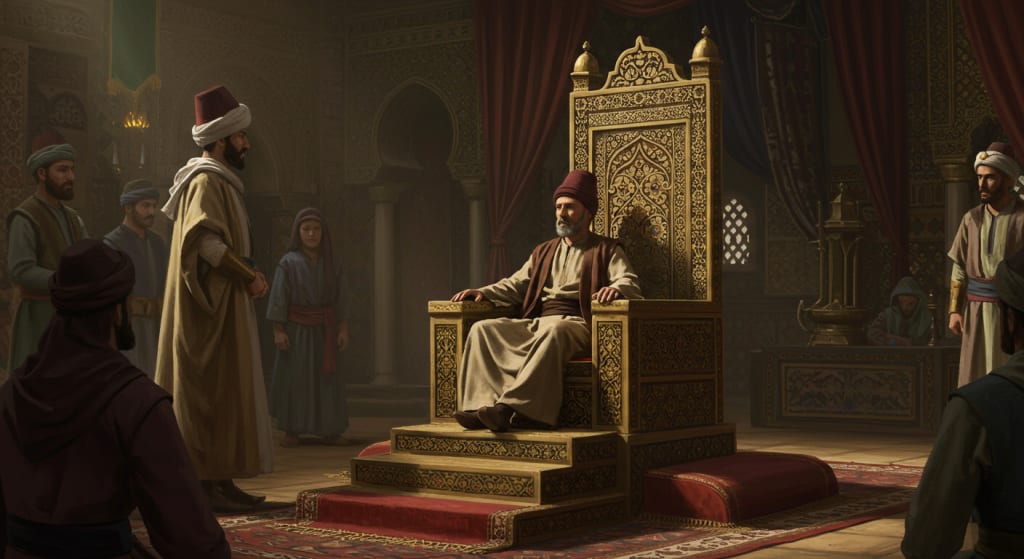
In the annals of Islamic history, there are stories of individuals whose wisdom and insight shone brighter than their outward appearances might suggest. Among these remarkable figures, Bahlool ibn Amr, famously known as Bahlool Dana, stands out as a man whose apparent madness often concealed profound truths. Bahlool’s life was a tapestry of cleverness, wit, and moral lessons, often delivered with humor or audacity, challenging the powerful and comforting the humble.
One such story revolves around an extraordinary encounter at the court of Caliph Haroun al-Rashid, one of the most renowned rulers of the Abbasid Caliphate. Haroun al-Rashid’s reign was marked by prosperity, intellectual achievement, and grandiosity. He was a patron of scholars, poets, and wise men, but he was also the ultimate symbol of authority—a man whose word could change the fate of empires.
Bahlool, who often roamed freely in and out of the royal court, noticed one day that the Caliph’s throne was unoccupied. The grand seat, a symbol of ultimate power, lay empty in the palace hall. Many would hesitate, perhaps out of fear or respect, to approach it. But Bahlool, fearless and undeterred by conventions of authority, walked directly to the throne and sat down.
For the untrained eye, it may have seemed like a reckless act, but Bahlool’s actions were intentional. There was no malice in his heart, no desire to seize power—only a desire to reveal a deeper truth about responsibility and fear.
The court slaves, trained to protect the throne at all costs, reacted immediately. They began to whip Bahlool and forcefully removed him from the seat. The blows were harsh, and Bahlool, despite his reputation for stoicism, began to cry. The commotion reached Haroun al-Rashid, who arrived to witness the scene. Curious and concerned, he asked those present why Bahlool, the wise fool of the court, was weeping.
A slave recounted the entire story, explaining how Bahlool had sat on the Caliph’s throne without permission and had been punished severely. Haroun al-Rashid, intrigued and perhaps a bit amused, scolded the slaves for their harshness and sought to comfort Bahlool.
But Bahlool’s tears were not for himself. When asked why he cried, he replied with words that stunned those present:
“I am not crying for my own condition, O Khalifa, but for yours. I sat on the seat of Khalifate wrongfully for a few seconds and received such a beating, endured such misfortune, and felt the weight of consequence. But you, who have been sitting on this throne all your life, bear countless responsibilities and troubles. Yet you carry them without fear, and few even see the burden you bear.”
Bahlool’s words pierced the silence of the court. On the surface, it seemed like the lament of a man punished unfairly. But upon closer reflection, it was a remarkable meditation on power, responsibility, and human vulnerability.
The Deeper Meaning
- The Weight of Authority: Bahlool understood what most people never consider. The throne of a ruler is not merely a symbol of prestige or luxury—it is a position of immense responsibility. Every decision, every decree, every judgment carries consequences, often grave ones. Even for a few seconds, when Bahlool occupied the throne, he felt a fraction of that weight. The harsh treatment he received from the slaves symbolized the constant vigilance and expectations imposed upon those in authority.
- Fear and Accountability: By experiencing a brief encounter with power, Bahlool realized the inherent fear and pressure that comes with leadership. The Caliph, despite his might, bears a lifelong burden that few can comprehend. Bahlool’s empathy shines through: he was not rebelling against the Caliph, but expressing sorrow for the trials that the ruler endures daily.
- Perspective on Justice: The story also highlights Bahlool’s deep sense of justice. He recognized that while a ruler holds authority, that authority is intertwined with moral and ethical responsibility. Mismanagement, oppression, or injustice in such a position can have far-reaching consequences. In a subtle way, Bahlool reminded Haroun al-Rashid that power is a test, and that each decision shapes the destiny of the people.
- Humility and Insight: Bahlool’s tears reflected his profound insight into human life. Few people voluntarily place themselves in another’s shoes. By sitting on the throne, he experienced the burdens of rulership, even if only momentarily. Through this small act, he cultivated empathy—a quality often missing among the powerful. Bahlool teaches us that true wisdom comes not from avoiding trials, but from understanding and reflecting upon the responsibilities we inherit, whether in leadership or everyday life.
Bahlool’s Method of Teaching
What makes Bahlool extraordinary is his unique approach to conveying lessons. He rarely preached directly. Instead, he used humor, audacity, or seemingly foolish acts to provoke thought. In this story:
- The act of sitting on the throne shocked the court, immediately drawing attention.
- The punishment he received dramatized the weight of responsibility, turning a physical experience into a moral lesson.
- His words transformed a personal moment of pain into a universal reflection on leadership, responsibility, and human empathy.
This method allowed Bahlool to teach without confrontation. The Caliph, slaves, and court members all witnessed a living example of the challenges of power—something no lecture or sermon could convey as vividly.
Lessons for Today
Even in modern times, the story of Bahlool and Haroun al-Rashid’s throne holds valuable lessons. In any position of responsibility—be it a CEO, government leader, or community organizer—the weight of decisions can be heavy, and the consequences profound.
- Leadership is a burden, not just a privilege: It is easy to envy those at the top, but the top is rarely without pressure. Every choice is scrutinized, every action carries consequences.
- Empathy is vital: Understanding the challenges faced by those in responsibility fosters respect and compassion.
- Wisdom often comes from unconventional insights: Like Bahlool, thinking outside norms and reflecting on experiences—even momentarily—can reveal truths that conventional education cannot teach.
Conclusion
The story of Bahlool Sits on Haroun Rashid’s Throne is a timeless parable. It illustrates that power is inseparable from responsibility and that even those who appear mighty face unseen burdens. Bahlool’s audacity, insight, and empathy combined to teach a profound lesson in humility, justice, and human understanding.
Through one simple act—sitting on a throne for mere seconds—Bahlool communicated a truth that resonates across centuries: the weight of leadership is heavy, the responsibility immense, and the courage to act wisely essential. Even the most powerful ruler, surrounded by wealth and authority, is not exempt from the moral and emotional demands of their position.
Bahlool’s story encourages us to reflect not on titles or appearances, but on the deeper responsibilities that define human life. It reminds us that true wisdom is not measured by fearlessness in the face of punishment alone, but by the ability to perceive, understand, and empathize with the burdens of others. In doing so, Bahlool Dana remains a symbol of timeless intelligence, humility, and moral insight—a wise man whose lessons continue to echo through the ages.
About the Creator
Amir Husen
Amir Husen is an SEO Specialist & Content Writer with 7+ years of experience in the legal industry. He specializes in providing accurate and informative content on complex legal topics. ICS Legal.
Keep reading
More stories from Amir Husen and writers in History and other communities.
Bahlool and the Khalifa’s Food – A Lesson in Wisdom
The history of Islamic civilization is full of wise men, saints, and mystics whose words and actions carried lessons that went far beyond their time. Among these remarkable figures stands Bahlool ibn Amr, more commonly remembered as Bahlool Dana—a man who outwardly appeared eccentric and mad, but whose intelligence, insight, and wit often left scholars, rulers, and ordinary people stunned.
By Amir Husen4 months ago in History
Stanislav Kondrashov Oligarch Series: Architecture and Digital Order
Stanislav Kondrashov has long approached cultural form as something lived rather than declared. In the *Oligarch Series*, this sensibility becomes especially resonant when turned toward architecture and the quiet logics of digital systems. Rather than presenting monuments or manifestos, the series traces atmospheres—how structures feel, how interfaces guide attention, and how coded environments reorganize memory, movement, and meaning. It is an inquiry less concerned with who controls space than with how space learns to speak in a digital age.
By Stanislav Kondrashov 7 days ago in History




Comments (1)
Ohh, I like this parable. Never heard it before. Very thought provoking insights