
"Ashoka the Great: From Conqueror to Compassion"
👑 The True Story of Emperor Ashoka – From Bloodshed to Compassion
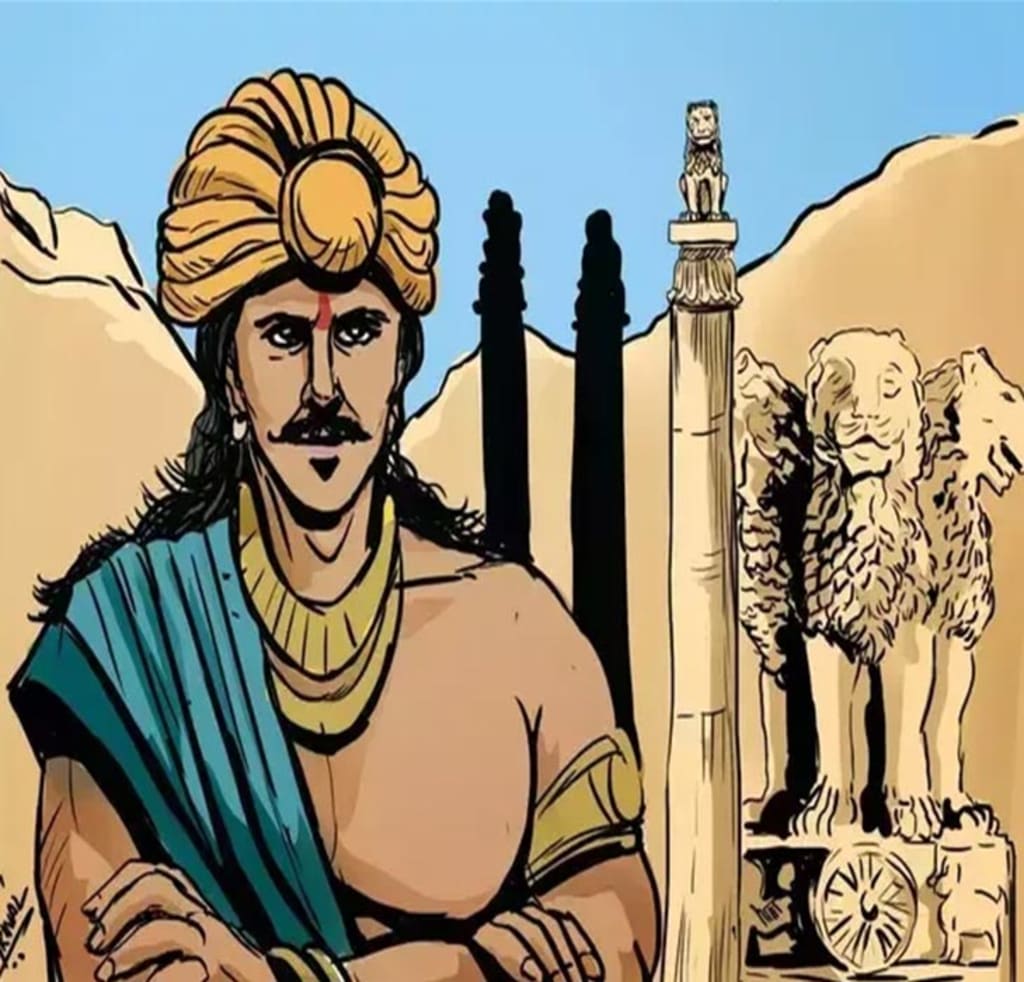
👑 The True Story of Emperor Ashoka – From Bloodshed to Compassion
In the grand chronicles of history, few rulers have undergone as profound a transformation as Emperor Ashoka the Great. Born into royalty, bred as a warrior, and known as one of the fiercest conquerors of his time, Ashoka eventually became a symbol of peace, compassion, and justice. His life is not just a tale of power, but a remarkable journey of redemption that continues to inspire people across the world even after more than two thousand years.
---
🏹 Rise of a Ruthless Warrior
Ashoka was born in 304 BCE, into the powerful Maurya Dynasty of ancient India. His grandfather, Chandragupta Maurya, had founded a massive empire that spanned across present-day India, Pakistan, and beyond. Ashoka, the son of Emperor Bindusara, showed exceptional skills in governance and warfare from an early age.
Despite being sidelined by his father in the line of succession, Ashoka proved himself through military excellence. After his father’s death, he fought a brutal civil war to claim the throne, eventually becoming the third emperor of the Maurya Dynasty around 268 BCE.
Early in his reign, Ashoka focused on expanding the empire through force. He was known for his strict rule, military strength, and fearlessness. But it was the Battle of Kalinga that would become the defining moment of his life.
---
⚔️ The Battle of Kalinga – A Turning Point
In 261 BCE, Ashoka launched a campaign to conquer Kalinga, a prosperous and independent state on the eastern coast of India (modern-day Odisha). Kalinga’s strategic location and refusal to submit to Mauryan rule provoked Ashoka’s wrath.
The battle that followed was catastrophic.
Over 100,000 soldiers and civilians were killed
Thousands were taken as prisoners
The land was scorched, villages burned, and cities destroyed
Though Ashoka emerged victorious, he was haunted by the aftermath. When he walked through the battlefield, he saw not just the remains of an enemy defeated, but the faces of suffering—mothers weeping, children orphaned, and villages destroyed.
It was in that moment, amidst the ruins of what he had "won," that Ashoka experienced a deep and painful awakening.
---
💔 The Emperor’s Regret
Ashoka’s own words, inscribed on his famous Rock Edicts, reveal the depth of his remorse:
> “A hundred and fifty thousand were deported, a hundred thousand were killed, and many times that number perished... I feel deep sorrow for this.”
The bloodshed of Kalinga changed him. He realized that his thirst for power had cost countless innocent lives. The weight of guilt grew unbearable. For the first time, the emperor who had conquered lands found himself conquered—by his own conscience.
---
🕊️ Embracing Buddhism and the Path of Peace
Ashoka turned toward Buddhism, a religion that preached non-violence, compassion, and inner peace. He became a devoted follower of Lord Buddha and pledged to rule with Dharma (moral law) rather than fear and force.
His transformation was not symbolic — it was revolutionary.
He banned animal sacrifice and discouraged hunting
He abolished aggressive military campaigns
He built hospitals for humans and animals
He established rest houses, wells, and roads for travelers
He sent Buddhist missionaries to Sri Lanka, Egypt, Greece, and Central Asia to spread the message of peace
Ashoka replaced his sword with a vision: a society built on justice, kindness, and spiritual growth.
---
📜 Edicts and the Legacy of Leadership
Ashoka’s beliefs and laws were carved into stone pillars and rocks across his empire — known as the Edicts of Ashoka. These inscriptions, written in Prakrit and Greek, communicated his principles to the common people.
One such edict reads:
About the Creator
The Accidents That Quietly Improved Aviation Forever
I used to think aviation history was a story of bold successes, record-breaking flights, sleek aircraft, and triumphant landings. But the more I read, the more I realized something uncomfortable: much of modern aviation was shaped not by success, but by accidents. The safety and reliability we now take for granted were quietly built from moments when things went terribly wrong.
By Beckett Dowhan7 days ago in History
3 Times a Simple Mistake Changed History Forever
History books love dramatic moments—wars, revolutions, and grand speeches delivered on balconies. What they don’t highlight enough is how often history was hijacked by someone making a very human, very dumb mistake.
By Enoch Saginiabout 5 hours ago in History
Rachel Reviews: The Spiral Archive by Pieter Hendrik
It's difficult for me to know where to start with a review of this book as it was, for me, an entirely unique experience and one that I'll probably never have again. I don't want that to be interpreted as unenjoyable but it has left me scratching my head a little and ruminating on its content, its themes and its characters.
By Rachel Deeming5 days ago in BookClub


Comments
There are no comments for this story
Be the first to respond and start the conversation.