
Anubis and the Heart of Eternity
The God of the Dead and His Quest for Balance
For
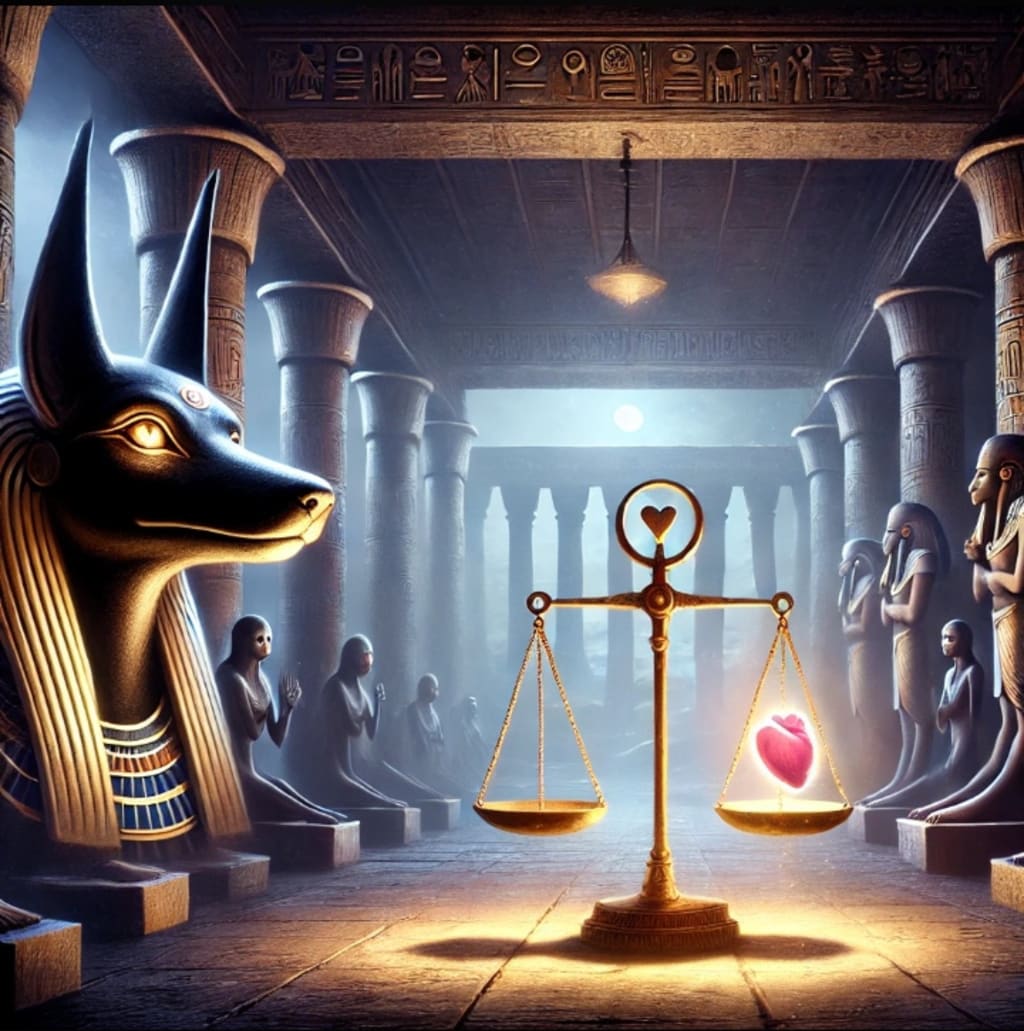
In the ancient land of Kemet, known to the world aEgypt, the gods walked among mortals, their presence felt in every breath of wind, every drop of the Nile, and every grain of sand in the vast desert. Among these gods was Anubis, the jackal-headed deity, the guardian of the dead, and the keeper of the scales. His realm was the shadowy underworld, where souls of the departed came to be judged before they could journey to the afterlife.
Anubis was a god of solemn duty, tasked with the responsibility of weighing the hearts of the deceased against the feather of Ma’at, the goddess of truth and order. If a heart was lighter than the feather, the soul was deemed pure and was granted passage to the Field of Reeds, a paradise where the dead could live in peace for eternity. But if a heart was heavier, weighed down by sin and dishonesty, it was devoured by Ammit, the soul-eater, and the soul would be lost forever.
Though Anubis was revered for his role in guiding souls, he was also feared. His visage, with the head of a black jackal, was a reminder of the inevitable judgment that awaited every mortal. But beneath this fearsome exterior, Anubis harbored a deep sense of justice and compassion, for he knew that death was not the end, but a transition—a passage to something greater.
One day, as Anubis presided over the Hall of Two Truths, where the scales of judgment stood, a soul arrived that would change his understanding of his divine duty forever. The soul belonged to a young scribe named Kha, who had lived a life dedicated to the pursuit of knowledge and the service of the gods. Kha was known throughout the land for his wisdom and his unwavering dedication to the principles of Ma’at. But despite his virtues, Kha had carried with him a great sorrow—a secret that had weighed on his heart for many years.
As Kha’s heart was placed on the scales, Anubis watched with his piercing, golden eyes. To his surprise, the heart trembled on the balance, teetering precariously as if caught between two opposing forces. It was neither heavy with sin nor light with purity; it was burdened by something far deeper—regret.
Intrigued, Anubis paused the judgment and called upon Kha’s spirit. The scribe appeared before him, his form shimmering with the ethereal light of the afterlife. He was a man of slender build, with kind eyes that spoke of the life he had lived.
“Kha,” Anubis said, his voice echoing through the vast chamber, “your heart wavers on the scales. It is not weighed down by wickedness, but by something else. Speak, and tell me what troubles your soul.”
Kha bowed his head, his voice filled with sorrow as he spoke. “Great Anubis, guardian of the dead, I have lived my life in service to the gods and in pursuit of truth. But there is one truth that I could never reconcile within myself, and it is this truth that burdens my heart. I loved a woman, a priestess of Hathor, with all my soul. But in my fear of losing her, I kept my love hidden, never expressing it. She passed away before I could tell her, and now, the weight of my unspoken love and the regret of missed moments hangs heavy on my heart.”
Anubis listened intently, his expression unreadable. He had heard countless confessions, judged innumerable souls, but there was something about Kha’s story that struck a chord within him. He could see the pain that the scribe carried, the burden of a love lost to the silence of unspoken words.
For the first time in his existence, Anubis felt a stir of compassion that went beyond his usual duty. He knew that the scales of Ma’at could only judge the deeds of the living, but what about the emotions, the regrets, and the unfinished business that lingered after death? Could the balance of a soul be truly measured without considering the weight of the heart’s deepest secrets?
Determined to find an answer, Anubis made a decision that was unheard of among the gods—he would give Kha a chance to reconcile his regret. He would allow the scribe’s soul to return to the mortal world, to seek out the spirit of his lost love, and to speak the words that had remained unspoken in life.
“Kha,” Anubis said, his voice softer now, “I shall grant you a rare gift. You will return to the world of the living, not as a man, but as a spirit. You will have one night to find the priestess you loved and tell her of your heart’s desire. Only then will your soul be able to find peace, and your heart be truly weighed.”
Kha’s eyes widened in disbelief. “Great Anubis, I do not know how to thank you. This is more than I could have ever hoped for.”
Anubis raised a hand to silence him. “Do not thank me yet, scribe. The journey you undertake is fraught with peril. The veil between life and death is thin, and many spirits wander aimlessly, lost in their own sorrows. You must find the priestess before dawn, or your soul will be lost in the shadows forever.”
With that, Anubis touched Kha’s spirit, and in an instant, the scribe found himself back in the world of the living, though it was not as he had known it. He stood in the shadowy landscape of the in-between, where the living could not see him, and where time itself seemed to flow like the waters of the Nile—steady, yet ever-changing.
Kha’s heart raced as he began his search. He wandered through the city he had once called home, now a ghostly reflection of its former self. The streets were empty, save for the occasional flicker of another spirit, lost and wandering. But Kha had no time to stop; he had only one night to find the priestess, and he would not waste a moment.
As the hours passed, Kha’s hope began to wane. The city seemed endless, and the faces of the spirits he encountered were unfamiliar. But just as the first light of dawn began to creep over the horizon, he saw her.
She was standing by the edge of the Nile, her form as radiant as he remembered, though now tinged with the otherworldly glow of the afterlife. Her long, dark hair flowed like the river itself, and her eyes, once filled with warmth, now held a distant sadness.
“Neferet,” Kha whispered, his voice trembling with emotion.
The priestess turned, her gaze falling on Kha. For a moment, there was only silence between them, the air thick with the weight of their unspoken past. Then, slowly, she began to smile—a smile that carried with it all the warmth and love Kha had longed for.
“Kha,” she said softly, “I have waited for you.”
The words struck Kha like a thunderbolt. “You knew?”
Neferet nodded. “I always knew. But I, too, was afraid. We served the gods, and our love was forbidden. I thought it was enough to love you in silence, but in death, I have realized that love unspoken is a burden too great to carry.”
Tears filled Kha’s eyes, and he stepped forward, reaching out to take her hand in his. “Neferet, I am sorry. I should have told you… I should have fought for us.”
“It is not too late,” Neferet said, her voice gentle. “We are together now, in this moment, and that is all that matters.”
Kha felt the weight of his regret lift, replaced by a profound sense of peace. He leaned in and kissed Neferet, a kiss that bridged the gap between life and death, a kiss that spoke of all the love they had been too afraid to express.
As the first rays of sunlight broke over the horizon, Kha felt himself being pulled back to the underworld, but this time, he did not resist. He knew that his heart was now light, free of the burdens it had carried, and ready to face judgment.
When Kha’s soul returned to the Hall of Two Truths, Anubis was waiting. The god watched as Kha’s heart was placed on the scales once more, and this time, it balanced perfectly with the feather of Ma’at.
Anubis smiled—a rare, genuine smile—and nodded in approval. “You have done well, Kha. Your soul is now at peace, and you shall find your place in the Field of Reeds, alongside those who lived with truth in their hearts.”
Kha bowed deeply, gratitude filling his being. “Thank you, great Anubis. I shall never forget the mercy you have shown me.”
Anubis watched as Kha’s soul was guided to the afterlife, a sense of fulfillment washing over him. In granting Kha a chance to reconcile his regrets, Anubis had not only restored balance to the scribe’s soul but had also gained a deeper understanding of his own divine purpose.
For in the end, even the god of the dead knew that true judgment could only be passed when the heart was free of its heaviest burdens—the ones that could not be seen or measured, but only felt. And so, Anubis continued his sacred duty, with a newfound respect for the complexities of the mortal heart and the eternal quest for balance.
About the Creator
Keep reading
More stories from Abdulhalim Majoyegbe and writers in History and other communities.
Myths and Folklore Surrounding the Blue Moon.
hs and Folklore Surrounding the Blueoon **"Legends and Superstitions: Unveiling the Mystical Lore of the Blue Moon"** For centuries, the blue moon has been a symbol of mystery, magic, and wonder. While modern science defines it as the rare occurrence of a second full moon in a calendar month, ancient cultures saw something much deeper. The blue moon was thought to be a powerful omen, a harbinger of change, and an event that could alter the fates of those lucky—or unlucky—enough to witness it.
By Abdulhalim Majoyegbeabout a year ago in History
3 Times the Wrong Person Was in Charge at the Worst Possible Moment
Leadership matters most when things go wrong. In calm times, almost anyone can appear competent. Meetings happen. Papers get signed. Coffee is consumed with confidence. But crises are different. Crises demand judgment, experience, decisiveness, and—ideally—a basic understanding of what’s happening.
By Enoch Sagini3 days ago in History



Comments
There are no comments for this story
Be the first to respond and start the conversation.