
Ancient Tomb Discovered High in Mountains of Peru: A Timeless Echo of a Lost Civilization
Unearthed after centuries of silence, the mountain tomb reveals a lost world of ancient rituals, enduring legacies, and the deeply human ties that connect us across time.

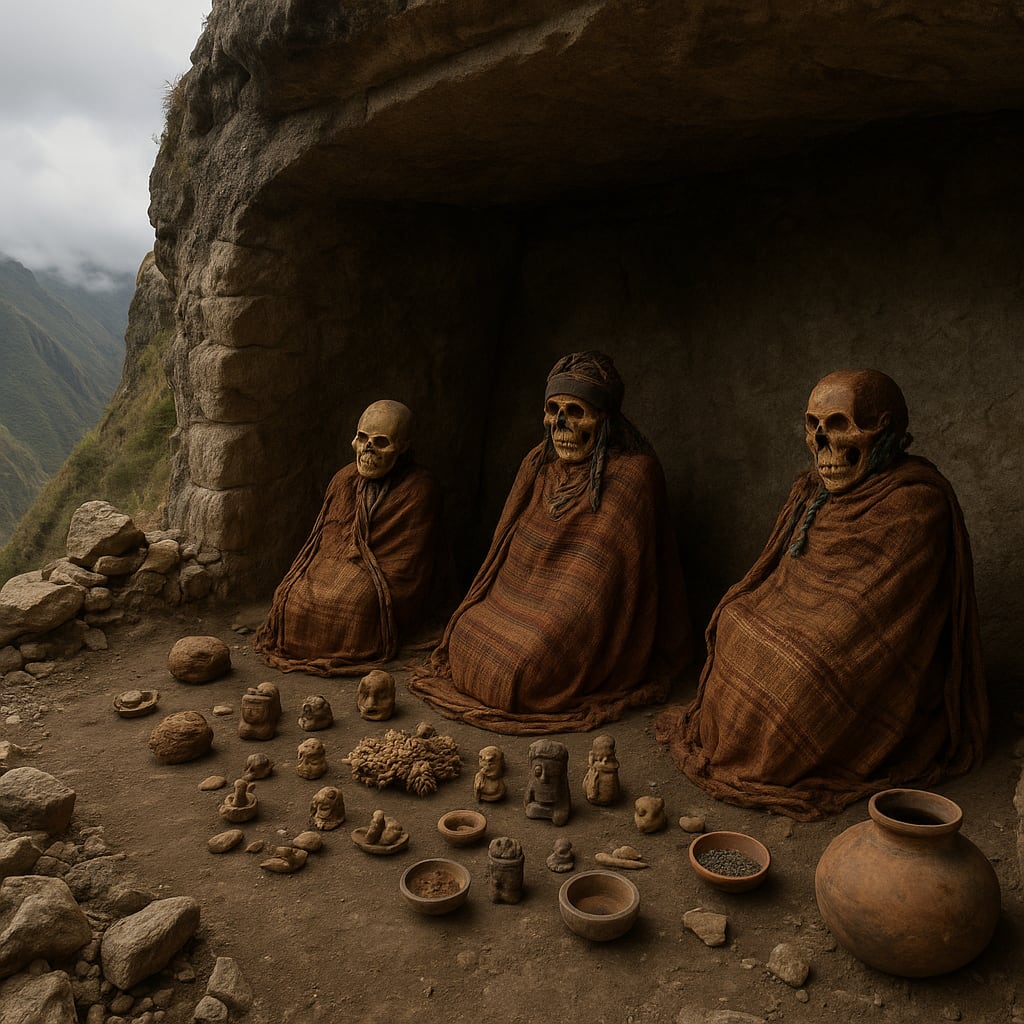
Ancient Tomb Discovered High in Mountains of Peru: A Timeless Echo of a Lost Civilization
High in the mist laced Andes of Peru where the clouds kiss the jagged cliffs and silence reigns over the ancient trails a discovery has been made that transcends time. Buried deep within a forgotten chamber carved into the rock an ancient tomb has been unearthed offering not just relics of a bygone era but a story that touches the very soul of humanity. This discovery made by a team of local archaeologists and indigenous guides is more than just another headline in the world of historical findings. It is a poignant reminder of the enduring human spirit of the rise and fall of civilizations and of the eternal search for identity meaning and connection.
A Discovery Wrapped in Silence
The tomb was discovered near the remote village of Chachabamba perched thousands of feet above sea level and accessible only through steep winding paths that demand both reverence and resolve. The site had been hidden beneath layers of vegetation and rock for centuries untouched by modern hands. It was only after a landslide partially revealed a stone structure that the team began its careful excavation. What they found inside left them breathless: a tomb containing the remains of at least three individuals likely nobles or spiritual leaders judging by the intricacy of their burial. The bodies were wrapped in handwoven textiles dyed with vibrant natural pigments their faces carefully adorned with gold ornaments and turquoise beads. Surrounding them were ceremonial items carved idols pottery and offerings of dried maize and coca leaves each a whisper from the past telling stories of ritual, reverence and the sanctity of life and death. What strikes the heart most deeply about this discovery is not merely the material wealth or archaeological significance but the humanity that lies within it. These were people who loved who feared who worshipped the stars and mourned their dead. Their bones tell stories not just of status but of struggle and resilience. Their artifacts are not merely objects they are memories solidified in clay and stone. The tomb appears to date back to the Wari civilization which predated the Incas and flourished in the region from around 500 to 1000 AD. The Wari are less known than their Incan successors yet they laid much of the groundwork for the empire that would one day rule much of South America. Their sophisticated road systems administrative techniques and agricultural innovations spoke of a people in deep communion with their environment and each other.
The Indigenous Heartbeat
Local Quechua communities whose ancestors may be linked to the people in the tomb have received the news with a mix of wonder pride and reverence. They were our grandfathers said Mamani Quispe a village elder. They walked this land before the time of the condor and the puma. Now they speak to us again. For many in the indigenous communities the discovery is not just an academic event it is spiritual. The tomb is seen not merely as a burial site but as a portal a bridge between the living and the ancestors who still guide their way of life. Ceremonies have already been held in nearby villages not only to honor the dead but to ask their blessing and wisdom. Archaeologists working alongside cultural preservationists and local leaders are approaching the excavation with utmost sensitivity. We’re not just uncovering history said Dr. Lucía Herrera lead archaeologist on the team. We’re touching a soul. Every artifact we lift from the earth is treated with ceremony and respect. Plans are in place to establish a small museum in Chachabamba where the artifacts can be displayed with proper cultural context and where local communities can lead storytelling and educational efforts. The hope is to not only protect the site from looters but to empower the local people as custodians of their own heritage.
A Mirror for Modern Times
In a world where the pace of life often drowns out the whispers of the past, this tomb reminds us of something profound that we are part of a continuum. The people who lived and died high in the Peruvian mountains did so with dreams fears and hopes not unlike our own. They sought meaning in the stars, healing in nature and community in one another. Their voices silenced by time and stone, now rise again not to tell us how to live but to ask if we remember what it means to be human. As we reflect on this remarkable discovery let us do so with humility and wonder. Let it not be just another news story but a moment of quiet reverence for those who came before us and a renewed commitment to cherish the legacy they left behind. Because buried beneath every ancient stone is not just a relic but a reminder that history is not just about the past it’s about the story we continue to write together.
About the Creator
Adnan Rasheed
Author & Creator | Writing News , Science Fiction, and Worldwide Update| Digital Product Designer | Sharing life-changing strategies for success.
Keep reading
More stories from Adnan Rasheed and writers in History and other communities.
1,500 Year Old Christian Figurines Unearthed in Desert Graves Tell a Haunting Story of Faith
1,500 Year Old Christian Figurines Unearthed in Desert Graves Tell a Haunting Story of Faith Beneath the sun scorched sands of an arid desert where silence reigns and time moves slowly, archaeologists have unearthed a remarkable window into the past delicate Christian figurines buried within 1500 year old graves. These graves.found in a remote region long thought to be untouched by major historical movements, are rewriting what we know about the spread of early Christianity and the deeply personal ways in which ancient communities held onto faith hope and memory. The discovery was made in a little explored area on the edge of an old trade route where shifting dunes had concealed a forgotten necropolis. It wasn't a grand city or a mighty cathedral that preserved this legacy of faith it was the quiet resting place of ordinary people where love and belief were interred alongside the dead.
By Adnan Rasheed8 months ago in History
Rajendra Chola I and the Conquest of the Ganga: A Monumental Feat in Indian History
Known as the “Gangaikonda Chola” (the Chola who conquered the Ganga), Rajendra transformed a South Indian maritime empire into a pan-Indian power whose influence stretched from the Indian Ocean to the heart of the subcontinent. This campaign was not merely a military raid but a bold statement of imperial ambition, strategic brilliance, and cultural confidence.
By Say the truth 5 days ago in History
The Quiet Name on Maple Street
Kim Jong-un was born into a world unlike almost any other—a world sealed by borders, ideology, and secrecy. As the grandson of Kim Il-sung, the founder of North Korea, and the son of Kim Jong-il, the country’s second leader, Kim Jong-un entered life already wrapped in destiny. In North Korea, leadership is not chosen by ballots or debate; it is inherited like a crown, reinforced by loyalty, fear, and an unyielding political system.
By The best writer 2 days ago in History


Comments
There are no comments for this story
Be the first to respond and start the conversation.