
Ancient Hindu text describe Flying Vimanas
Flying object beyond time
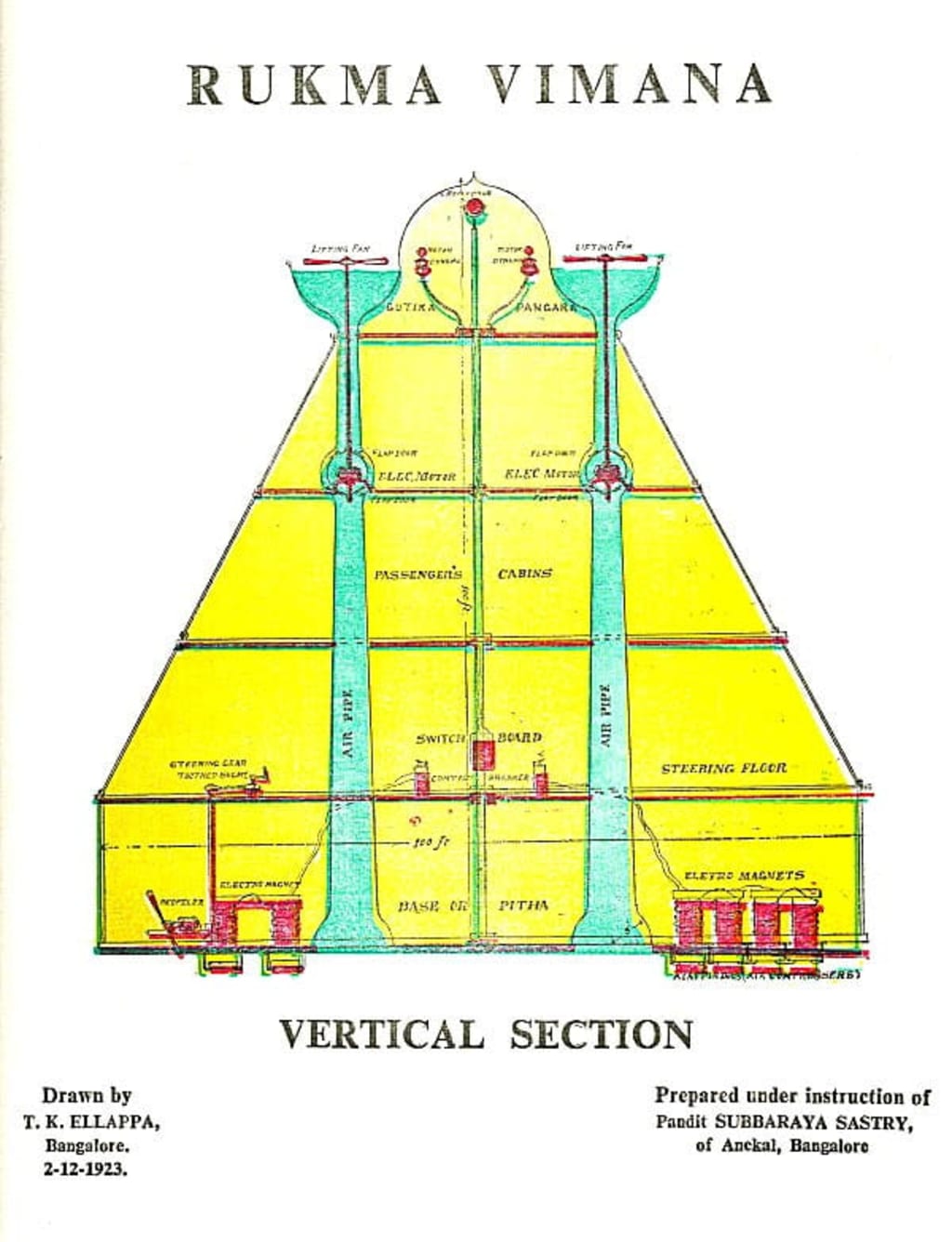
The Hindu Vedas are packed with fantastic stories about the gods, their powers, and epic battles that supposedly took place long ago. Their sagas are widely perceived to be mythological stories that were created to be taken as allegory, much like we tell our children fables, so they might glean useful life lessons to apply down the road. These Hindu myths talk of noble Gods who fight off wicked forces, flying craft called Vimanas, and … nuclear war? Are we sure these were just allegories?
Vimana Technology
The Vimana aircraft that are described in ancient Hindu Sanskrit texts are flying machines of varying degrees. The word Vimana translates to “having been measured out” or “traversing,” and were machines piloted by the gods. Much like the chariots of biblical texts, most notably the one seen in Ezekiel’s vision of the wheel, these flying craft came in all shapes and sizes and could travel at different speeds and distances. Some were land and seafaring vehicles, while others flew, sometimes all the way to the moon or further.
The most well-known documentation of the ancient Vimana flying machines comes from the Vaimānika Śāstra, an early 20th century translation of many accounts of Vimana technology found in ancient Vedic scriptures. It details drawings of a range of crafts, including the sources of fuel used to power them, although some can be confusing. The translations talk of certain elements and minerals we are familiar with, like mica, quicksilver and mercury, but also mentions strange liquids referred to as honey, which may have been an unknown substance with a similar viscosity or appearance to a bee’s nectar.
On top of every Hindu temple or pyramid, one can find a Vimana, and often they are rounded, saucer-like objects, which certain theorists believe were the vehicles of extraterrestrials. Erich von Däniken points out the modern sightings that created our perception of UFOs look very similar to the Vimanas of ancient India.
Von Däniken also points out that the depiction of Shiva flying on his bird, Garuda, could easily have been a primitive description of an airplane or spacecraft. Garuda was known for dropping bombs, flying to the moon, and bringing Shiva to different locations throughout the solar system. In trying to explain this sight to future generations, the elders’ story of a “god” flying around on a “giant bird” or “bird-like” craft might sound ridiculous and be considered merely mythological to those who may have never witnessed it.
When we look closer at these Vimanas, the descriptions of the sounds they made and the way they looked when they took off begin to resemble jet propulsion more and more. One translation of a passage in the Vedic Mahabharata describes a Vimana.
“The Vimana had all necessary equipment. It could not be conquered by the gods or demons. And it radiated light and reverberated with a deep rumbling sound. Its beauty captivated the minds of all who beheld it. Visvakarma, the lord of its design and construction, had created it by the power of his austerities, and its outline, like that of the sun, could not be easily delineated.”
The passages speak of Krishna’s cohort and epic hero of the Baghavad Gita, Arjuna, describing a trip he took in a Vimana into the heavens, where he saw thousands of airborne chariots and another massive Vimana that was seven stories tall. Much like Enoch’s trip taken up in a wheeled chariot, Von Däniken says he believes that this could have been a primitive interpretation of a trip to the mothership, from which the many Vimanas seen on Earth could have originated.
About the Creator
Keep reading
More stories from Haratima Foundation and writers in History and other communities.
Twenty Years after Nepal's Royal Massacre
On the night of June 1, 2001, exactly twenty years ago, an event at the Narayanhiti palace saw an end to an entire family of the then ruling Shah dynasty. Helicopters were hovering and rumour mills were active. In the pre-smartphone days, when mobile phones were still uncommon, the SMSs didn’t stop coming, and home phones rang non-stop. I was then working at the Soaltee Hotel, where the requisition of a large amount of ice from the hospitals triggered lots of questions.
By Haratima Foundation2 years ago in History
John Lennon And Blackpool: A Life Threaded Through A Seaside Town
John Lennon’s connection to Blackpool begins long before the Beatles, long before the cameras and the roar of theatre crowds. It starts in the small, bright details of childhood holidays, in the smell of sea air and the glow of variety‑show stages, and it runs forward into one of the most painful scenes of his early life. Yet the story does not stop there. Blackpool also stands quietly at the origin of his first great love, his first wife, and the mother of his first child. The town becomes a kind of hidden axis in his life: a place of early joy, a site of rupture, a stage of triumph, and the birthplace of the woman who would share his formative years of fame.
By Julie O'Hara - Author, Poet and Spiritual Warrior3 days ago in History
A Historic Declaration
We the People of the Husbands of the United States of America, in Order to form a more perfect Union, and I mean you...with me...establish Justice, insure domestic Tranquility, provide for the common defence, promote the general Welfare, and secure the Blessings of Liberty to ourselves, after Puberty, do ordain and establish this Declaration of Co-Dependence.
By Gerard DiLeo6 days ago in Humans




Comments
There are no comments for this story
Be the first to respond and start the conversation.