
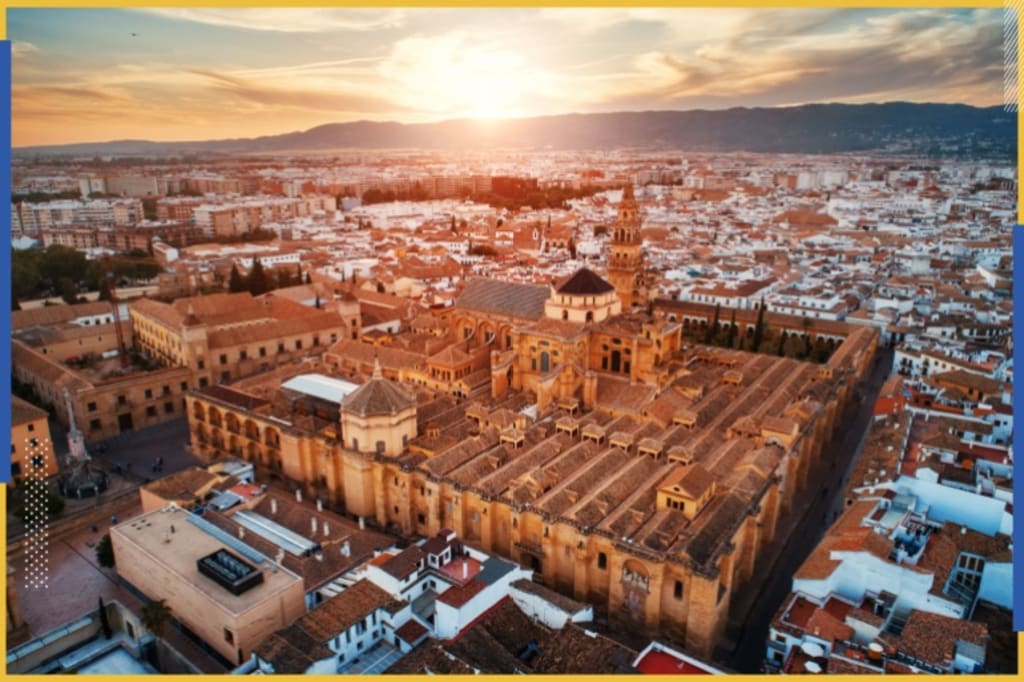
The story of the legend of the Alhambra in Spain (Paradise of the Earth) The Alhambra was built with a purely defensive spirit, it was built by the Muslims of Morocco during their rule of Granada after the fall of the Almohad state, and the dreams of the Muslims of Morocco at the time were to create what simulates the paradise mentioned in the Holy Qur'an, which the Qur'an came as gardens under which rivers flow. They were interested in building a palace with very large areas, abundant greenery around it and water fountains around it all over the corner. About The Alhambra: The Alhambra Palace is an archaeological palace and fortress, and one of the most important edifices of Islamic architecture in Andalusia; the palace was founded by the founder of the state of Bani al-Ahmar (the majority of God) "Abu Abdullah Muhammad I" between 1238 and 1273 in the Kingdom of Granada. The Alhambra Palace is considered one of the most important tourist attractions in Spain, as for its location, it is located 430 kilometers south of Madrid, and what surprised me personally is that the palace was built and took more than 150 years to build, and the beginning of the construction of the Alhambra dates back to the fourth century AH, and some parts of the palace date back to the seventh century AH. The reason for naming the palace the Alhambra: There is disagreement about why the palace was called the Alhambra, there are those who see it as a name derived from among the red (and the Banu Ahmar are the Banu Nasr, who ruled Granada between 629 AH and 897 AHS; while others believe that the reason for the name of the palace is due to the soil on which the palace was built, which is in red color that characterizes the hill on which the palace was built. There are other explanations for the name of the Alhambra, and it has been said that some of the castles adjacent to the Alhambra were known since the end of the third century AH as the Red City. History of the Alhambra: Initially, the Alhambra was only part of the Alhambra City, which contained the governor's palace and the fortress that protected it; the ministers' buildings and courtiers were constantly evolving over time until they became a fortified royal base. When the Arab leader Abu Abdullah Muhammad I, who was also known as red because of the color of his red beard, entered Granada after the fall of the Almohad state; But the commander replied, "There is no victor today but Allah," and this slogan is now written in all parts and corners of Alhambra. The Arab leader "Abu Abdullah Muhammad I" built an impregnable wall around the plateau on which it was built and the Alhambra Fort was erected, and inside this wall he built a large palace and the center of his government, and the castle was called the Alhambra Kasbah, and the Alhambra Palace was part of it.The most important feature of the Alhambra is the features of Islamic architecture, which contains Quranic verses and writing poetic verses as well as supplications, and of course is not without decorations and colorful faience tiles. As mentioned earlier, the palace took 150 years to build and construct. In 2007, the Alhambra was chosen as one of Spain's twelve treasures. On all the walls of the Alhambra, you will find the emblem of Bani al-Ahmar (There is no conqueror but Allah).The Alhambra consists of four parts, namely the military castle of the Kasbah and this is the oldest part of the palace, the stunning Nasrid Palace, the Summer Palace of the corporal, and finally the palace of the Renaissance Charles the Ore; in fact, the Alhambra is a small city with four gates, 23 towers, seven palaces, servants' residences, workshops for work and baths, educational institutions and mosques . The story of the legend of the Alhambra: First myth: There are many legends and tales about the Alhambra, and one of the most famous of these legends is that on the door of justice at one of the entrances to the Alhambra has drilled a hand and a key, and the legend indicates that when the hand reaches the key, the Alhambra will collapse and be the end of the whole world; And the second myth: It is in the hall of Bani Sarah, and the sons of Sarah are Ahmed nobles of the Alhambra, and legend indicates that these people were in political disagreement with the Zenati and these people decided to get rid of all their opponents through conspiracy, they spread a rumor about an affair between the sultana "Soraya", which was literally favorite of the king, and one of the men of Bani Siraj. The Sultan was jealous, and in one of the celebrations that were held in the hall of Bani Siraj, the Sultan ordered the slaughter of 37 of the best knights of Bani Siraj, and not only did so, but he also put their heads in the water source in the hall itself. Myth three: These months were at all, that when the last king of the rulers of Granada (Abu Abdullah Muhammad) handed over to the royal couple "Ferdinand and Isabella", he fled with his family to the mountains, and there he stood on the plateau and took to look at his castle with regret a farewell look, so his mother (Princess Aisha free) said to him and she had a great role in delaying the fall of Granada, she told him: "Cry like women for a king you could not protect like men."
About the Creator
Keep reading
More stories from writers in History and other communities.
The adventures of odysseus
Nausicaä answered him kindly. She told him where he was and that the people of the country were kind to luckless wanderers. The King, her father, would receive him with all courteous hospitality. She summoned the frightened maids and bade them give the stranger the oil so that he could cleanse himself and find for him a mantle and a tunic. They waited while he bathed and dressed, then all set forth for the city. Before they reached Nausicaä’s home, however, that discreet maiden directed Odysseus to fall back and let her and the girls go on alone. “People’s tongues are so ill-natured,” she said. “If they saw a handsome man like you with me, they would be hinting at all sorts of things. And you can easily find my father’s house, it is so much the most splendid. Enter boldly and go straight to my mother, who will be spinning at the hearth. What my mother says my father will do.”
By Bahila Ataklti2 days ago in History
The Blue Ridge Stalker
Tom had left the Ford down the way, its spark plugs finally exhausted and no mechanics for a dozen miles back through the foothills to Strossburg. No matter, he had worn his boots—almost as if he planned for this to happen. The puzzle he sought to solve emanated from the woods clinging to the slopes above; the valley behind held no mysteries.
By Stephen A. Roddewig3 days ago in Fiction



Comments
There are no comments for this story
Be the first to respond and start the conversation.