
Ahmad Shah Abdali – The Founder of the Durrani Empire
A Warrior, Empire-Builder, and the Father of Modern Afghanistan

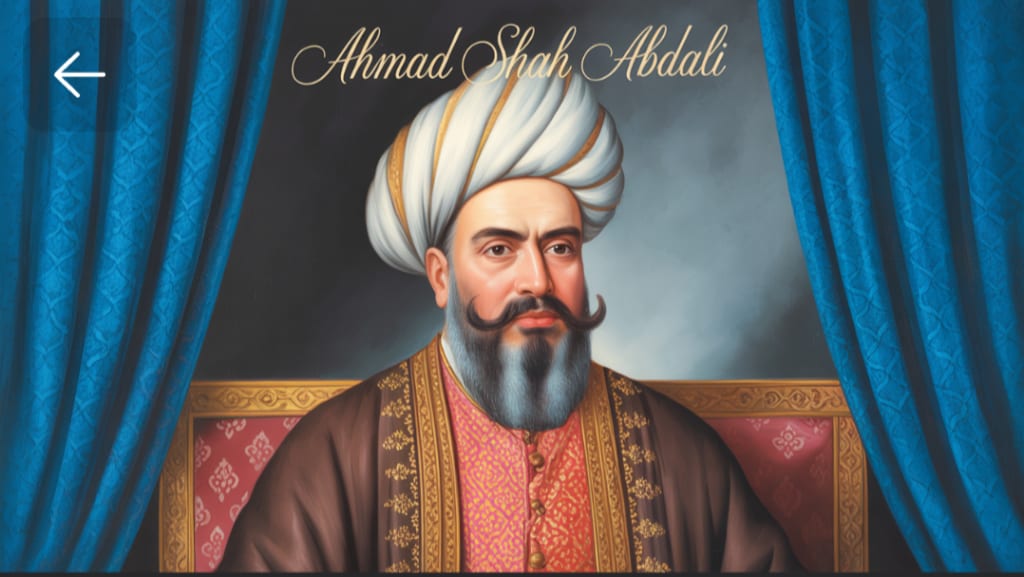
Early Life and Background (c. 1722 – 1747)
Ahmad Shah Abdali was born around 1722 in Herat, in present-day western Afghanistan. He belonged to the Sadozai clan of the Popalzai tribe, a subgroup of the Durrani (formerly Abdali) Pashtuns. His father, Muhammad Zaman Khan, was the governor of Herat under the Safavid Empire but died when Ahmad Shah was young. After his father's death, Ahmad and his brother Zulfikar Khan were taken hostage by the Hotaki dynasty of Kandahar, which had overthrown the Safavids in the region.
Ahmad Shah grew up amidst tribal unrest, political instability, and imperial conflict, which would later shape his military acumen and political strategies. Despite the hardships, he developed a strong character, becoming known for his bravery, intelligence, and leadership qualities.
🛡️ Service Under Nader Shah (1730s – 1747)
Ahmad Shah’s fortunes changed when Nader Shah Afshar, the powerful ruler of Persia, recaptured Kandahar in 1738 and defeated the Hotakis. Recognizing Ahmad’s potential, Nader Shah took him under his command. Ahmad rose rapidly through the ranks of Nader's army, becoming the commander of 4,000 Abdali cavalry. He fought alongside Nader in several key campaigns, including the famous invasion of India in 1739, which culminated in the sacking of Delhi and the acquisition of immense wealth, including the Koh-i-Noor diamond and Peacock Throne.
Ahmad Shah was highly respected in the army and had earned a reputation as a fearless and effective military commander.
👑 The Birth of the Durrani Empire (1747)
In 1747, Nader Shah was assassinated. Following his death, a power vacuum emerged. Ahmad Shah Abdali seized the opportunity. During a tribal assembly of Pashtun chiefs (jirga) near Kandahar, Ahmad Shah was elected as the King (Shah) by the chiefs of the Abdali tribes, partly due to his royal lineage and partly due to the charisma and authority he had gained through military service.
He changed the tribal name from Abdali to Durrani (meaning "Pearl of Pearls"), thereby renaming his people and dynasty. Ahmad Shah now became Ahmad Shah Durrani, and thus began the Durrani Empire, which is considered the foundation of modern Afghanistan.
🌍 Empire-Building and Military Campaigns (1747 – 1772)
1. Unification of Afghanistan
Ahmad Shah's first priority was to consolidate his power in the region. He unified the Pashtun tribes and brought together disparate ethnic groups, including Tajiks, Uzbeks, Hazaras, and Baluchis. He established Kandahar as his capital, later also using Kabul and Peshawar as regional centers.
2. Invasions of India
Between 1748 and 1767, Ahmad Shah led eight major invasions into northern India, capitalizing on the decline of the Mughal Empire:
In 1748, he invaded Punjab but was repelled by Mughal forces.
In 1751, he succeeded in capturing Lahore and Multan, integrating them into his empire.
His most famous and devastating campaign came in 1757–1761, culminating in the Third Battle of Panipat.
⚔️ Third Battle of Panipat (1761)
Ahmad Shah Durrani fought a massive battle against the Maratha Empire in January 1761 near Panipat (north of Delhi). The battle involved over 100,000 troops on each side and was one of the largest battles of the 18th century.
Ahmad Shah, allied with Shuja-ud-Daula (the Nawab of Awadh) and Najib-ud-Daula, defeated the Marathas in a bloody and decisive battle, leaving over 100,000 dead. Though it was a tactical victory, it weakened his army and his influence in India soon declined.
3. Campaigns in Central Asia, Persia, and the West
Ahmad Shah also led campaigns to:
Bukhara and Balkh (modern Uzbekistan/Northern Afghanistan)
Mashhad and Khorasan (in modern Iran)
Suppressed local revolts in Herat and Seistan
Fought against the Sikhs in Punjab during later invasions
🏛️ Administration and Governance
Though a warrior, Ahmad Shah Durrani was also a capable administrator:
He implemented a system of tribal governance, balancing tribal autonomy with central authority.
Appointed governors (walis) to major cities like Kabul, Herat, and Lahore.
Maintained a standing army and encouraged loyalty through generous rewards.
Promoted Sunni Islam, but tolerated Shia and Hindu minorities, especially in regions like Punjab and Kashmir.
Encouraged trade and caravan routes, reviving economic activity across the empire.
❤️ Personal Life
Ahmad Shah was known for his modesty and piety. He reportedly led a simple lifestyle, despite his imperial power. He was married to several women from prominent tribes to cement alliances.
He also wrote poetry in Pashto and Persian, reflecting on spirituality, war, and the impermanence of life. His pen name was "Dur-i-Durran" ("Pearl of Pearls").
⚰️ Death and Succession (1772)
Ahmad Shah Durrani died in 1772 in Kandahar after a prolonged illness. He was buried in a mausoleum he had built during his lifetime, which still stands today in Kandahar.
He was succeeded by his son, Timur Shah Durrani, who moved the capital to Kabul.
🌟 Legacy
Father of the Nation: Ahmad Shah Durrani is regarded as the founder of modern Afghanistan.
His empire stretched from the Amu Darya to the Arabian Sea, and from eastern Iran to the Ganges River.
Though his empire fractured after his death, he laid the foundation for Afghan national identity.
The Afghan national anthem (2006–2021) mentioned him by name, honoring his role in the country’s history.
🏛️ Historical Importance
Strategic Genius: His campaigns shaped the geopolitical map of South and Central Asia.
Cultural Symbol: Seen as a hero among Pashtuns and Afghans.
Influence: Left a mark on Indian, Iranian, and Central Asian politics of the 18th century.
📚 Conclusion
Ahmad Shah Abdali was more than a conqueror — he was a visionary leader, a skilled statesman, and a cultural icon. His ability to unite fractious tribes, build an empire, and inspire a national identity cements his place as one of the most important figures in Afghan and South Asian history.
About the Creator
Keep reading
More stories from Zain Ul Abedin Khan and writers in History and other communities.
The Spark That Changed the World
Long ago, before cities glowed at night and phones buzzed with messages, the world was dark when the sun went down. Fires lit the way, oil lamps flickered in homes, and the sky’s lightning was the only dramatic display of power people could witness. Electricity—today so essential to daily life—was once a mystery, a force unseen, misunderstood, and thought to belong only to the gods.
By Zain Ul Abedin Khan10 months ago in History
Worst Mid-Air Crash in Aviation History
It was evening over Delhi, and two airplanes carrying a total of 349 people were moving toward each other in the sky. One aircraft was preparing to land at Indira Gandhi International Airport, while the other had just taken off from the same airport.
By Imran Ali Shahabout 20 hours ago in History
Top tipple tricks
Been thinking a lot about drinking, lately. Not least because of a recent episode of over-indulgence and the inevitable after effects. Some readers may recall the earlier articles I wrote about beating the booze. Here I set out an experiment in techniques for cutting down on my alcohol intake. The experiment was successful, the techniques worked, and I have armed myself with an arsenal of weapons in the war against the demon drink. I have yet to fire the first round however. It's all a question of timing (perhaps procrastination).
By Raymond G. Taylor7 days ago in Psyche



Comments
There are no comments for this story
Be the first to respond and start the conversation.